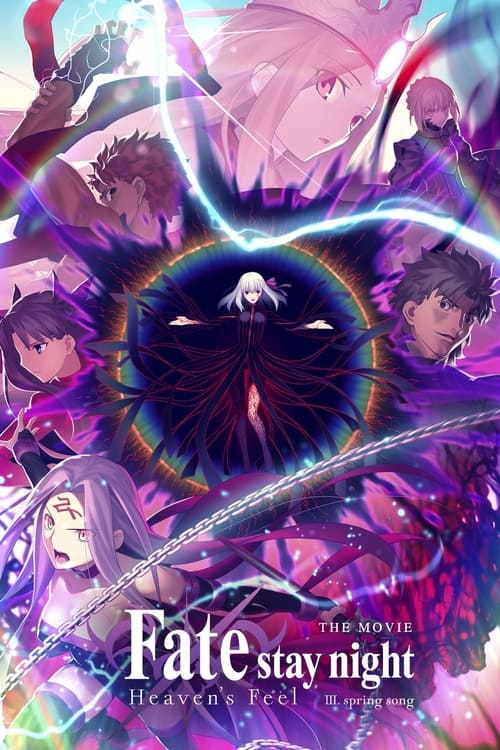
Fate/stay night: Heaven's Feel III. Spring Song
The battle rages on as Shirou continues to protect Sakura, now consumed by the darkness. He joins forces with Rin to end the Holy Grail War, while Illyasviel, who knows the truth behind it, confronts her fate. Amidst the chaos, Zouken plots to manipulate Sakura for his own desires. The final fight begins.
The film earned $20.1M at the global box office.







Plot Structure
Story beats plotted across runtime


Narrative Arc
Emotional journey through the story's key moments
Story Circle
Blueprint 15-beat structure
Arcplot Score Breakdown
Weighted: Precision (70%) + Arc (15%) + Theme (15%)
Fate/stay night: Heaven's Feel III. Spring Song (2020) demonstrates deliberately positioned dramatic framework, characteristic of Tomonori Sudo's storytelling approach. This structural analysis examines how the film's 11-point plot structure maps to proven narrative frameworks across 2 hours. With an Arcplot score of 6.3, the film takes an unconventional approach to traditional narrative frameworks.
Structural Analysis
The Status Quo at 1 minutes (1% through the runtime) establishes Shirou awakens in devastation after the previous film's climax. His body is breaking down, arm replaced by Archer's, and Sakura has been consumed by the Shadow. The world he knew is already shattered.. Notably, this early placement immediately immerses viewers in the story world.
The inciting incident occurs at 14 minutes when Kirei Kotomine reveals the full truth about the Holy Grail's corruption and Angra Mainyu. Shirou learns that saving Sakura means abandoning his ideal of saving everyone and potentially dooming the world.. At 11% through the film, this Disruption aligns precisely with traditional story structure. This beat shifts the emotional landscape, launching the protagonist into the central conflict.
At 60 minutes, the Midpoint arrives at 50% of the runtime—precisely centered, creating perfect narrative symmetry. Significantly, this crucial beat Berserker and Illya are consumed by the Shadow attempting to protect Shirou. The first major death and sacrifice. False defeat - it seems hopeless, and the cost of their choice becomes devastatingly real. Stakes are raised to maximum., fundamentally raising what's at risk. The emotional intensity shifts, dividing the narrative into clear before-and-after phases.
The Collapse moment at 89 minutes (74% through) represents the emotional nadir. Here, Rider sacrifices herself to give Shirou a chance against Saber Alter. A literal death - Rider dies protecting the one she serves. Shirou is pushed to his absolute physical limit, his body nearly destroyed. The darkest moment of complete loss., indicates the protagonist at their lowest point. This beat's placement in the final quarter sets up the climactic reversal.
The Synthesis at 96 minutes initiates the final act resolution at 80% of the runtime. The finale. Shirou enters the Grail to save Sakura from Angra Mainyu. Rin confronts and defeats Kirei. Shirou reaches Sakura's consciousness and brings her back. Zouken is finally destroyed. The Grail is dismantled. All threads resolved through love and sacrifice., demonstrating the transformation achieved throughout the journey.
Emotional Journey
Fate/stay night: Heaven's Feel III. Spring Song's emotional architecture traces a deliberate progression across 11 carefully calibrated beats.
Narrative Framework
This structural analysis employs proven narrative structure principles that track dramatic progression. By mapping Fate/stay night: Heaven's Feel III. Spring Song against these established plot points, we can identify how Tomonori Sudo utilizes or subverts traditional narrative conventions. The plot point approach reveals not only adherence to structural principles but also creative choices that distinguish Fate/stay night: Heaven's Feel III. Spring Song within the animation genre.
Tomonori Sudo's Structural Approach
Among the 3 Tomonori Sudo films analyzed on Arcplot, the average structural score is 6.6, demonstrating varied approaches to story architecture. Fate/stay night: Heaven's Feel III. Spring Song takes a more unconventional approach compared to the director's typical style. For comparative analysis, explore the complete Tomonori Sudo filmography.
Comparative Analysis
Additional animation films include The Bad Guys, The Quintessential Quintuplets Movie. For more Tomonori Sudo analyses, see Fate/stay night: Heaven's Feel I. Presage Flower, Fate/stay night: Heaven's Feel II. Lost Butterfly.
Plot Points by Act
Act I
SetupStatus Quo
Shirou awakens in devastation after the previous film's climax. His body is breaking down, arm replaced by Archer's, and Sakura has been consumed by the Shadow. The world he knew is already shattered.
Theme
Illya tells Shirou: "You can't save everyone." The core thematic question - can Shirou choose one person over his ideal of being a hero of justice?
Worldbuilding
Establishing the dire situation: Sakura has become the manifestation of All the World's Evil, Shirou's body is failing, Rin struggles with having to kill her sister, and the Holy Grail War's true nature is revealed. The city is being consumed.
Disruption
Kirei Kotomine reveals the full truth about the Holy Grail's corruption and Angra Mainyu. Shirou learns that saving Sakura means abandoning his ideal of saving everyone and potentially dooming the world.
Resistance
Shirou debates his choice between his ideals and Sakura. Rin prepares to kill Sakura, Rider pledges loyalty to Shirou, and Illya explains the consequences of each path. The weight of choosing one person over the world.
Act II
ConfrontationPremise
The "war" to save Sakura begins. Shirou fights alongside Rider against other servants and Zouken. Spectacular battles showcase the promise of the premise - a hero willing to fight the world for one person. Rin also commits to saving her sister.
Midpoint
Berserker and Illya are consumed by the Shadow attempting to protect Shirou. The first major death and sacrifice. False defeat - it seems hopeless, and the cost of their choice becomes devastatingly real. Stakes are raised to maximum.
Opposition
Everything intensifies. Shirou's body deteriorates further as he projects more swords. Saber Alter appears as a corrupted enemy. Kirei and Zouken close in. Sakura loses more control to Angra Mainyu. The antagonist forces gain complete ground.
Collapse
Rider sacrifices herself to give Shirou a chance against Saber Alter. A literal death - Rider dies protecting the one she serves. Shirou is pushed to his absolute physical limit, his body nearly destroyed. The darkest moment of complete loss.
Crisis
Shirou lies broken after defeating Saber Alter. His body is destroyed, arm disintegrating. He processes that he may not survive, that his choice might have been for nothing. The emotional darkness before the final revelation.
Act III
ResolutionSynthesis
The finale. Shirou enters the Grail to save Sakura from Angra Mainyu. Rin confronts and defeats Kirei. Shirou reaches Sakura's consciousness and brings her back. Zouken is finally destroyed. The Grail is dismantled. All threads resolved through love and sacrifice.