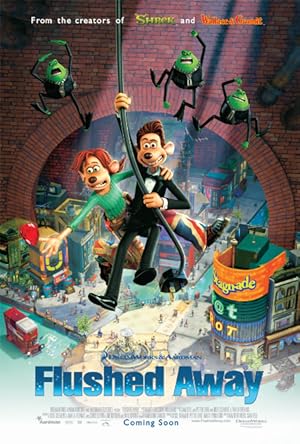
Flushed Away
Roddy is a decidedly upper-crust "society mouse" who lives the life of a beloved pet in a posh Kensington flat. When a sewer rat named Sid comes spewing out of the sink and decides he's hit the jackpot, Roddy schemes to rid himself of the pest by luring him into the "whirlpool." Sid may be an ignorant slob, but he's no fool, so it is Roddy who winds up being flushed away into the bustling sewer world of Ratropolis. There Roddy meets Rita, an enterprising scavenger who works the sewers in her faithful boat, the Jammy Dodger. Roddy immediately wants out, or rather, up; Rita wants to be paid for her trouble; and, speaking of trouble, the villainous Toad - who royally despises all rodents equally, making no distinction between mice and rats--wants them iced... literally. The Toad dispatches his two hapless hench-rats, Spike and Whitey, to get the job done. When they fail, the Toad has no choice but to send to France for his cousin - that dreaded mercenary, Le Frog.
Working with a considerable budget of $149.0M, the film achieved a steady performer with $178.1M in global revenue (+20% profit margin).
Nominated for 1 BAFTA Award7 wins & 15 nominations


Plot Structure
Story beats plotted across runtime


Narrative Arc
Emotional journey through the story's key moments
Story Circle
Blueprint 15-beat structure
Arcplot Score Breakdown
Weighted: Precision (70%) + Arc (15%) + Theme (15%)
Flushed Away (2006) showcases deliberately positioned plot construction, characteristic of David Bowers's storytelling approach. This structural analysis examines how the film's 15-point plot structure maps to proven narrative frameworks across 1 hour and 24 minutes. With an Arcplot score of 6.9, the film balances conventional beats with creative variation.
Characters
Cast & narrative archetypes

Roddy St. James
Rita Malone
The Toad
Sid
Le Frog
Whitey
Spike
Main Cast & Characters
Roddy St. James
Played by Hugh Jackman
A pampered upper-class pet rat who is flushed down the toilet into London's sewers and must find his way home.
Rita Malone
Played by Kate Winslet
A resourceful and independent rat from the sewers who captains her own boat and dreams of a better life for her large family.
The Toad
Played by Ian McKellen
A villainous amphibian who rules the sewers and seeks revenge on all rodents for being replaced as a pet by a rat.
Sid
Played by Shane Richie
A lazy, crude sewer rat who temporarily takes over Roddy's luxurious cage and inadvertently sends Roddy into the sewers.
Le Frog
Played by Jean Reno
A French mercenary frog and leader of a team of ninja-like henchfrogs who works for The Toad.
Whitey
Played by Bill Nighy
The Toad's loyal but incompetent albino rat henchman who tries his best despite constant failures.
Spike
Played by Andy Serkis
The Toad's brutish and aggressive rat henchman who serves as muscle for the villain's operations.
Structural Analysis
The Status Quo at 1 minutes (1% through the runtime) establishes Roddy St. James lives alone in a luxurious Kensington flat, surrounded by expensive possessions but no real friends. He pretends to have a social life with inanimate action figures while his owners are away.. Structural examination shows that this early placement immediately immerses viewers in the story world.
The inciting incident occurs at 8 minutes when Roddy's attempt to trick Sid into leaving backfires spectacularly - he is flushed down the toilet instead, plummeting into the sewers and losing everything he knows.. At 10% through the film, this Disruption aligns precisely with traditional story structure. This beat shifts the emotional landscape, launching the protagonist into the central conflict.
The First Threshold at 18 minutes marks the transition into Act II, occurring at 22% of the runtime. This demonstrates the protagonist's commitment to Roddy actively chooses to make a deal with Rita - trading the "ruby" for passage back to Kensington. This decision commits him to the adventure and the relationship that will transform him., moving from reaction to action.
At 41 minutes, the Midpoint arrives at 49% of the runtime—precisely centered, creating perfect narrative symmetry. Significantly, this crucial beat False victory: Roddy and Rita successfully escape The Toad and retrieve the ruby. They share a genuine connection and Roddy begins to see value in this new world. But the "ruby" is revealed to be a fake, raising the stakes., fundamentally raising what's at risk. The emotional intensity shifts, dividing the narrative into clear before-and-after phases.
The Collapse moment at 61 minutes (73% through) represents the emotional nadir. Here, Rita rejects Roddy, calling him out for his selfishness and deception. Roddy returns alone to his Kensington flat - he got what he originally wanted, but his dream of belonging and connection has died., reveals the protagonist at their lowest point. This beat's placement in the final quarter sets up the climactic reversal.
The Second Threshold at 67 minutes initiates the final act resolution at 79% of the runtime. Roddy has his breakthrough - he realizes Rita and her family are what truly matter. He chooses to go back to help them, not for personal gain but because it's right. He synthesizes his upper-world resources with his new understanding of what matters., demonstrating the transformation achieved throughout the journey.
Emotional Journey
Flushed Away's emotional architecture traces a deliberate progression across 15 carefully calibrated beats.
Narrative Framework
This structural analysis employs a 15-point narrative structure framework that maps key story moments. By mapping Flushed Away against these established plot points, we can identify how David Bowers utilizes or subverts traditional narrative conventions. The plot point approach reveals not only adherence to structural principles but also creative choices that distinguish Flushed Away within the animation genre.
David Bowers's Structural Approach
Among the 5 David Bowers films analyzed on Arcplot, the average structural score is 6.9, demonstrating varied approaches to story architecture. Flushed Away takes a more unconventional approach compared to the director's typical style. For comparative analysis, explore the complete David Bowers filmography.
Comparative Analysis
Additional animation films include The Bad Guys, Puss in Boots and Violet Evergarden: Eternity and the Auto Memory Doll. For more David Bowers analyses, see Astro Boy, Diary of a Wimpy Kid: The Long Haul and Diary of a Wimpy Kid: Dog Days.
Plot Points by Act
Act I
SetupStatus Quo
Roddy St. James lives alone in a luxurious Kensington flat, surrounded by expensive possessions but no real friends. He pretends to have a social life with inanimate action figures while his owners are away.
Theme
Sid the sewer rat makes an offhand comment about "making yourself at home" - foreshadowing Roddy's journey to discover where he truly belongs and what home really means.
Worldbuilding
Establishment of Roddy's isolated but materially comfortable life in Kensington. Sid arrives from the sewers and takes over Roddy's home, showing the contrast between Roddy's shallow existence and the vibrant world below.
Disruption
Roddy's attempt to trick Sid into leaving backfires spectacularly - he is flushed down the toilet instead, plummeting into the sewers and losing everything he knows.
Resistance
Roddy navigates the overwhelming world of Ratropolis, desperately trying to find a way home. He meets Rita and initially tries to buy his way back, clinging to his old worldview that everything can be solved with money.
Act II
ConfrontationFirst Threshold
Roddy actively chooses to make a deal with Rita - trading the "ruby" for passage back to Kensington. This decision commits him to the adventure and the relationship that will transform him.
Mirror World
Rita fully enters as the thematic mirror - a rat who values family and loyalty over material wealth. Her relationship with Roddy begins to develop as they evade The Toad's henchrats together.
Premise
The "fun and games" of the adventure through Ratropolis - exciting chases, narrow escapes from The Toad, ice-cold shower disasters, and the developing chemistry between Roddy and Rita as they work together.
Midpoint
False victory: Roddy and Rita successfully escape The Toad and retrieve the ruby. They share a genuine connection and Roddy begins to see value in this new world. But the "ruby" is revealed to be a fake, raising the stakes.
Opposition
The Toad's plan to flood Ratropolis during the World Cup is revealed. Rita discovers Roddy's deception about the ruby. Their relationship fractures. The Toad captures Rita's father. Everything falls apart as Roddy's old selfish patterns catch up with him.
Collapse
Rita rejects Roddy, calling him out for his selfishness and deception. Roddy returns alone to his Kensington flat - he got what he originally wanted, but his dream of belonging and connection has died.
Crisis
Roddy sits alone in his perfect flat, realizing that material comfort means nothing without real relationships. His "friends" are just action figures. He processes that he's lost something far more valuable than anything he owns.
Act III
ResolutionSecond Threshold
Roddy has his breakthrough - he realizes Rita and her family are what truly matter. He chooses to go back to help them, not for personal gain but because it's right. He synthesizes his upper-world resources with his new understanding of what matters.
Synthesis
Roddy returns to save Ratropolis. He works with Rita and her family to stop The Toad's flood plan. The finale includes the destruction of The Toad's scheme, Roddy proving his transformation by sacrificing his Kensington life, and choosing community over comfort.
Transformation
Roddy is now living in Ratropolis with Rita and her large, chaotic family. The final image mirrors the opening - but instead of being alone with possessions, he's surrounded by genuine relationships and belonging. He's found his real home.