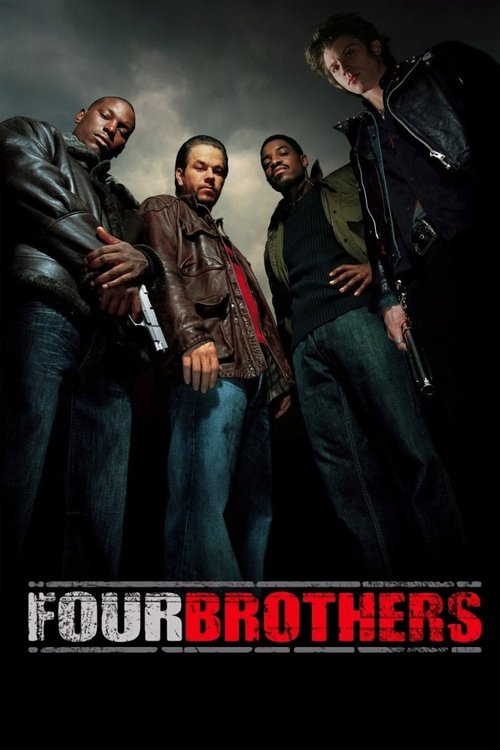
Four Brothers
Four adopted brothers return to their Detroit hometown when their mother is murdered and vow to exact revenge on the killers.
Despite a mid-range budget of $45.0M, Four Brothers became a financial success, earning $92.4M worldwide—a 105% return.


Plot Structure
Story beats plotted across runtime


Narrative Arc
Emotional journey through the story's key moments
Story Circle
Blueprint 15-beat structure
Arcplot Score Breakdown
Weighted: Precision (70%) + Arc (15%) + Theme (15%)
Four Brothers (2005) demonstrates carefully calibrated narrative design, characteristic of John Singleton's storytelling approach. This structural analysis examines how the film's 15-point plot structure maps to proven narrative frameworks across 1 hour and 49 minutes. With an Arcplot score of 6.7, the film balances conventional beats with creative variation.
Characters
Cast & narrative archetypes

Bobby Mercer
Angel Mercer
Jeremiah Mercer
Jack Mercer
Evelyn Mercer
Lieutenant Green
Victor Sweet
Sofi
Main Cast & Characters
Bobby Mercer
Played by Mark Wahlberg
The hot-headed leader of the brothers, a street fighter driven by loyalty and vengeance for his adoptive mother's murder.
Angel Mercer
Played by Tyrese Gibson
The family man and responsible brother, trying to balance his loyalty to family with protecting his wife and daughters.
Jeremiah Mercer
Played by André Benjamin
The successful businessman brother who has built a legitimate life but returns to help his family seek justice.
Jack Mercer
Played by Garrett Hedlund
The unpredictable wild card brother, a rock musician with a volatile temperament and questionable judgment.
Evelyn Mercer
Played by Fionnula Flanagan
The beloved adoptive mother who took in foster children and raised them with love, whose murder sets the story in motion.
Lieutenant Green
Played by Terrence Howard
The investigating police detective who warns the brothers against taking the law into their own hands.
Victor Sweet
Played by Chiwetel Ejiofor
The ruthless crime boss who controls the neighborhood and becomes the brothers' primary antagonist.
Sofi
Played by Sofía Vergara
Angel's wife who fears for her family's safety as the brothers pursue their vendetta.
Structural Analysis
The Status Quo at 1 minutes (1% through the runtime) establishes Evelyn Mercer shops at a convenience store on a snowy Detroit night, establishing her as a beloved community figure and saintly foster mother who transformed troubled boys into men.. Of particular interest, this early placement immediately immerses viewers in the story world.
The inciting incident occurs at 13 minutes when The brothers learn from a witness that their mother's death was not a random robbery - she was deliberately executed. The killers shot her on purpose, shattering the brothers' ability to grieve and move on.. At 12% through the film, this Disruption aligns precisely with traditional story structure. This beat shifts the emotional landscape, launching the protagonist into the central conflict.
The First Threshold at 27 minutes marks the transition into Act II, occurring at 25% of the runtime. This reveals the protagonist's commitment to Bobby leads his brothers to confront and beat a local thug connected to the killers. They cross the line from grieving sons to vigilantes, committing to finding and punishing everyone responsible for their mother's death., moving from reaction to action.
At 55 minutes, the Midpoint arrives at 50% of the runtime—precisely centered, creating perfect narrative symmetry. Of particular interest, this crucial beat The brothers learn that Victor Sweet, Detroit's most dangerous crime lord, ordered the hit on their mother. This false defeat reveals the true scope of what they're up against - not street thugs but an untouchable criminal empire with police protection., fundamentally raising what's at risk. The emotional intensity shifts, dividing the narrative into clear before-and-after phases.
The Collapse moment at 82 minutes (75% through) represents the emotional nadir. Here, In a brutal ambush at the Mercer house, Jack is shot and killed by Sweet's men. The youngest brother dies in Bobby's arms in the snow. The family is shattered - they've now lost both their mother and their baby brother., indicates the protagonist at their lowest point. This beat's placement in the final quarter sets up the climactic reversal.
The Second Threshold at 87 minutes initiates the final act resolution at 80% of the runtime. Bobby discovers Jeremiah was actually trying to protect the family from Sweet's extortion. The three surviving brothers reunite with renewed purpose, combining Jeremiah's insider knowledge of Sweet's operations with Bobby's street tactics to plan their final assault., demonstrating the transformation achieved throughout the journey.
Emotional Journey
Four Brothers's emotional architecture traces a deliberate progression across 15 carefully calibrated beats.
Narrative Framework
This structural analysis employs a 15-point narrative structure framework that maps key story moments. By mapping Four Brothers against these established plot points, we can identify how John Singleton utilizes or subverts traditional narrative conventions. The plot point approach reveals not only adherence to structural principles but also creative choices that distinguish Four Brothers within the action genre.
John Singleton's Structural Approach
Among the 9 John Singleton films analyzed on Arcplot, the average structural score is 7.0, reflecting strong command of classical structure. Four Brothers takes a more unconventional approach compared to the director's typical style. For comparative analysis, explore the complete John Singleton filmography.
Comparative Analysis
Additional action films include The Bad Guys, Puss in Boots and Venom: The Last Dance. For more John Singleton analyses, see Higher Learning, Abduction and Poetic Justice.
Plot Points by Act
Act I
SetupStatus Quo
Evelyn Mercer shops at a convenience store on a snowy Detroit night, establishing her as a beloved community figure and saintly foster mother who transformed troubled boys into men.
Theme
At Evelyn's funeral, a mourner reflects that she took in boys nobody wanted and loved them unconditionally - stating the theme that family is not about blood but about choosing to love and stand together.
Worldbuilding
The four estranged brothers reunite in Detroit for their mother's funeral. We meet each brother: Bobby the volatile hothead, Angel the ex-military womanizer, Jeremiah the legitimate businessman, and Jack the youngest musician. Their dynamics and troubled pasts are established.
Disruption
The brothers learn from a witness that their mother's death was not a random robbery - she was deliberately executed. The killers shot her on purpose, shattering the brothers' ability to grieve and move on.
Resistance
The brothers debate what to do with this information. Bobby pushes for street justice while Jeremiah urges caution and working with police. They interview witnesses, visit the crime scene, and begin their own investigation into who ordered the hit.
Act II
ConfrontationFirst Threshold
Bobby leads his brothers to confront and beat a local thug connected to the killers. They cross the line from grieving sons to vigilantes, committing to finding and punishing everyone responsible for their mother's death.
Mirror World
Angel reconnects with his former girlfriend Sofi, and we see the brothers bonding at their mother's house, playing hockey and sharing meals. These moments of family warmth contrast with their violent mission and represent what they're truly fighting for.
Premise
The brothers work their way up the criminal food chain, using intimidation and violence to extract information. They discover connections between the shooters and local organized crime, uncovering a conspiracy much larger than a simple robbery.
Midpoint
The brothers learn that Victor Sweet, Detroit's most dangerous crime lord, ordered the hit on their mother. This false defeat reveals the true scope of what they're up against - not street thugs but an untouchable criminal empire with police protection.
Opposition
Victor Sweet strikes back ruthlessly. Corrupt cops and hired killers target the brothers. Jeremiah is revealed to have had business dealings with Sweet, creating suspicion among the brothers. Police Detective Green investigates the brothers while Sweet tightens his grip.
Collapse
In a brutal ambush at the Mercer house, Jack is shot and killed by Sweet's men. The youngest brother dies in Bobby's arms in the snow. The family is shattered - they've now lost both their mother and their baby brother.
Crisis
The surviving brothers are devastated and scattered. Bobby is consumed by grief and rage. Jeremiah must prove his loyalty wasn't compromised. The brothers face the darkness of losing Jack and question whether their vendetta was worth the cost.
Act III
ResolutionSecond Threshold
Bobby discovers Jeremiah was actually trying to protect the family from Sweet's extortion. The three surviving brothers reunite with renewed purpose, combining Jeremiah's insider knowledge of Sweet's operations with Bobby's street tactics to plan their final assault.
Synthesis
The brothers execute their plan to take down Victor Sweet. They manipulate Sweet's own people against him, engineering a confrontation on a frozen lake. Bobby fights Sweet one-on-one while Angel and Jeremiah handle the remaining threats. Sweet falls through the ice and drowns.
Transformation
The surviving brothers gather at their mother's grave with Sofi and Jeremiah's family. Though scarred by loss, they remain united as a family. They've honored their mother's memory and proven that the bond she created between them is unbreakable.