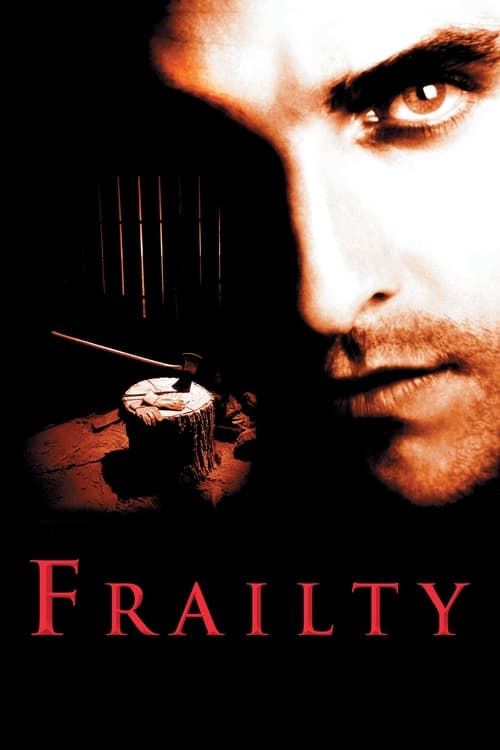
Frailty
A mysterious man arrives at the offices of an FBI agent and recounts his childhood: how his religious fanatic father received visions telling him to kill people who were in fact "demons."
Working with a tight budget of $11.0M, the film achieved a steady performer with $17.4M in global revenue (+58% profit margin).
5 wins & 16 nominations


Plot Structure
Story beats plotted across runtime


Narrative Arc
Emotional journey through the story's key moments
Story Circle
Blueprint 15-beat structure
Arcplot Score Breakdown
Weighted: Precision (70%) + Arc (15%) + Theme (15%)
Frailty (2002) showcases strategically placed dramatic framework, characteristic of Bill Paxton's storytelling approach. This structural analysis examines how the film's 15-point plot structure maps to proven narrative frameworks across 1 hour and 40 minutes. With an Arcplot score of 7.2, the film balances conventional beats with creative variation.
Characters
Cast & narrative archetypes

Fenton Meiks / Adam
Dad Meiks
Young Fenton Meiks
Young Adam Meiks
Agent Wesley Doyle
Main Cast & Characters
Fenton Meiks / Adam
Played by Matthew McConaughey
Adult son recounting his family's dark past to an FBI agent, revealing a twisted tale of religious delusion and murder.
Dad Meiks
Played by Bill Paxton
Widowed father who believes God commands him to destroy demons disguised as people, dragging his sons into his violent mission.
Young Fenton Meiks
Played by Matt O'Leary
The older son who questions his father's divine mission and struggles with the horrific reality of their family's actions.
Young Adam Meiks
Played by Jeremy Sumpter
The younger son who fully embraces his father's vision and claims to see demons like his father does.
Agent Wesley Doyle
Played by Powers Boothe
FBI agent investigating the God's Hand serial killer case who listens to Fenton's disturbing confession.
Structural Analysis
The Status Quo at 1 minutes (1% through the runtime) establishes FBI Agent Wesley Doyle works late into the night on the God's Hand serial killer case, frustrated and exhausted by the unsolved murders.. Notably, this early placement immediately immerses viewers in the story world.
The inciting incident occurs at 13 minutes when Dad wakes his sons in the middle of the night to announce that an angel visited him with a divine mission: God has chosen their family to destroy demons disguised as humans.. At 13% through the film, this Disruption is delayed, allowing extended setup of the story world. This beat shifts the emotional landscape, launching the protagonist into the central conflict.
The First Threshold at 25 minutes marks the transition into Act II, occurring at 25% of the runtime. This indicates the protagonist's commitment to Dad brings home the first "demon" - a terrified woman - and kills her with an axe in front of his sons, claiming God revealed her sins to him. The family has crossed into murder., moving from reaction to action.
At 50 minutes, the Midpoint arrives at 50% of the runtime—precisely centered, creating perfect narrative symmetry. Of particular interest, this crucial beat Young Fenton attempts to escape and report his father to the sheriff, but Dad intercepts him. As punishment, Dad locks Fenton in a cellar for days, trying to force him to "see the truth."., fundamentally raising what's at risk. The emotional intensity shifts, dividing the narrative into clear before-and-after phases.
The Collapse moment at 75 minutes (75% through) represents the emotional nadir. Here, Young Fenton kills his father with an axe to stop the murders. Dad's dying words forgive Fenton but predict God will punish him. Adam buries their father in the rose garden., demonstrates the protagonist at their lowest point. This beat's placement in the final quarter sets up the climactic reversal.
The Second Threshold at 80 minutes initiates the final act resolution at 80% of the runtime. Fenton leads Doyle to the rose garden to dig up the bodies. The devastating revelation: the man is actually Adam, not Fenton. Fenton was the believer; Adam was the doubter who died. The narrator has been lying., demonstrating the transformation achieved throughout the journey.
Emotional Journey
Frailty's emotional architecture traces a deliberate progression across 15 carefully calibrated beats.
Narrative Framework
This structural analysis employs structural analysis methodology used to understand storytelling architecture. By mapping Frailty against these established plot points, we can identify how Bill Paxton utilizes or subverts traditional narrative conventions. The plot point approach reveals not only adherence to structural principles but also creative choices that distinguish Frailty within the drama genre.
Bill Paxton's Structural Approach
Among the 2 Bill Paxton films analyzed on Arcplot, the average structural score is 7.1, reflecting strong command of classical structure. Frailty represents one of the director's most structurally precise works. For comparative analysis, explore the complete Bill Paxton filmography.
Comparative Analysis
Additional drama films include After Thomas, South Pacific and Dirty Dancing: Havana Nights. For more Bill Paxton analyses, see The Greatest Game Ever Played.
Plot Points by Act
Act I
SetupStatus Quo
FBI Agent Wesley Doyle works late into the night on the God's Hand serial killer case, frustrated and exhausted by the unsolved murders.
Theme
Fenton Meiks tells Doyle, "My father said he could see demons" - introducing the central question of faith, perception, and whether divine visions justify murder.
Worldbuilding
Fenton arrives at FBI headquarters claiming to know the God's Hand killer. Through flashback, we meet the Meiks family in 1979: a widowed father raising two boys, Fenton and Adam, in a small Texas town. They live a simple, religious life.
Disruption
Dad wakes his sons in the middle of the night to announce that an angel visited him with a divine mission: God has chosen their family to destroy demons disguised as humans.
Resistance
Young Fenton resists and questions his father's visions while Adam believes completely. Dad prepares them for their mission, waiting for God to deliver weapons and a list of demon names. Fenton struggles with whether to report his father or protect his brother.
Act II
ConfrontationFirst Threshold
Dad brings home the first "demon" - a terrified woman - and kills her with an axe in front of his sons, claiming God revealed her sins to him. The family has crossed into murder.
Mirror World
The relationship between Fenton and Adam becomes the thematic mirror: Adam sees demons and shares Dad's visions; Fenton sees only innocent victims, representing faith versus reason.
Premise
The family continues killing "demons" on God's list. Dad and Adam experience visions of their victims' sins, while Fenton sees only murder. The parallel investigation by FBI Agent Doyle unfolds as adult Fenton narrates the horrifying family history.
Midpoint
Young Fenton attempts to escape and report his father to the sheriff, but Dad intercepts him. As punishment, Dad locks Fenton in a cellar for days, trying to force him to "see the truth."
Opposition
Fenton emerges from the cellar broken but pretending to believe. The family dynamic deteriorates as Fenton plots to end the killings. Dad grows suspicious of Fenton's true loyalties. Present-day Doyle becomes increasingly invested in Fenton's story.
Collapse
Young Fenton kills his father with an axe to stop the murders. Dad's dying words forgive Fenton but predict God will punish him. Adam buries their father in the rose garden.
Crisis
Adult Fenton finishes his story, emotionally devastated. He tells Doyle that Adam continued their father's mission and became the God's Hand killer. Doyle processes this confession.
Act III
ResolutionSecond Threshold
Fenton leads Doyle to the rose garden to dig up the bodies. The devastating revelation: the man is actually Adam, not Fenton. Fenton was the believer; Adam was the doubter who died. The narrator has been lying.
Synthesis
Adam touches Doyle and receives a vision of Doyle's sins: he murdered his mother. Adam kills Doyle with the family axe. Security footage mysteriously shows nothing. Adam walks away unseen, protected by divine intervention or delusion.
Transformation
Adam returns to his normal life as a respected family man and sheriff, his wife and children waiting. The question remains unanswered: was he destroying demons or murdering innocents?