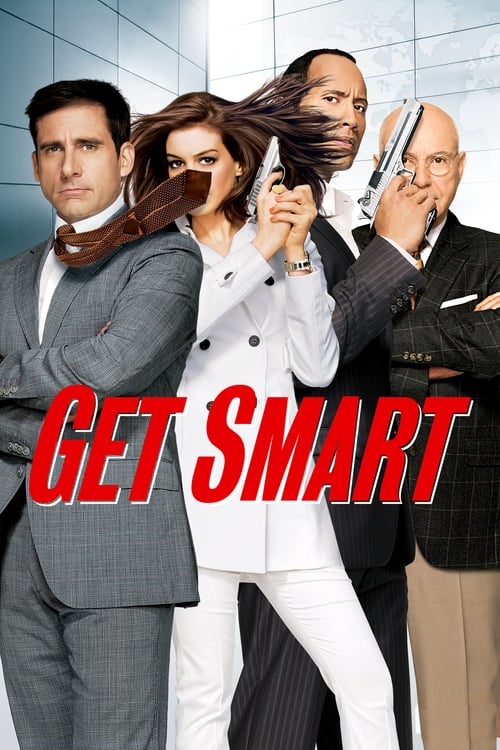
Get Smart
When members of the nefarious crime syndicate KAOS attack the U.S. spy agency Control and the identities of secret agents are compromised, the Chief has to promote hapless but eager analyst Maxwell Smart to field agent. He is partnered with veteran and capable Agent 99, the only spy whose cover remains intact. Can they work together to thwart the evil world-domination plans of KAOS and its crafty operative?
Despite a substantial budget of $80.0M, Get Smart became a box office success, earning $230.7M worldwide—a 188% return.
3 wins & 6 nominations


Plot Structure
Story beats plotted across runtime


Narrative Arc
Emotional journey through the story's key moments
Story Circle
Blueprint 15-beat structure
Arcplot Score Breakdown
Weighted: Precision (70%) + Arc (15%) + Theme (15%)
Get Smart (2008) exhibits deliberately positioned narrative architecture, characteristic of Peter Segal's storytelling approach. This structural analysis examines how the film's 15-point plot structure maps to proven narrative frameworks across 1 hour and 50 minutes. With an Arcplot score of 6.9, the film balances conventional beats with creative variation.
Characters
Cast & narrative archetypes

Maxwell Smart / Agent 86
Agent 99
Agent 23
The Chief
Siegfried
Shtarker
Dalip
Main Cast & Characters
Maxwell Smart / Agent 86
Played by Steve Carell
A brilliant but awkward CONTROL analyst promoted to field agent after headquarters is compromised. Earnest, rule-following, and eager to prove himself.
Agent 99
Played by Anne Hathaway
A highly skilled and experienced CONTROL agent who becomes Max's reluctant partner. Professional, competent, and initially skeptical of Max's abilities.
Agent 23
Played by Dwayne Johnson
CONTROL's top field agent and golden boy. Confident, charming, and initially Max's role model before revealing himself as a KAOS mole.
The Chief
Played by Alan Arkin
The gruff but caring head of CONTROL who believes in Max despite his inexperience. Loyal to his agents and committed to protecting the country.
Siegfried
Played by Terence Stamp
The ruthless and cunning leader of KAOS who orchestrates a plot to destabilize world security. Cold, calculating, and willing to sacrifice anyone.
Shtarker
Played by Kenneth Davitian
Siegfried's loyal and brutish second-in-command at KAOS. Physically intimidating but ultimately follows orders without question.
Dalip
Played by Dalip Singh
A massive KAOS enforcer who becomes Max's unlikely ally after being treated with unexpected kindness. Powerful but gentle-hearted.
Structural Analysis
The Status Quo at 1 minutes (1% through the runtime) establishes Maxwell Smart works as a dedicated analyst at CONTROL headquarters, excelling at his desk job but dreaming of becoming a field agent. He's competent, earnest, but stuck in his current role.. Of particular interest, this early placement immediately immerses viewers in the story world.
The inciting incident occurs at 12 minutes when KAOS attacks CONTROL headquarters, killing most field agents and stealing the identities of all current operatives. The entire agency is compromised and vulnerable.. At 11% through the film, this Disruption aligns precisely with traditional story structure. This beat shifts the emotional landscape, launching the protagonist into the central conflict.
The First Threshold at 27 minutes marks the transition into Act II, occurring at 24% of the runtime. This demonstrates the protagonist's commitment to Max and 99 board a plane to Moscow to track down the nuclear bomb threat. Max fully accepts his role as a field agent and commits to the mission despite 99's skepticism., moving from reaction to action.
At 56 minutes, the Midpoint arrives at 50% of the runtime—precisely centered, creating perfect narrative symmetry. The analysis reveals that this crucial beat Max and 99 successfully stop the bomb at the factory and share a victory kiss. It appears they've won—but the stakes raise when they realize KAOS has more bombs and a larger plan. Max is celebrated as a hero, but the real threat remains., fundamentally raising what's at risk. The emotional intensity shifts, dividing the narrative into clear before-and-after phases.
The Collapse moment at 82 minutes (75% through) represents the emotional nadir. Here, Max is captured and faces execution by CONTROL as a traitor. Everything he's worked for is destroyed—his career, his relationship with 99, his identity as a hero. His dream of being a field agent has turned into a nightmare., shows the protagonist at their lowest point. This beat's placement in the final quarter sets up the climactic reversal.
The Second Threshold at 87 minutes initiates the final act resolution at 79% of the runtime. Max synthesizes his analyst abilities with his field training. He understands the complete picture of KAOS's plan and knows how to stop it. With 99's trust restored, they race to save the President and stop Siegfried., demonstrating the transformation achieved throughout the journey.
Emotional Journey
Get Smart's emotional architecture traces a deliberate progression across 15 carefully calibrated beats.
Narrative Framework
This structural analysis employs systematic plot point analysis that identifies crucial turning points. By mapping Get Smart against these established plot points, we can identify how Peter Segal utilizes or subverts traditional narrative conventions. The plot point approach reveals not only adherence to structural principles but also creative choices that distinguish Get Smart within the action genre.
Peter Segal's Structural Approach
Among the 8 Peter Segal films analyzed on Arcplot, the average structural score is 7.2, reflecting strong command of classical structure. Get Smart takes a more unconventional approach compared to the director's typical style. For comparative analysis, explore the complete Peter Segal filmography.
Comparative Analysis
Additional action films include The Bad Guys, Puss in Boots and Venom: The Last Dance. For more Peter Segal analyses, see 50 First Dates, Second Act and Grudge Match.
Plot Points by Act
Act I
SetupStatus Quo
Maxwell Smart works as a dedicated analyst at CONTROL headquarters, excelling at his desk job but dreaming of becoming a field agent. He's competent, earnest, but stuck in his current role.
Theme
The Chief tells Max that being a field agent isn't about gadgets and glory—it's about making the right choices under pressure. "It's not about the gun, it's about the man."
Worldbuilding
Establishment of CONTROL vs KAOS conflict. Max takes his field agent exam. We meet Agent 23 (the ideal field agent), Agent 99, and see the high-tech spy world. Max's competence as an analyst is demonstrated even as his field agent aspirations are shown.
Disruption
KAOS attacks CONTROL headquarters, killing most field agents and stealing the identities of all current operatives. The entire agency is compromised and vulnerable.
Resistance
With all field agents compromised, Max is promoted to Agent 86 by necessity. He's paired with the reluctant Agent 99. Max receives his gadgets and mission briefing. 99 doubts Max's abilities; Max must prove himself worthy of the role he's always wanted.
Act II
ConfrontationFirst Threshold
Max and 99 board a plane to Moscow to track down the nuclear bomb threat. Max fully accepts his role as a field agent and commits to the mission despite 99's skepticism.
Mirror World
Max and 99 begin working together in the field. Despite rocky beginnings, their partnership begins to form. 99 represents the experienced professional Max must learn from, while also learning to value Max's unique analytical approach.
Premise
Max and 99 navigate missions together—the airplane bathroom fight, infiltrating the Russian factory, the car chase, the dance sequence. Max's unconventional methods create chaos but also achieve results. Their relationship deepens from antagonism to respect and romance. Classic spy movie "fun and games."
Midpoint
Max and 99 successfully stop the bomb at the factory and share a victory kiss. It appears they've won—but the stakes raise when they realize KAOS has more bombs and a larger plan. Max is celebrated as a hero, but the real threat remains.
Opposition
Evidence suggests Max is a double agent working for KAOS. 99 is forced to doubt him. CONTROL turns against Max. Agent 23 and the agency hunt him. Max must prove his innocence while KAOS closes in on their true target: the President at Disney Concert Hall.
Collapse
Max is captured and faces execution by CONTROL as a traitor. Everything he's worked for is destroyed—his career, his relationship with 99, his identity as a hero. His dream of being a field agent has turned into a nightmare.
Crisis
In his darkest moment, Max uses his analytical skills to piece together the real conspiracy. 99 chooses to believe in him. Agent 23 is revealed as the real mole. Max realizes his unique combination of analysis and field work is his true strength.
Act III
ResolutionSecond Threshold
Max synthesizes his analyst abilities with his field training. He understands the complete picture of KAOS's plan and knows how to stop it. With 99's trust restored, they race to save the President and stop Siegfried.
Synthesis
The finale at Disney Concert Hall. Max confronts Siegfried and Agent 23. Epic action sequence combining Max's intelligence with his newfound field skills. He saves the President, defeats the villains, and proves he's a true agent—not because of gadgets, but because of his heart and mind.
Transformation
Max and 99 are together as partners and lovers. Max is recognized as a true field agent, but unlike the opening where he desperately wanted validation, he's now secure in who he is. The final image shows him dancing with 99, comfortable in his own skin.