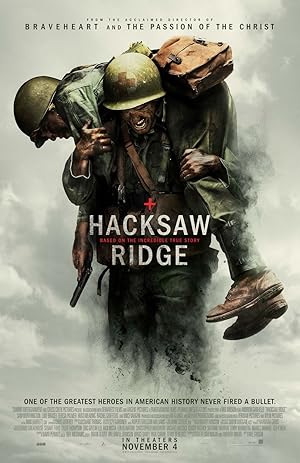
Hacksaw Ridge
The true story of Desmond T. Doss, the conscientious objector who, at the Battle of Okinawa, was awarded the Medal of Honor for his incredible bravery and regard for his fellow soldiers. We see his upbringing and how this shaped his views, especially his religious view and anti-killing stance. We see Doss's trials and tribulations after enlisting in the US Army and trying to become a medic. Finally, we see the hell on Earth that was Hacksaw Ridge.
Despite a respectable budget of $40.0M, Hacksaw Ridge became a commercial success, earning $175.3M worldwide—a 338% return.
2 Oscars. 57 wins & 115 nominations


Plot Structure
Story beats plotted across runtime


Narrative Arc
Emotional journey through the story's key moments
Story Circle
Blueprint 15-beat structure
Arcplot Score Breakdown
Weighted: Precision (70%) + Arc (15%) + Theme (15%)
Hacksaw Ridge (2016) showcases carefully calibrated narrative architecture, characteristic of Mel Gibson's storytelling approach. This structural analysis examines how the film's 15-point plot structure maps to proven narrative frameworks across 2 hours and 19 minutes. With an Arcplot score of 2.8, the film takes an unconventional approach to traditional narrative frameworks.
Characters
Cast & narrative archetypes

Desmond Doss
Dorothy Schutte
Sergeant Howell
Captain Glover
Tom Doss
Bertha Doss
Smitty Ryker
Main Cast & Characters
Desmond Doss
Played by Andrew Garfield
A Seventh-day Adventist combat medic who refuses to carry a weapon due to his religious convictions, yet saves 75 men during the Battle of Okinawa.
Dorothy Schutte
Played by Teresa Palmer
Desmond's love interest and eventual wife, a nurse who supports his convictions and provides emotional grounding.
Sergeant Howell
Played by Vince Vaughn
Desmond's tough drill sergeant who initially sees him as a coward and obstacle, but eventually witnesses his extraordinary courage.
Captain Glover
Played by Sam Worthington
Desmond's commanding officer who attempts to discharge him for refusing to carry a weapon, later comes to respect his bravery.
Tom Doss
Played by Hugo Weaving
Desmond's father, a traumatized WWI veteran whose violence and alcoholism shape Desmond's commitment to non-violence.
Bertha Doss
Played by Rachel Griffiths
Desmond's loving mother who instills deep religious faith in him and supports his convictions.
Smitty Ryker
Played by Luke Bracey
A fellow soldier who initially bullies Desmond but becomes one of the men saved by him on Hacksaw Ridge.
Structural Analysis
The Status Quo at 1 minutes (1% through the runtime) establishes Hellish battlefield imagery at Hacksaw Ridge as soldiers are torn apart by Japanese forces, establishing the brutal world Desmond will enter and the stakes of his pacifist conviction.. Of particular interest, this early placement immediately immerses viewers in the story world.
The inciting incident occurs at 15 minutes when Desmond meets Dorothy Schutte at the hospital after donating blood and is immediately smitten, disrupting his quiet life and setting him on a path toward both love and his decision to serve his country.. At 11% through the film, this Disruption aligns precisely with traditional story structure. This beat shifts the emotional landscape, launching the protagonist into the central conflict.
The First Threshold at 31 minutes marks the transition into Act II, occurring at 22% of the runtime. This demonstrates the protagonist's commitment to Desmond arrives at Fort Jackson for basic training, actively choosing to enter the military world as a conscientious objector—a decision that will test everything he believes., moving from reaction to action.
At 63 minutes, the Midpoint arrives at 45% of the runtime—arriving early, accelerating into Act IIb complications. Structural examination shows that this crucial beat At his court-martial, Desmond's father arrives with a letter from a general confirming his right to serve without a weapon. The charges are dropped—a false victory as the true test of battle awaits., fundamentally raising what's at risk. The emotional intensity shifts, dividing the narrative into clear before-and-after phases.
The Collapse moment at 94 minutes (67% through) represents the emotional nadir. Here, The Americans retreat from the ridge, leaving their wounded behind enemy lines. Captain Glover orders full withdrawal. Desmond alone remains atop the ridge as night falls, surrounded by Japanese soldiers and dying men—his darkest hour., shows the protagonist at their lowest point. This beat's placement in the final quarter sets up the climactic reversal.
The Second Threshold at 100 minutes initiates the final act resolution at 72% of the runtime. As dawn breaks, Desmond has saved 75 men without firing a shot. The soldiers who once despised him now revere him. Sergeant Howell and Captain Glover recognize his extraordinary courage, transforming the unit's understanding of true bravery., demonstrating the transformation achieved throughout the journey.
Emotional Journey
Hacksaw Ridge's emotional architecture traces a deliberate progression across 15 carefully calibrated beats.
Narrative Framework
This structural analysis employs structural analysis methodology used to understand storytelling architecture. By mapping Hacksaw Ridge against these established plot points, we can identify how Mel Gibson utilizes or subverts traditional narrative conventions. The plot point approach reveals not only adherence to structural principles but also creative choices that distinguish Hacksaw Ridge within the biography genre.
Mel Gibson's Structural Approach
Among the 5 Mel Gibson films analyzed on Arcplot, the average structural score is 5.9, showcasing experimental approaches to narrative form. Hacksaw Ridge takes a more unconventional approach compared to the director's typical style. For comparative analysis, explore the complete Mel Gibson filmography.
Comparative Analysis
Additional biography films include After Thomas, Taking Woodstock and The Fire Inside. For more Mel Gibson analyses, see The Passion of the Christ, Braveheart and The Man Without a Face.
Plot Points by Act
Act I
SetupStatus Quo
Hellish battlefield imagery at Hacksaw Ridge as soldiers are torn apart by Japanese forces, establishing the brutal world Desmond will enter and the stakes of his pacifist conviction.
Theme
Young Desmond's mother reads the commandment "Thou shalt not kill" after he nearly kills his brother with a brick, planting the seed of his lifelong conviction against violence.
Worldbuilding
Desmond's childhood in rural Virginia establishes his alcoholic, traumatized WWI veteran father, his devout Seventh-day Adventist upbringing, and the formative moment when he almost killed his brother, cementing his vow never to touch a weapon.
Disruption
Desmond meets Dorothy Schutte at the hospital after donating blood and is immediately smitten, disrupting his quiet life and setting him on a path toward both love and his decision to serve his country.
Resistance
Desmond courts Dorothy while wrestling with his desire to serve after Pearl Harbor. His father, scarred by WWI, opposes enlistment. Dorothy supports him, and Desmond decides to enlist as a medic, refusing to carry a weapon despite everyone's objections.
Act II
ConfrontationFirst Threshold
Desmond arrives at Fort Jackson for basic training, actively choosing to enter the military world as a conscientious objector—a decision that will test everything he believes.
Mirror World
Desmond's relationship with Dorothy deepens as she visits him at camp; she represents the life of love and faith waiting for him, embodying the thematic truth that saving life matters more than taking it.
Premise
Desmond endures brutal hazing from fellow soldiers and commanding officers who view his refusal to carry a rifle as cowardice. He is beaten, threatened with court-martial, and nearly dishonorably discharged, but refuses to compromise his convictions.
Midpoint
At his court-martial, Desmond's father arrives with a letter from a general confirming his right to serve without a weapon. The charges are dropped—a false victory as the true test of battle awaits.
Opposition
The 77th Infantry Division assaults Hacksaw Ridge in Okinawa. The battle is apocalyptic carnage. Despite proving himself heroically by saving wounded men under fire, the Americans are driven back by a Japanese counterattack, leaving dozens of wounded behind.
Collapse
The Americans retreat from the ridge, leaving their wounded behind enemy lines. Captain Glover orders full withdrawal. Desmond alone remains atop the ridge as night falls, surrounded by Japanese soldiers and dying men—his darkest hour.
Crisis
Alone on the ridge at night, Desmond prays desperately: "Lord, help me get one more." He begins his impossible one-man rescue mission, lowering wounded soldiers down the cliff face one by one with a rope sling, evading Japanese patrols.
Act III
ResolutionSecond Threshold
As dawn breaks, Desmond has saved 75 men without firing a shot. The soldiers who once despised him now revere him. Sergeant Howell and Captain Glover recognize his extraordinary courage, transforming the unit's understanding of true bravery.
Synthesis
The battalion refuses to attack without Desmond. He prays, then leads them back up the ridge. In the final battle, Desmond continues saving lives, even treating wounded Japanese soldiers, until he is seriously wounded. He is lowered from the ridge clutching his Bible.
Transformation
Real footage and narration reveal Desmond received the Medal of Honor—the first conscientious objector so honored. The closing image shows the real Desmond Doss, transformed from outcast to American hero, his faith vindicated.