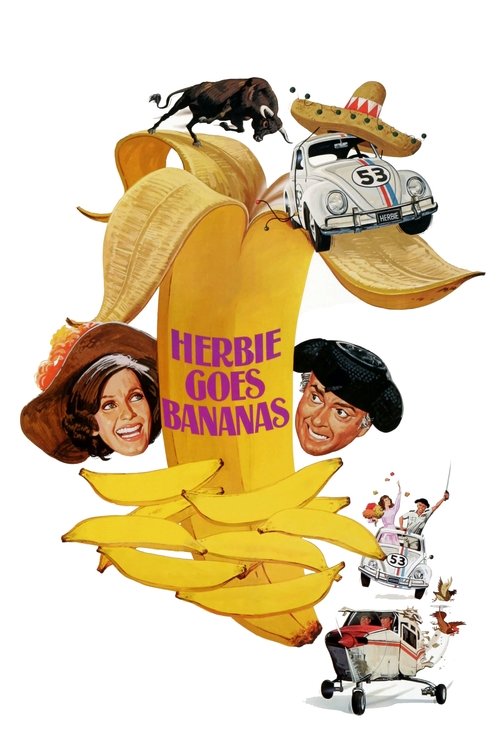
Herbie Goes Bananas
The adorable little VW helps its owners break up a counterfeiting ring in Mexico.
The film earned $18.0M at the global box office.


Plot Structure
Story beats plotted across runtime


Narrative Arc
Emotional journey through the story's key moments
Story Circle
Blueprint 15-beat structure
Arcplot Score Breakdown
Weighted: Precision (70%) + Arc (15%) + Theme (15%)
Herbie Goes Bananas (1980) demonstrates deliberately positioned narrative architecture, characteristic of Vincent McEveety's storytelling approach. This structural analysis examines how the film's 15-point plot structure maps to proven narrative frameworks across 1 hour and 33 minutes. With an Arcplot score of 7.7, the film showcases strong structural fundamentals.
Characters
Cast & narrative archetypes

Herbie
Pete Stanchek
D.J. Davis
Paco
Aunt Louise
Captain Blythe
Prindle
Melissa
Main Cast & Characters
Herbie
A sentient white Volkswagen Beetle with racing stripes and a mind of his own who becomes the true hero of the adventure.
Pete Stanchek
Played by Stephen W. Burns
A young man who inherits Herbie and travels to South America to pick up his uncle's car, becoming caught up in an adventure.
D.J. Davis
Played by Charles Martin Smith
Pete's mechanically-inclined friend who accompanies him on the journey and helps maintain Herbie.
Paco
Played by Joaquin Garay III
A charming young orphan pickpocket who befriends Herbie and the group, bringing heart and street-smarts to the adventure.
Aunt Louise
Played by Cloris Leachman
Pete's wealthy aunt who funds the expedition and later joins the adventure, providing comic relief and determination.
Captain Blythe
Played by Harvey Korman
The pompous and increasingly frustrated captain of the cruise ship who clashes with Herbie and the gang.
Prindle
Played by John Vernon
The villainous treasure hunter who wants to steal Herbie to help him locate Incas gold hidden in Panama.
Melissa
Played by Elyssa Davalos
A beautiful woman who becomes romantically involved with Pete during the adventure.
Structural Analysis
The Status Quo at 1 minutes (1% through the runtime) establishes Pete and D.J. Arrive in Puerto Vallarta to claim their inheritance - Herbie the sentient Volkswagen Beetle - planning to race him in Brazil for prize money.. Notably, this early placement immediately immerses viewers in the story world.
The inciting incident occurs at 12 minutes when Herbie is loaded onto the Sun Princess cruise ship, where thieves secretly hide stolen Incan gold inside him, unknowingly turning him into smuggled contraband.. At 13% through the film, this Disruption is delayed, allowing extended setup of the story world. This beat shifts the emotional landscape, launching the protagonist into the central conflict.
The First Threshold at 23 minutes marks the transition into Act II, occurring at 25% of the runtime. This shows the protagonist's commitment to Herbie goes overboard into the ocean during a chaotic chase scene. Pete and D.J. Must commit to rescuing him, jumping into the water after their "worthless" car., moving from reaction to action.
At 47 minutes, the Midpoint arrives at 51% of the runtime—precisely centered, creating perfect narrative symmetry. Structural examination shows that this crucial beat False victory: Pete and D.J. Finally reunite with Herbie and Paco. They agree to take Paco along, seemingly solving everyone's problems. Stakes raise as the thieves close in., fundamentally raising what's at risk. The emotional intensity shifts, dividing the narrative into clear before-and-after phases.
The Collapse moment at 69 minutes (74% through) represents the emotional nadir. Here, Pimco and Shepard successfully capture Herbie with the gold. Paco is separated from his beloved friend, and Pete and D.J. Face losing both their inheritance and the race opportunity., indicates the protagonist at their lowest point. This beat's placement in the final quarter sets up the climactic reversal.
The Second Threshold at 74 minutes initiates the final act resolution at 80% of the runtime. Pete and D.J. Choose friendship over profit, rallying together with Paco to rescue Herbie from the criminals. They finally understand Herbie's true value isn't monetary., demonstrating the transformation achieved throughout the journey.
Emotional Journey
Herbie Goes Bananas's emotional architecture traces a deliberate progression across 15 carefully calibrated beats.
Narrative Framework
This structural analysis employs a 15-point narrative structure framework that maps key story moments. By mapping Herbie Goes Bananas against these established plot points, we can identify how Vincent McEveety utilizes or subverts traditional narrative conventions. The plot point approach reveals not only adherence to structural principles but also creative choices that distinguish Herbie Goes Bananas within the fantasy genre.
Vincent McEveety's Structural Approach
Among the 3 Vincent McEveety films analyzed on Arcplot, the average structural score is 7.5, reflecting strong command of classical structure. Herbie Goes Bananas represents one of the director's most structurally precise works. For comparative analysis, explore the complete Vincent McEveety filmography.
Comparative Analysis
Additional fantasy films include Thinner, Ella Enchanted and Conan the Barbarian. For more Vincent McEveety analyses, see The Apple Dumpling Gang Rides Again, Herbie Goes to Monte Carlo.
Plot Points by Act
Act I
SetupStatus Quo
Pete and D.J. arrive in Puerto Vallarta to claim their inheritance - Herbie the sentient Volkswagen Beetle - planning to race him in Brazil for prize money.
Theme
Captain Blythe dismisses Herbie as "just a car," establishing the thematic tension between seeing Herbie as property versus family.
Worldbuilding
Introduction of the world: Pete and D.J.'s partnership dynamics, Herbie's personality, the cruise ship setting, and criminals Pimco and Shepard hiding stolen gold in Herbie.
Disruption
Herbie is loaded onto the Sun Princess cruise ship, where thieves secretly hide stolen Incan gold inside him, unknowingly turning him into smuggled contraband.
Resistance
Pete and D.J. navigate cruise ship complications: Herbie's mischievous behavior, Aunt Louise's interference, and budding romance with Melissa. They debate whether Herbie is worth the trouble.
Act II
ConfrontationFirst Threshold
Herbie goes overboard into the ocean during a chaotic chase scene. Pete and D.J. must commit to rescuing him, jumping into the water after their "worthless" car.
Mirror World
Orphan boy Paco discovers Herbie washed up on shore and forms an immediate loving bond, seeing Herbie as a friend rather than a machine or asset.
Premise
The fun and games: Herbie and Paco's adventures in Panama, bullfighting sequences, Pete and D.J. searching for their lost car, comedic misunderstandings, and the developing friendship between boy and beetle.
Midpoint
False victory: Pete and D.J. finally reunite with Herbie and Paco. They agree to take Paco along, seemingly solving everyone's problems. Stakes raise as the thieves close in.
Opposition
Journey to Brazil grows increasingly difficult: Aunt Louise creates obstacles, the thieves actively pursue them, Herbie faces mechanical issues, and tensions rise about what to do with Paco.
Collapse
Pimco and Shepard successfully capture Herbie with the gold. Paco is separated from his beloved friend, and Pete and D.J. face losing both their inheritance and the race opportunity.
Crisis
Dark night: The heroes process their loss. They must decide what truly matters - the money they could make racing Herbie, or saving their friend and helping Paco.
Act III
ResolutionSecond Threshold
Pete and D.J. choose friendship over profit, rallying together with Paco to rescue Herbie from the criminals. They finally understand Herbie's true value isn't monetary.
Synthesis
The finale: Elaborate rescue mission and chase sequence. Herbie helps defeat the thieves, the gold is recovered by authorities, and the chosen family (Pete, D.J., Paco, Herbie) triumphs together.
Transformation
Closing image mirrors the opening: Pete and D.J. with Herbie, but transformed. They've adopted Paco, race as a family rather than for profit, celebrating friendship over material gain.