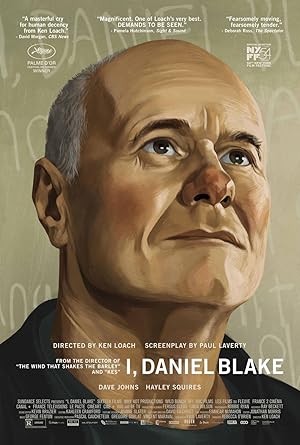
I, Daniel Blake
A 59 year old carpenter recovering from a heart attack befriends a single mother and her two kids as they navigate their way through the impersonal, Kafkaesque benefits system. With equal amounts of humor, warmth and despair, the journey is heartfelt and emotional until the end.
The film earned $15.8M at the global box office.
1 BAFTA Award30 wins & 37 nominations


Plot Structure
Story beats plotted across runtime


Narrative Arc
Emotional journey through the story's key moments
Story Circle
Blueprint 15-beat structure
Arcplot Score Breakdown
Weighted: Precision (70%) + Arc (15%) + Theme (15%)
I, Daniel Blake (2016) demonstrates meticulously timed narrative design, characteristic of Ken Loach's storytelling approach. This structural analysis examines how the film's 15-point plot structure maps to proven narrative frameworks across 1 hour and 40 minutes. With an Arcplot score of 6.6, the film balances conventional beats with creative variation.
Characters
Cast & narrative archetypes

Daniel Blake
Katie Morgan
Daisy Morgan
Dylan Morgan
Ann
Main Cast & Characters
Daniel Blake
Played by Dave Johns
A 59-year-old widowed carpenter recovering from a heart attack who struggles against the bureaucratic welfare system after being deemed fit to work.
Katie Morgan
Played by Hayley Squires
A single mother of two who has been rehoused from London to Newcastle, struggling with poverty and navigating the welfare system while trying to provide for her children.
Daisy Morgan
Played by Briana Shann
Katie's young daughter who witnesses her mother's struggles with poverty and the welfare system.
Dylan Morgan
Played by Dylan McKiernan
Katie's young son who experiences the family's hardship and poverty in Newcastle.
Ann
Played by Kate Rutter
A sympathetic jobcentre employee who wants to help Daniel but is constrained by bureaucratic rules and procedures.
Structural Analysis
The Status Quo at 1 minutes (1% through the runtime) establishes Daniel Blake, a 59-year-old widowed carpenter from Newcastle, is heard over a black screen being assessed for Employment and Support Allowance. Despite having suffered a heart attack and being told by his doctor not to work, the healthcare professional asks absurd, irrelevant questions about his physical mobility, establishing the dehumanizing bureaucracy he faces.. Structural examination shows that this early placement immediately immerses viewers in the story world.
The inciting incident occurs at 12 minutes when Daniel receives the letter informing him his claim for Employment and Support Allowance has been denied. Despite his doctor's orders not to work, the "decision maker" has ruled him fit for employment, forcing him into the Kafkaesque nightmare of appealing while simultaneously having to claim Jobseeker's Allowance—proving he's looking for work he cannot do.. At 12% through the film, this Disruption aligns precisely with traditional story structure. This beat shifts the emotional landscape, launching the protagonist into the central conflict.
The First Threshold at 25 minutes marks the transition into Act II, occurring at 25% of the runtime. This indicates the protagonist's commitment to Daniel witnesses Katie, a single mother from London, being sanctioned for arriving late to her appointment—despite having been misdirected. Daniel publicly defends her against the security guards and staff, choosing to intervene and connect. This marks his active decision to move beyond his own struggle and form human solidarity in an inhumane system., moving from reaction to action.
At 50 minutes, the Midpoint arrives at 50% of the runtime—precisely centered, creating perfect narrative symmetry. Notably, this crucial beat Katie, unable to afford food for her children after being sanctioned, is discovered by Daniel eating from tins in the food bank, so desperately hungry she cannot stop herself. She breaks down in shame and despair. This false defeat marks the point where the system's violence becomes undeniable—poverty is not abstract but embodied starvation., fundamentally raising what's at risk. The emotional intensity shifts, dividing the narrative into clear before-and-after phases.
The Collapse moment at 75 minutes (75% through) represents the emotional nadir. Here, Daniel, exhausted and humiliated beyond endurance, spray-paints "I, Daniel Blake demand my appeal date before I starve" on the Job Centre wall. A crowd gathers in support, but he is arrested. This act of public desperation represents the death of his belief that the system can be navigated through proper channels—only visible resistance remains., indicates the protagonist at their lowest point. This beat's placement in the final quarter sets up the climactic reversal.
The Second Threshold at 80 minutes initiates the final act resolution at 80% of the runtime. Katie convinces Daniel to accept help and reapply for his benefits, combining her bureaucratic knowledge with his renewed determination. He finally receives his appeal date. Daniel prepares a statement declaring his humanity and citizenship—synthesizing his dignity with practical action. He chooses to fight one more time., demonstrating the transformation achieved throughout the journey.
Emotional Journey
I, Daniel Blake's emotional architecture traces a deliberate progression across 15 carefully calibrated beats.
Narrative Framework
This structural analysis employs proven narrative structure principles that track dramatic progression. By mapping I, Daniel Blake against these established plot points, we can identify how Ken Loach utilizes or subverts traditional narrative conventions. The plot point approach reveals not only adherence to structural principles but also creative choices that distinguish I, Daniel Blake within the drama genre.
Ken Loach's Structural Approach
Among the 7 Ken Loach films analyzed on Arcplot, the average structural score is 6.8, demonstrating varied approaches to story architecture. I, Daniel Blake takes a more unconventional approach compared to the director's typical style. For comparative analysis, explore the complete Ken Loach filmography.
Comparative Analysis
Additional drama films include After Thomas, South Pacific and Dirty Dancing: Havana Nights. For more Ken Loach analyses, see Looking for Eric, Jimmy's Hall and The Angels' Share.
Plot Points by Act
Act I
SetupStatus Quo
Daniel Blake, a 59-year-old widowed carpenter from Newcastle, is heard over a black screen being assessed for Employment and Support Allowance. Despite having suffered a heart attack and being told by his doctor not to work, the healthcare professional asks absurd, irrelevant questions about his physical mobility, establishing the dehumanizing bureaucracy he faces.
Theme
Daniel's neighbor China tells him the system is designed to make people give up, that they want you to "crawl away and die." This encapsulates the film's central theme: the welfare state has become a mechanism of cruelty rather than care, stripping citizens of their dignity.
Worldbuilding
Daniel's world is established: a skilled craftsman who has worked his entire life, now unable to work due to his heart condition. He lives alone following his wife's death, maintains his modest home, and possesses no computer skills. The rules of this world are bureaucratic absurdity—he's too sick to work but not sick enough for benefits.
Disruption
Daniel receives the letter informing him his claim for Employment and Support Allowance has been denied. Despite his doctor's orders not to work, the "decision maker" has ruled him fit for employment, forcing him into the Kafkaesque nightmare of appealing while simultaneously having to claim Jobseeker's Allowance—proving he's looking for work he cannot do.
Resistance
Daniel navigates the hostile bureaucracy of the Job Centre, attempting to file his appeal while complying with Jobseeker's requirements. He encounters the online-only application system he cannot use, the arbitrary rules, and the hostile staff. His guide through this world is not a mentor but the system itself, teaching him through humiliation.
Act II
ConfrontationFirst Threshold
Daniel witnesses Katie, a single mother from London, being sanctioned for arriving late to her appointment—despite having been misdirected. Daniel publicly defends her against the security guards and staff, choosing to intervene and connect. This marks his active decision to move beyond his own struggle and form human solidarity in an inhumane system.
Mirror World
Daniel begins helping Katie and her two children, Daisy and Dylan, settle into their dilapidated council flat. He fixes broken fixtures, teaches Dylan carpentry, and forms a surrogate family bond. Katie represents the thematic mirror—another victim of the system, but with children to protect, showing what dignity means when others depend on you.
Premise
Daniel and Katie's friendship deepens as they support each other through the system's cruelties. Daniel helps around Katie's flat while she helps him with computers. Brief moments of warmth emerge: shared meals, Daniel whittling a fish mobile for Dylan. The "promise of the premise" is this fragile human connection flowering within bureaucratic brutality.
Midpoint
Katie, unable to afford food for her children after being sanctioned, is discovered by Daniel eating from tins in the food bank, so desperately hungry she cannot stop herself. She breaks down in shame and despair. This false defeat marks the point where the system's violence becomes undeniable—poverty is not abstract but embodied starvation.
Opposition
The system tightens its grip. Daniel is sanctioned for minor infractions. Katie, desperate for money, begins sex work. Daniel's appeal date keeps getting pushed back. The Job Centre supervisor Ann, despite personal sympathy, enforces the rules. Every attempt to maintain dignity is crushed by bureaucratic indifference designed to break them.
Collapse
Daniel, exhausted and humiliated beyond endurance, spray-paints "I, Daniel Blake demand my appeal date before I starve" on the Job Centre wall. A crowd gathers in support, but he is arrested. This act of public desperation represents the death of his belief that the system can be navigated through proper channels—only visible resistance remains.
Crisis
In the aftermath of his arrest, Daniel withdraws. He stops eating properly, stops caring for himself. Katie discovers him selling his furniture to survive. The dark night deepens as Daniel faces not just poverty but the psychological toll of being treated as less than human by the state he served his whole working life.
Act III
ResolutionSecond Threshold
Katie convinces Daniel to accept help and reapply for his benefits, combining her bureaucratic knowledge with his renewed determination. He finally receives his appeal date. Daniel prepares a statement declaring his humanity and citizenship—synthesizing his dignity with practical action. He chooses to fight one more time.
Synthesis
Daniel and Katie prepare for his appeal hearing. He writes his statement about being a citizen, not a client or customer. On the day of the appeal, they arrive together. Daniel goes to the bathroom to compose himself before facing the tribunal that will finally hear his case.
Transformation
Daniel suffers a fatal heart attack in the bathroom before his appeal can be heard. At his funeral, Katie reads the statement he never got to deliver: "I am not a client, a customer, nor a service user. I am a man... I am a citizen. Nothing more and nothing less." His transformation is tragic—he dies a man who never surrendered his dignity.