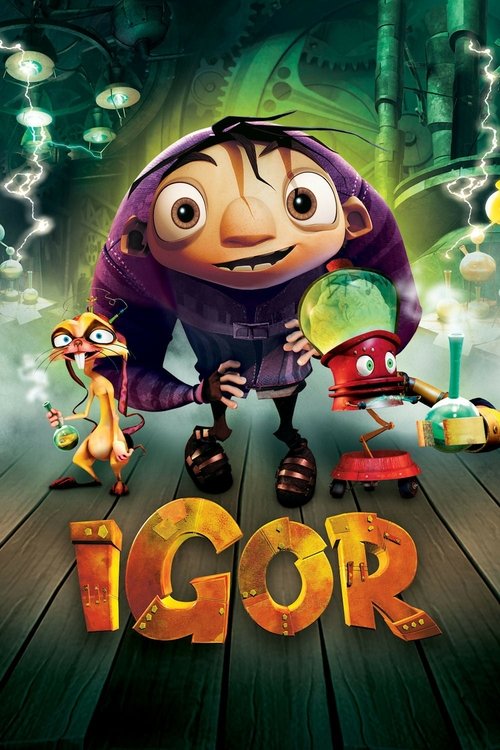
Igor
A cliché hunchbacked evil scientist's assistant aspires to become a scientist himself, much to the displeasure of the rest of the evil science community.
Working with a respectable budget of $25.0M, the film achieved a respectable showing with $30.7M in global revenue (+23% profit margin).


Plot Structure
Story beats plotted across runtime


Narrative Arc
Emotional journey through the story's key moments
Story Circle
Blueprint 15-beat structure
Arcplot Score Breakdown
Weighted: Precision (70%) + Arc (15%) + Theme (15%)
Igor (2008) showcases meticulously timed dramatic framework, characteristic of Tony Leondis's storytelling approach. This structural analysis examines how the film's 15-point plot structure maps to proven narrative frameworks across 1 hour and 27 minutes. With an Arcplot score of 6.7, the film balances conventional beats with creative variation.
Characters
Cast & narrative archetypes

Igor
Eva
Dr. Glickenstein
King Malbert
Scamper
Brain
Dr. Schadenfreude
Jaclyn
Main Cast & Characters
Igor
Played by John Cusack
An idealistic hunchbacked lab assistant who dreams of becoming an inventor and breaking free from his servant role.
Eva
Played by Molly Shannon
A feminine monster accidentally created to be good instead of evil, who believes she's an actress.
Dr. Glickenstein
Played by John Cleese
Igor's cruel and pompous mad scientist master who takes credit for Igor's inventions.
King Malbert
Played by Jay Leno
The tyrannical king of Malaria who perpetuates the evil scientist system to maintain power.
Scamper
Played by Steve Buscemi
Igor's immortal, suicidal rabbit companion who cannot die despite his constant attempts.
Brain
Played by Sean Hayes
Igor's dim-witted brain-in-a-jar companion with a cheerful, childlike personality.
Dr. Schadenfreude
Played by Eddie Izzard
A flamboyant, competitive evil scientist and Glickenstein's rival in the Evil Science Fair.
Jaclyn
Played by Jennifer Coolidge
Dr. Schadenfreude's beautiful but villainous girlfriend and accomplice who assists in his schemes.
Structural Analysis
The Status Quo at 1 minutes (1% through the runtime) establishes Igor works as a hunchbacked assistant in the kingdom of Malaria, where evil inventions are the nation's only export. He dreams of becoming an inventor himself but is relegated to servant status due to his deformity.. Notably, this early placement immediately immerses viewers in the story world.
The inciting incident occurs at 11 minutes when Dr. Glickenstein accidentally kills himself with his own invention, leaving Igor without a master just before the Evil Science Fair deadline.. At 13% through the film, this Disruption is delayed, allowing extended setup of the story world. This beat shifts the emotional landscape, launching the protagonist into the central conflict.
The First Threshold at 21 minutes marks the transition into Act II, occurring at 24% of the runtime. This illustrates the protagonist's commitment to Igor makes the active choice to pass Eva off as an evil invention and enter the Science Fair, committing to deception to achieve his dream of being recognized as an inventor., moving from reaction to action.
At 44 minutes, the Midpoint arrives at 50% of the runtime—precisely centered, creating perfect narrative symmetry. Notably, this crucial beat False victory: Igor and Eva appear to be winning at the Science Fair. Eva's performance convinces everyone she's evil, and Igor seems poised to achieve his dream of recognition as an inventor., fundamentally raising what's at risk. The emotional intensity shifts, dividing the narrative into clear before-and-after phases.
The Collapse moment at 64 minutes (73% through) represents the emotional nadir. Here, Eva discovers Igor's betrayal—that he created her only to use her for the competition and never valued her as a person. She rejects him, and Schadenfreude captures her, planning to kill the king with her., illustrates the protagonist at their lowest point. This beat's placement in the final quarter sets up the climactic reversal.
The Second Threshold at 69 minutes initiates the final act resolution at 79% of the runtime. Igor realizes that Eva taught him the true meaning of goodness and that he must save her not to win the fair, but because it's the right thing to do. He chooses heroism over ambition., demonstrating the transformation achieved throughout the journey.
Emotional Journey
Igor's emotional architecture traces a deliberate progression across 15 carefully calibrated beats.
Narrative Framework
This structural analysis employs structural analysis methodology used to understand storytelling architecture. By mapping Igor against these established plot points, we can identify how Tony Leondis utilizes or subverts traditional narrative conventions. The plot point approach reveals not only adherence to structural principles but also creative choices that distinguish Igor within the animation genre.
Tony Leondis's Structural Approach
Among the 2 Tony Leondis films analyzed on Arcplot, the average structural score is 6.7, demonstrating varied approaches to story architecture. Igor exemplifies the director's characteristic narrative technique. For comparative analysis, explore the complete Tony Leondis filmography.
Comparative Analysis
Additional animation films include The Bad Guys, Puss in Boots and Violet Evergarden: Eternity and the Auto Memory Doll. For more Tony Leondis analyses, see The Emoji Movie.
Plot Points by Act
Act I
SetupStatus Quo
Igor works as a hunchbacked assistant in the kingdom of Malaria, where evil inventions are the nation's only export. He dreams of becoming an inventor himself but is relegated to servant status due to his deformity.
Theme
Brain, one of Igor's creations, discusses the nature of good and evil, suggesting that anyone can choose to be more than what society expects them to be.
Worldbuilding
Establishment of Malaria as a kingdom built on evil inventions, the Evil Science Fair competition, Igor's secret laboratory with his creations Brain and Scamper, and his servitude to the cruel Dr. Glickenstein.
Disruption
Dr. Glickenstein accidentally kills himself with his own invention, leaving Igor without a master just before the Evil Science Fair deadline.
Resistance
Igor debates whether to seize this opportunity to enter the Science Fair himself. He decides to create his own monster, Eva, but struggles when she emerges good-natured instead of evil, complicating his plans.
Act II
ConfrontationFirst Threshold
Igor makes the active choice to pass Eva off as an evil invention and enter the Science Fair, committing to deception to achieve his dream of being recognized as an inventor.
Mirror World
Igor's relationship with Eva deepens as he teaches her about the world. She represents innocence and goodness, the thematic opposite of what Malaria demands, challenging Igor's assumptions about good and evil.
Premise
The fun of the premise: Igor tries to train Eva to be evil while hiding her true nature. Eva explores her identity, discovering her love for acting. Igor navigates the competition while keeping up the deception.
Midpoint
False victory: Igor and Eva appear to be winning at the Science Fair. Eva's performance convinces everyone she's evil, and Igor seems poised to achieve his dream of recognition as an inventor.
Opposition
The antagonist Dr. Schadenfreude and his girlfriend Jaclyn plot to steal Eva and claim her as their own invention. Igor's deception becomes harder to maintain as Eva's goodness keeps surfacing, and the truth threatens to unravel.
Collapse
Eva discovers Igor's betrayal—that he created her only to use her for the competition and never valued her as a person. She rejects him, and Schadenfreude captures her, planning to kill the king with her.
Crisis
Igor falls into despair, believing he's lost everything and that he's no better than the evil society he lives in. He faces his darkest moment, questioning whether he can truly be more than a hunchbacked assistant.
Act III
ResolutionSecond Threshold
Igor realizes that Eva taught him the true meaning of goodness and that he must save her not to win the fair, but because it's the right thing to do. He chooses heroism over ambition.
Synthesis
Igor storms Schadenfreude's fortress with Brain and Scamper, rescues Eva, and stops the plot to kill the king. He publicly reveals the corruption in Malaria and declares that anyone can choose to be good, inspiring a revolution.
Transformation
Igor stands proud and accepted, no longer defined by his hunchback or servant status. Eva pursues her dream of acting, and Malaria begins to transform from evil to good. Igor has become the inventor and hero he always wanted to be.