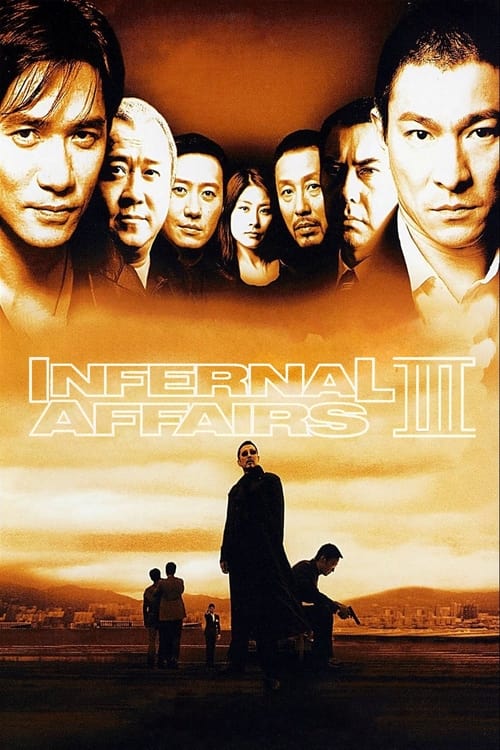
Infernal Affairs III
While Yeung Kam Wing is trying to remove all connections between the mob and him, his actions are being carefully observed by Lau Kin Ming, who bears a personal grudge against him.
Despite its minimal budget of $250K, Infernal Affairs III became a box office phenomenon, earning $4.5M worldwide—a remarkable 1687% return. The film's distinctive approach found its audience, proving that strong storytelling can transcend budget limitations.


Plot Structure
Story beats plotted across runtime


Narrative Arc
Emotional journey through the story's key moments
Story Circle
Blueprint 15-beat structure
Arcplot Score Breakdown
Weighted: Precision (70%) + Arc (15%) + Theme (15%)
Infernal Affairs III (2003) exhibits meticulously timed narrative architecture, characteristic of Alan Mak Siu-Fai's storytelling approach. This structural analysis examines how the film's 15-point plot structure maps to proven narrative frameworks across 1 hour and 58 minutes. With an Arcplot score of 7.6, the film showcases strong structural fundamentals.
Characters
Cast & narrative archetypes

Lau Kin Ming
Chan Wing Yan
Yeung Kam Wing
Shen Chen
Dr. Lee Sum Yee
SP Wong Chi Shing
Hon Sam
Main Cast & Characters
Lau Kin Ming
Played by Andy Lau
Former triad mole in police force struggling with guilt and identity after assuming a dead undercover cop's legacy
Chan Wing Yan
Played by Tony Leung Chiu-wai
Deceased undercover officer whose ghost haunts Ming's conscience and appears in flashbacks revealing his psychological decline
Yeung Kam Wing
Played by Leon Lai
Senior police inspector who suspects Ming's true identity and relentlessly investigates his past
Shen Chen
Played by Chen Daoming
Mainland security officer investigating crimes connected to the triad infiltration network
Dr. Lee Sum Yee
Played by Kelly Chen
Psychiatrist treating Ming who becomes romantically involved while unaware of his dark past
SP Wong Chi Shing
Played by Anthony Wong
Wong's character from the first film appearing in flashbacks showing his role in the mole operations
Hon Sam
Played by Eric Tsang
Triad boss and Ming's former handler who continues to manipulate events from prison
Structural Analysis
The Status Quo at 1 minutes (1% through the runtime) establishes Chen Yan (Tony Leung) struggles with psychological trauma and guilt following the deaths of both undercover officers. The opening establishes his fractured mental state and the weight of secrets.. Of particular interest, this early placement immediately immerses viewers in the story world.
The inciting incident occurs at 13 minutes when Inspector Yeung begins investigating inconsistencies in the evidence surrounding Sam's death, threatening to expose both Yan's and Lau's true identities. The past refuses to stay hidden.. At 11% through the film, this Disruption aligns precisely with traditional story structure. This beat shifts the emotional landscape, launching the protagonist into the central conflict.
The First Threshold at 29 minutes marks the transition into Act II, occurring at 25% of the runtime. This demonstrates the protagonist's commitment to Yan decides to actively investigate Sam's death himself, choosing to confront the truth rather than run from it. This choice pulls him deeper into the dangerous web connecting him to Lau and the triad remnants., moving from reaction to action.
At 59 minutes, the Midpoint arrives at 50% of the runtime—precisely centered, creating perfect narrative symmetry. Significantly, this crucial beat Yeung discovers critical evidence linking Lau to Sam and the triads. The stakes escalate dramatically - false defeat as Yan realizes his own identity may be exposed in the investigation. The game becomes deadly serious., fundamentally raising what's at risk. The emotional intensity shifts, dividing the narrative into clear before-and-after phases.
The Collapse moment at 88 minutes (75% through) represents the emotional nadir. Here, Yeung is killed by Lau in the confrontation. The death of this truth-seeker represents the death of hope for justice and redemption. Yan witnesses or discovers this, confirming that the past's sins cannot be undone., shows the protagonist at their lowest point. This beat's placement in the final quarter sets up the climactic reversal.
The Second Threshold at 95 minutes initiates the final act resolution at 81% of the runtime. Yan achieves clarity about his true nature and accepts his identity. He synthesizes his undercover experience with his police training to understand what must be done. He sees Lau's true nature clearly now., demonstrating the transformation achieved throughout the journey.
Emotional Journey
Infernal Affairs III's emotional architecture traces a deliberate progression across 15 carefully calibrated beats.
Narrative Framework
This structural analysis employs proven narrative structure principles that track dramatic progression. By mapping Infernal Affairs III against these established plot points, we can identify how Alan Mak Siu-Fai utilizes or subverts traditional narrative conventions. The plot point approach reveals not only adherence to structural principles but also creative choices that distinguish Infernal Affairs III within the crime genre.
Alan Mak Siu-Fai's Structural Approach
Among the 2 Alan Mak Siu-Fai films analyzed on Arcplot, the average structural score is 7.2, reflecting strong command of classical structure. Infernal Affairs III represents one of the director's most structurally precise works. For comparative analysis, explore the complete Alan Mak Siu-Fai filmography.
Comparative Analysis
Additional crime films include The Bad Guys, Rustom and The Whole Ten Yards. For more Alan Mak Siu-Fai analyses, see Infernal Affairs.
Plot Points by Act
Act I
SetupStatus Quo
Chen Yan (Tony Leung) struggles with psychological trauma and guilt following the deaths of both undercover officers. The opening establishes his fractured mental state and the weight of secrets.
Theme
Dr. Lee tells Yan: "The past never stays buried. What you suppress will eventually surface." This establishes the theme of inescapable identity and psychological consequences of dual lives.
Worldbuilding
The film establishes its complex temporal structure, interweaving events before, during, and after the first two films. We see Yan's deteriorating mental state, Lau's continued deception in the force, and Yeung's investigation into police corruption.
Disruption
Inspector Yeung begins investigating inconsistencies in the evidence surrounding Sam's death, threatening to expose both Yan's and Lau's true identities. The past refuses to stay hidden.
Resistance
Yan debates whether to come clean or continue hiding. Flashbacks reveal how both he and Lau entered their double lives. Yan consults with Dr. Lee while Lau tries to manipulate the investigation. Both men struggle with the impossibility of true redemption.
Act II
ConfrontationFirst Threshold
Yan decides to actively investigate Sam's death himself, choosing to confront the truth rather than run from it. This choice pulls him deeper into the dangerous web connecting him to Lau and the triad remnants.
Mirror World
Yan's relationship with Dr. Lee deepens. She represents the possibility of psychological healing and authentic identity, the mirror showing what a genuine life could be - contrasting with his fractured existence.
Premise
The film delivers on its premise of psychological thriller and identity crisis. Parallel investigations unfold as Yan and Yeung both dig into the past while Lau desperately tries to maintain his false identity. Temporal shifts reveal the origins and consequences of deception.
Midpoint
Yeung discovers critical evidence linking Lau to Sam and the triads. The stakes escalate dramatically - false defeat as Yan realizes his own identity may be exposed in the investigation. The game becomes deadly serious.
Opposition
Lau takes increasingly desperate measures to protect his secret, while Yeung closes in on the truth. Yan's psychological state deteriorates further under the pressure. The temporal structure reveals how past choices trap both men in impossible situations.
Collapse
Yeung is killed by Lau in the confrontation. The death of this truth-seeker represents the death of hope for justice and redemption. Yan witnesses or discovers this, confirming that the past's sins cannot be undone.
Crisis
Yan spirals into his darkest psychological state. He must confront that there is no escape from who he has become - the dual identity has fractured him permanently. He processes the impossibility of redemption or normal life.
Act III
ResolutionSecond Threshold
Yan achieves clarity about his true nature and accepts his identity. He synthesizes his undercover experience with his police training to understand what must be done. He sees Lau's true nature clearly now.
Synthesis
The finale interweaves past and present as all secrets are revealed. Yan confronts Lau with evidence. The resolution plays out across multiple timelines, showing how the choices made years ago determine the final outcomes. Justice arrives in unexpected form.
Transformation
Final image mirrors the opening but shows transformation: Yan has either found peace in death/sacrifice or Lau remains trapped in his false identity forever. The psychological cost of living a lie is complete - one or both men destroyed by their dual lives.