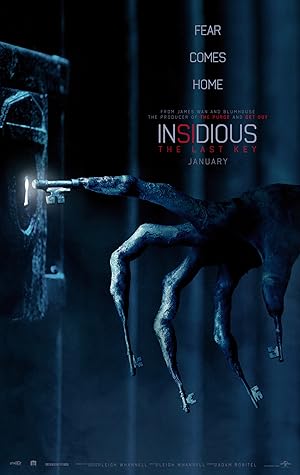
Insidious: The Last Key
The parapsychologist Dr. Elise Rainier has nightmares with her childhood in New Mexico, where she lived with her brother Christian, her supportive mother Audrey and her father Gerald, who frequently beats her when she claims that she sees ghosts everywhere in the house. When the client Ted Garza calls Elise to ask for help since he is haunted since he moved to a house in New Mexico, Elise refuses the request since the address is the same house where she spent her childhood. However she changes her mind and accepts the job, and travels with her assistants Specs and Tucker to New Mexico where they will discover an evil entity in the house.
Despite its small-scale budget of $10.0M, Insidious: The Last Key became a massive hit, earning $172.8M worldwide—a remarkable 1628% return. The film's distinctive approach connected with viewers, proving that strong storytelling can transcend budget limitations.


Plot Structure
Story beats plotted across runtime


Narrative Arc
Emotional journey through the story's key moments
Story Circle
Blueprint 15-beat structure
Arcplot Score Breakdown
Weighted: Precision (70%) + Arc (15%) + Theme (15%)
Insidious: The Last Key (2018) demonstrates strategically placed plot construction, characteristic of Adam Robitel's storytelling approach. This structural analysis examines how the film's 15-point plot structure maps to proven narrative frameworks across 1 hour and 43 minutes. With an Arcplot score of 7.2, the film balances conventional beats with creative variation.
Characters
Cast & narrative archetypes

Elise Rainier
KeyFace
Tucker
Specs
Imogen Rainier
Melissa Rainier
Ted Garza
Gerald Rainier
Main Cast & Characters
Elise Rainier
Played by Lin Shaye
A gifted psychic medium who confronts demons from her traumatic childhood while investigating a haunting in her childhood home.
KeyFace
Played by Javier Botet
A malevolent demon with keys for fingers who imprisoned souls in Elise's childhood home and now seeks to reclaim her.
Tucker
Played by Angus Sampson
Elise's loyal tech specialist and paranormal investigator partner who provides comic relief and technical support.
Specs
Played by Leigh Whannell
Elise's devoted partner and documentarian who helps investigate paranormal cases with earnest enthusiasm.
Imogen Rainier
Played by Caitlin Gerard
Elise's younger niece who possesses psychic abilities and seeks her aunt's help with a haunting.
Melissa Rainier
Played by Spencer Locke
Ted Garza's current girlfriend who becomes caught up in the supernatural terror plaguing the house.
Ted Garza
Played by Kirk Acevedo
The current owner of Elise's childhood home who has been abusing his girlfriend and unknowingly unleashing dark forces.
Gerald Rainier
Played by Josh Stewart
Elise's abusive father who punished her for her psychic abilities and created the trauma that haunts her.
Structural Analysis
The Status Quo at 1 minutes (1% through the runtime) establishes Young Elise is trapped in her childhood bedroom in 1953 New Mexico, terrified of the supernatural entities she can see, establishing her lifelong fear and the abuse she suffered from her father for her gift.. Notably, this early placement immediately immerses viewers in the story world.
The inciting incident occurs at 12 minutes when Elise receives a call from a man named Ted Garza who now lives in her childhood home and is experiencing paranormal activity, forcing her to confront the place she has avoided for decades.. At 12% through the film, this Disruption aligns precisely with traditional story structure. This beat shifts the emotional landscape, launching the protagonist into the central conflict.
The First Threshold at 25 minutes marks the transition into Act II, occurring at 24% of the runtime. This reveals the protagonist's commitment to Elise makes the active choice to return to her childhood home in New Mexico, crossing the threshold into her traumatic past to help Ted and confront the demons that have haunted her entire life., moving from reaction to action.
At 52 minutes, the Midpoint arrives at 50% of the runtime—precisely centered, creating perfect narrative symmetry. Of particular interest, this crucial beat Elise discovers that KeyFace has been using her childhood home as a portal to the prison next door, stealing the souls of executed prisoners, and realizes her father was trying to protect them by being cruel—a false defeat that recontextualizes everything., fundamentally raising what's at risk. The emotional intensity shifts, dividing the narrative into clear before-and-after phases.
The Collapse moment at 77 minutes (75% through) represents the emotional nadir. Here, Elise is captured by KeyFace in The Further and forced to relive her mother's death, confronting the moment her father killed her mother while trying to stop the demon—the ultimate "whiff of death" that reveals the deepest trauma., reveals the protagonist at their lowest point. This beat's placement in the final quarter sets up the climactic reversal.
The Second Threshold at 82 minutes initiates the final act resolution at 80% of the runtime. Elise realizes she must fully embrace her gift and forgive her father to gain the power to defeat KeyFace—synthesizing her mother's wisdom about responsibility with her lifetime of experience helping others., demonstrating the transformation achieved throughout the journey.
Emotional Journey
Insidious: The Last Key's emotional architecture traces a deliberate progression across 15 carefully calibrated beats.
Narrative Framework
This structural analysis employs proven narrative structure principles that track dramatic progression. By mapping Insidious: The Last Key against these established plot points, we can identify how Adam Robitel utilizes or subverts traditional narrative conventions. The plot point approach reveals not only adherence to structural principles but also creative choices that distinguish Insidious: The Last Key within the horror genre.
Adam Robitel's Structural Approach
Among the 3 Adam Robitel films analyzed on Arcplot, the average structural score is 7.4, reflecting strong command of classical structure. Insidious: The Last Key takes a more unconventional approach compared to the director's typical style. For comparative analysis, explore the complete Adam Robitel filmography.
Comparative Analysis
Additional horror films include Thinner, A Nightmare on Elm Street and Mary Reilly. For more Adam Robitel analyses, see Escape Room: Tournament of Champions, Escape Room.
Plot Points by Act
Act I
SetupStatus Quo
Young Elise is trapped in her childhood bedroom in 1953 New Mexico, terrified of the supernatural entities she can see, establishing her lifelong fear and the abuse she suffered from her father for her gift.
Theme
Elise's mother tells her: "Your gift is also your responsibility," establishing the central theme that Elise must embrace rather than run from her abilities to save others.
Worldbuilding
Present-day Elise works with Specs and Tucker as a renowned paranormal investigator, but still carries deep trauma from her childhood and avoids returning to her past.
Disruption
Elise receives a call from a man named Ted Garza who now lives in her childhood home and is experiencing paranormal activity, forcing her to confront the place she has avoided for decades.
Resistance
Elise resists returning home, debates with Specs and Tucker about whether she can face her past, and learns more about the current hauntings at the house that mirror her childhood terror.
Act II
ConfrontationFirst Threshold
Elise makes the active choice to return to her childhood home in New Mexico, crossing the threshold into her traumatic past to help Ted and confront the demons that have haunted her entire life.
Mirror World
Elise reconnects with her estranged brother Christian, who represents the other side of their shared trauma—he chose denial and anger while she chose to help others, creating the emotional B-story of family reconciliation.
Premise
Elise investigates the house, uncovers the demon KeyFace who steals souls, discovers her father's dark secrets and the prison connection, and explores The Further to understand the evil that infected her childhood home.
Midpoint
Elise discovers that KeyFace has been using her childhood home as a portal to the prison next door, stealing the souls of executed prisoners, and realizes her father was trying to protect them by being cruel—a false defeat that recontextualizes everything.
Opposition
KeyFace grows stronger and more aggressive, Christian's nieces are kidnapped into The Further, Elise's methods seem ineffective, and the team faces increasing danger as the demon closes in on claiming more victims.
Collapse
Elise is captured by KeyFace in The Further and forced to relive her mother's death, confronting the moment her father killed her mother while trying to stop the demon—the ultimate "whiff of death" that reveals the deepest trauma.
Crisis
Elise processes the revelation about her mother's death and her father's tragic attempt to protect them, experiencing her dark night of the soul while trapped and seemingly powerless against KeyFace.
Act III
ResolutionSecond Threshold
Elise realizes she must fully embrace her gift and forgive her father to gain the power to defeat KeyFace—synthesizing her mother's wisdom about responsibility with her lifetime of experience helping others.
Synthesis
Elise confronts and defeats KeyFace using her full abilities, rescues Christian's nieces, receives closure from her mother's spirit, reconciles with her brother, and sets up her continued mission helping others facing the supernatural.
Transformation
Elise stands peacefully in her childhood bedroom, now cleansed and free of evil, having transformed from a woman running from her past into someone who has integrated her trauma and fully accepted her gift and responsibility.