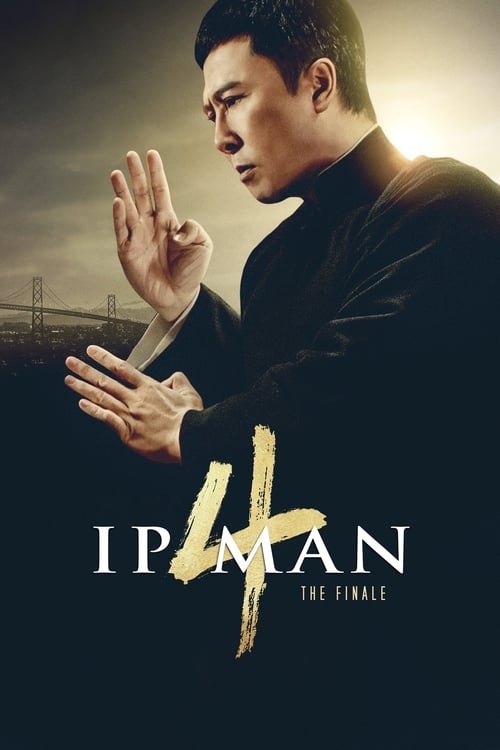
Ip Man 4: The Finale
Following the death of his wife, Ip Man travels to San Francisco to ease tensions between the local kung fu masters and his star student, Bruce Lee, while searching for a better future for his son.
Despite a respectable budget of $52.0M, Ip Man 4: The Finale became a financial success, earning $239.0M worldwide—a 360% return.
12 wins & 11 nominations


Plot Structure
Story beats plotted across runtime


Narrative Arc
Emotional journey through the story's key moments
Story Circle
Blueprint 15-beat structure
Arcplot Score Breakdown
Weighted: Precision (70%) + Arc (15%) + Theme (15%)
Ip Man 4: The Finale (2019) exhibits carefully calibrated plot construction, characteristic of Wilson Yip's storytelling approach. This structural analysis examines how the film's 15-point plot structure maps to proven narrative frameworks across 1 hour and 45 minutes. With an Arcplot score of 6.8, the film balances conventional beats with creative variation.
Characters
Cast & narrative archetypes

Ip Man
Wan Zong-hua
Bruce Lee
Hartman Wu
Yonah
Colin Frater
Walters
Cheung Ye-pang
Main Cast & Characters
Ip Man
Played by Donnie Yen
The legendary Wing Chun grandmaster travels to San Francisco to find a school for his son while battling terminal cancer.
Wan Zong-hua
Played by Wu Yue
President of the Chinese Benevolent Association in San Francisco's Chinatown who helps Ip Man navigate the Chinese community.
Bruce Lee
Played by Danny Chan
Ip Man's most famous student who has opened his own martial arts school in America, drawing controversy from traditional Chinese masters.
Hartman Wu
Played by Ng Tak-wing
A Tai Chi master in Chinatown who becomes an ally to Ip Man after initially opposing him.
Yonah
Played by Vanda Margraf
A Chinese-American cheerleader who befriends Ip Man and serves as a cultural bridge between East and West.
Colin Frater
Played by Scott Adkins
A racist Marine Gunnery Sergeant who despises Chinese immigrants and challenges Ip Man.
Walters
Played by Vanness Wu
The commanding officer at the Marine base who tries to maintain order and fairness.
Cheung Ye-pang
Played by Jim Liu
Ip Man's son who struggles with his father's absence and fights at school in Hong Kong.
Structural Analysis
The Status Quo at 1 minutes (1% through the runtime) establishes Ip Man practices Wing Chun in Foshan, maintaining his quiet life as a master teaching his students, but he appears weary and older.. Significantly, this early placement immediately immerses viewers in the story world.
The inciting incident occurs at 12 minutes when Ip Man learns he has cancer and limited time to live, while simultaneously his son gets into serious trouble at school, creating dual crises that force action.. At 11% through the film, this Disruption aligns precisely with traditional story structure. This beat shifts the emotional landscape, launching the protagonist into the central conflict.
The First Threshold at 26 minutes marks the transition into Act II, occurring at 24% of the runtime. This reveals the protagonist's commitment to Ip Man chooses to travel to San Francisco to secure a recommendation letter for his son's education, stepping into the unfamiliar Western world., moving from reaction to action.
At 52 minutes, the Midpoint arrives at 50% of the runtime—precisely centered, creating perfect narrative symmetry. Structural examination shows that this crucial beat The racist Marine karate instructor Barton Geddes severely injures Chinese martial artists during a demonstration, raising the stakes and revealing the true depth of prejudice and violence Ip Man must confront., fundamentally raising what's at risk. The emotional intensity shifts, dividing the narrative into clear before-and-after phases.
The Collapse moment at 79 minutes (75% through) represents the emotional nadir. Here, Yonah's father Wan is killed by Geddes during a violent confrontation at the INS office, representing the death of innocence and peaceful coexistence., illustrates the protagonist at their lowest point. This beat's placement in the final quarter sets up the climactic reversal.
The Second Threshold at 83 minutes initiates the final act resolution at 79% of the runtime. Ip Man decides to challenge Geddes directly, understanding that he must fight not just for justice but to demonstrate that Chinese dignity and martial arts deserve respect in both East and West., demonstrating the transformation achieved throughout the journey.
Emotional Journey
Ip Man 4: The Finale's emotional architecture traces a deliberate progression across 15 carefully calibrated beats.
Narrative Framework
This structural analysis employs structural analysis methodology used to understand storytelling architecture. By mapping Ip Man 4: The Finale against these established plot points, we can identify how Wilson Yip utilizes or subverts traditional narrative conventions. The plot point approach reveals not only adherence to structural principles but also creative choices that distinguish Ip Man 4: The Finale within the action genre.
Wilson Yip's Structural Approach
Among the 4 Wilson Yip films analyzed on Arcplot, the average structural score is 7.5, reflecting strong command of classical structure. Ip Man 4: The Finale takes a more unconventional approach compared to the director's typical style. For comparative analysis, explore the complete Wilson Yip filmography.
Comparative Analysis
Additional action films include The Bad Guys, Puss in Boots and Venom: The Last Dance. For more Wilson Yip analyses, see Ip Man 2, Ip Man and Ip Man 3.
Plot Points by Act
Act I
SetupStatus Quo
Ip Man practices Wing Chun in Foshan, maintaining his quiet life as a master teaching his students, but he appears weary and older.
Theme
A character discusses how the younger generation must find their own path while respecting tradition, introducing the film's central theme of bridging Eastern and Western cultures.
Worldbuilding
Establishment of Ip Man's life in Foshan, his relationship with his son, the revelation of his terminal cancer diagnosis, and the introduction of Bruce Lee's invitation to come to America.
Disruption
Ip Man learns he has cancer and limited time to live, while simultaneously his son gets into serious trouble at school, creating dual crises that force action.
Resistance
Ip Man debates traveling to America to secure his son's education, facing resistance from the Chinese Benevolent Association and grappling with leaving his homeland and traditional values.
Act II
ConfrontationFirst Threshold
Ip Man chooses to travel to San Francisco to secure a recommendation letter for his son's education, stepping into the unfamiliar Western world.
Mirror World
Ip Man meets Yonah, the young Chinese-American girl who embodies the harmony between Eastern and Western cultures that he must learn to accept.
Premise
Ip Man navigates American culture, witnesses discrimination against Chinese immigrants, attends a Mid-Autumn Festival, and encounters the conflict between traditional martial arts and Western attitudes.
Midpoint
The racist Marine karate instructor Barton Geddes severely injures Chinese martial artists during a demonstration, raising the stakes and revealing the true depth of prejudice and violence Ip Man must confront.
Opposition
Tensions escalate as Geddes's brutality increases, Bruce Lee is banned from teaching Caucasians, the Chinese community faces mounting violence, and Ip Man's health deteriorates while he struggles to obtain the recommendation letter.
Collapse
Yonah's father Wan is killed by Geddes during a violent confrontation at the INS office, representing the death of innocence and peaceful coexistence.
Crisis
Ip Man processes the tragedy and injustice, confronting his own mortality and the realization that some wrongs must be confronted directly despite his desire for peace.
Act III
ResolutionSecond Threshold
Ip Man decides to challenge Geddes directly, understanding that he must fight not just for justice but to demonstrate that Chinese dignity and martial arts deserve respect in both East and West.
Synthesis
Ip Man confronts and defeats Geddes in an epic battle that vindicates Chinese martial arts, earns respect from witnesses including American military officials, and Bruce Lee receives permission to continue teaching.
Transformation
Ip Man reads his son's letter expressing love and understanding, achieving peace with his legacy as he accepts both his impending death and his role in bridging cultures through Wing Chun.