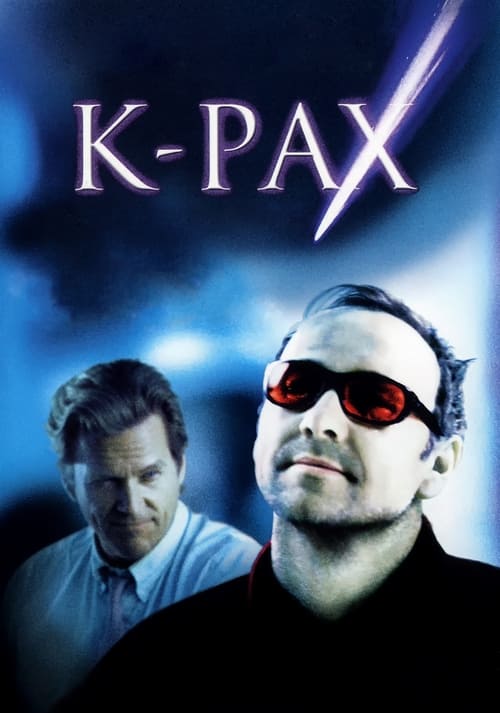
K-PAX
Prot is a patient at a mental hospital who claims to be from a far away planet. His psychiatrist tries to help him, only to begin to doubt his own explanations.
Working with a moderate budget of $48.0M, the film achieved a steady performer with $50.3M in global revenue (+5% profit margin).


Plot Structure
Story beats plotted across runtime


Narrative Arc
Emotional journey through the story's key moments
Story Circle
Blueprint 15-beat structure
Arcplot Score Breakdown
Weighted: Precision (70%) + Arc (15%) + Theme (15%)
K-PAX (2001) exhibits meticulously timed plot construction, characteristic of Iain Softley's storytelling approach. This structural analysis examines how the film's 15-point plot structure maps to proven narrative frameworks across 2 hours. With an Arcplot score of 6.4, the film takes an unconventional approach to traditional narrative frameworks.
Characters
Cast & narrative archetypes

Prot
Dr. Mark Powell
Howie
Ernie
Bess
Joyce
Main Cast & Characters
Prot
Played by Kevin Spacey
A mysterious patient claiming to be an alien from the planet K-PAX with extraordinary insights and abilities.
Dr. Mark Powell
Played by Jeff Bridges
A dedicated psychiatrist struggling to uncover the truth about Prot while balancing his deteriorating family life.
Howie
Played by David Patrick Kelly
A germophobic patient at the psychiatric institute who forms a bond with Prot.
Ernie
Played by Saul Williams
A traumatized patient who believes he was abused and finds hope through Prot's influence.
Bess
Played by Celia Weston
A depressed, withdrawn patient who begins to open up under Prot's care.
Joyce
Played by Alfre Woodard
A delusional patient who believes she is being watched by cameras.
Structural Analysis
The Status Quo at 1 minutes (1% through the runtime) establishes Dr. Powell is a dedicated psychiatrist with a stable family life, established in his rational, scientific worldview and traditional therapeutic methods.. The analysis reveals that this early placement immediately immerses viewers in the story world.
The inciting incident occurs at 14 minutes when Prot arrives at the hospital claiming to be an alien from the planet K-PAX, displaying unusual knowledge and abilities that challenge Dr. Powell's rational worldview. This patient is different from any he's encountered.. At 12% through the film, this Disruption aligns precisely with traditional story structure. This beat shifts the emotional landscape, launching the protagonist into the central conflict.
The First Threshold at 31 minutes marks the transition into Act II, occurring at 25% of the runtime. This indicates the protagonist's commitment to Dr. Powell makes the active choice to fully commit to Prot's case, deciding to use hypnotherapy and deep investigation to uncover the "truth" behind the delusion. He crosses into a journey that will challenge everything he believes., moving from reaction to action.
At 60 minutes, the Midpoint arrives at 50% of the runtime—precisely centered, creating perfect narrative symmetry. The analysis reveals that this crucial beat Dr. Powell discovers a critical lead about Prot's possible human identity - a missing person case from New Mexico. False victory: he thinks he's close to solving the mystery, but this discovery will lead him to a devastating truth that raises the stakes enormously., fundamentally raising what's at risk. The emotional intensity shifts, dividing the narrative into clear before-and-after phases.
The Collapse moment at 89 minutes (75% through) represents the emotional nadir. Here, Under hypnosis, the truth emerges: Prot is the alter ego of Robert Porter, who witnessed his family's murder and committed a mercy killing. The "whiff of death" - both literal (the murders) and metaphorical (the death of Powell's certainty and Prot's impending departure)., reveals the protagonist at their lowest point. This beat's placement in the final quarter sets up the climactic reversal.
The Second Threshold at 96 minutes initiates the final act resolution at 80% of the runtime. Dr. Powell realizes that Prot/Robert's "delusion" has healed others in ways his methods never could. He synthesizes his clinical knowledge with the understanding that some truths transcend empirical evidence. He chooses compassion over being "right."., demonstrating the transformation achieved throughout the journey.
Emotional Journey
K-PAX's emotional architecture traces a deliberate progression across 15 carefully calibrated beats.
Narrative Framework
This structural analysis employs structural analysis methodology used to understand storytelling architecture. By mapping K-PAX against these established plot points, we can identify how Iain Softley utilizes or subverts traditional narrative conventions. The plot point approach reveals not only adherence to structural principles but also creative choices that distinguish K-PAX within the science fiction genre.
Iain Softley's Structural Approach
Among the 5 Iain Softley films analyzed on Arcplot, the average structural score is 6.8, demonstrating varied approaches to story architecture. K-PAX takes a more unconventional approach compared to the director's typical style. For comparative analysis, explore the complete Iain Softley filmography.
Comparative Analysis
Additional science fiction films include The Postman, Mad Max 2 and AVP: Alien vs. Predator. For more Iain Softley analyses, see Inkheart, The Skeleton Key and Hackers.
Plot Points by Act
Act I
SetupStatus Quo
Dr. Powell is a dedicated psychiatrist with a stable family life, established in his rational, scientific worldview and traditional therapeutic methods.
Theme
A colleague or patient suggests that sometimes believing in something impossible can be more healing than cold facts - foreshadowing the film's central question about the power of belief versus empirical truth.
Worldbuilding
Establishment of the psychiatric hospital setting, Dr. Powell's methods, his family dynamics, and the various patients. We see his rational, by-the-book approach to mental illness and his dedication to finding logical explanations.
Disruption
Prot arrives at the hospital claiming to be an alien from the planet K-PAX, displaying unusual knowledge and abilities that challenge Dr. Powell's rational worldview. This patient is different from any he's encountered.
Resistance
Dr. Powell debates whether to take Prot's case, conducts initial evaluations, and witnesses increasingly inexplicable phenomena. He resists the implications while becoming obsessed with proving Prot is delusional. Prot begins affecting other patients positively.
Act II
ConfrontationFirst Threshold
Dr. Powell makes the active choice to fully commit to Prot's case, deciding to use hypnotherapy and deep investigation to uncover the "truth" behind the delusion. He crosses into a journey that will challenge everything he believes.
Mirror World
Prot's relationship with the other patients deepens - he becomes their guide and healer, offering them hope and perspective. This mirror world shows an alternative approach to healing based on wonder and possibility rather than clinical diagnosis.
Premise
The "fun and games" of watching Dr. Powell investigate while Prot demonstrates astronomical knowledge, heals patients, and creates genuine transformation in the hospital. Powell uncovers clues while Prot announces he'll return to K-PAX on a specific date.
Midpoint
Dr. Powell discovers a critical lead about Prot's possible human identity - a missing person case from New Mexico. False victory: he thinks he's close to solving the mystery, but this discovery will lead him to a devastating truth that raises the stakes enormously.
Opposition
Dr. Powell's investigation intensifies as he uncovers the tragic backstory of Robert Porter. Prot's influence on the patients grows stronger. Powell's obsession strains his family life. The deadline for Prot's departure approaches, creating urgency and tension.
Collapse
Under hypnosis, the truth emerges: Prot is the alter ego of Robert Porter, who witnessed his family's murder and committed a mercy killing. The "whiff of death" - both literal (the murders) and metaphorical (the death of Powell's certainty and Prot's impending departure).
Crisis
Dr. Powell sits with the devastating knowledge of Robert's trauma. He must decide what this means: Has he "cured" the delusion, or destroyed something precious? He grapples with whether empirical truth is always the answer.
Act III
ResolutionSecond Threshold
Dr. Powell realizes that Prot/Robert's "delusion" has healed others in ways his methods never could. He synthesizes his clinical knowledge with the understanding that some truths transcend empirical evidence. He chooses compassion over being "right."
Synthesis
The departure date arrives. Prot fulfills his promise, taking one patient "with him" while Robert Porter's body becomes catatonic. Dr. Powell accepts the mystery, allows the patients their hope, and demonstrates his transformation through changed behavior with his family and practice.
Transformation
Dr. Powell tends to the catatonic Robert with gentleness and wonder rather than clinical detachment. He looks at the stars, now open to mysteries he cannot explain. He has transformed from rigid rationalist to someone who embraces uncertainty and the healing power of belief.