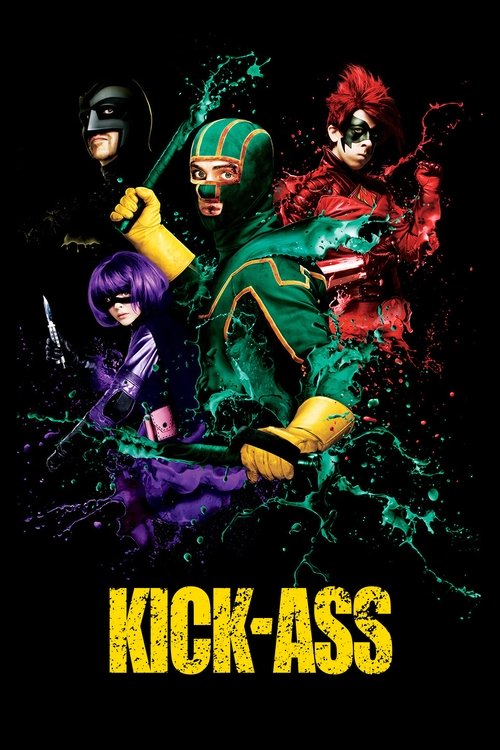
Kick-Ass
Dave Lizewski is an unnoticed high school student and comic book fan who one day decides to become a super-hero, even though he has no powers, training or meaningful reason to do so.
Despite a respectable budget of $28.0M, Kick-Ass became a financial success, earning $96.2M worldwide—a 244% return.
19 wins & 63 nominations


Plot Structure
Story beats plotted across runtime


Narrative Arc
Emotional journey through the story's key moments
Story Circle
Blueprint 15-beat structure
Arcplot Score Breakdown
Weighted: Precision (70%) + Arc (15%) + Theme (15%)
Kick-Ass (2010) exhibits strategically placed narrative design, characteristic of Matthew Vaughn's storytelling approach. This structural analysis examines how the film's 15-point plot structure maps to proven narrative frameworks across 1 hour and 58 minutes. With an Arcplot score of 6.3, the film takes an unconventional approach to traditional narrative frameworks.
Characters
Cast & narrative archetypes

Dave Lizewski / Kick-Ass
Mindy Macready / Hit-Girl
Damon Macready / Big Daddy
Chris D'Amico / Red Mist
Frank D'Amico
Katie Deauxma
Main Cast & Characters
Dave Lizewski / Kick-Ass
Played by Aaron Taylor-Johnson
An ordinary high school student who decides to become a real-life superhero despite having no powers or training.
Mindy Macready / Hit-Girl
Played by Chloë Grace Moretz
A highly trained 11-year-old vigilante raised by her father to be a lethal crime fighter.
Damon Macready / Big Daddy
Played by Nicolas Cage
A former cop turned vigilante who trains his daughter to help him take revenge on crime boss Frank D'Amico.
Chris D'Amico / Red Mist
Played by Christopher Mintz-Plasse
The son of mob boss Frank D'Amico who befriends Kick-Ass while secretly working for his father.
Frank D'Amico
Played by Mark Strong
A ruthless crime boss who becomes the target of Big Daddy's vendetta and views the costumed heroes as threats to his operation.
Katie Deauxma
Played by Lyndsy Fonseca
Dave's high school crush who believes he is gay and becomes his close friend.
Structural Analysis
The Status Quo at 2 minutes (1% through the runtime) establishes Dave Lizewski narrates his ordinary life as an invisible high school comic book nerd, wondering why no one has ever tried to become a superhero in real life.. Of particular interest, this early placement immediately immerses viewers in the story world.
The inciting incident occurs at 15 minutes when Dave orders a superhero costume online and commits to becoming a masked vigilante, despite having no powers, training, or plan. His delusion is immediately tested when he's stabbed and hit by a car on his first outing.. At 12% through the film, this Disruption aligns precisely with traditional story structure. This beat shifts the emotional landscape, launching the protagonist into the central conflict.
The First Threshold at 30 minutes marks the transition into Act II, occurring at 26% of the runtime. This illustrates the protagonist's commitment to The "Kick-Ass" video goes viral, making Dave an internet sensation. He commits fully to the superhero identity by creating a MySpace page and accepting responsibility for helping people. He chooses this path despite knowing the danger., moving from reaction to action.
At 60 minutes, the Midpoint arrives at 50% of the runtime—precisely centered, creating perfect narrative symmetry. Structural examination shows that this crucial beat Frank D'Amico's son Chris befriends Dave as "Red Mist," pretending to be a fellow superhero, but it's a trap. Dave is led into an ambush where he meets Big Daddy and Hit-Girl officially, but the stakes become lethal—people are actively hunting Kick-Ass. False victory (new superhero allies) conceals the real danger (Red Mist is the enemy)., fundamentally raising what's at risk. The emotional intensity shifts, dividing the narrative into clear before-and-after phases.
The Collapse moment at 89 minutes (75% through) represents the emotional nadir. Here, Red Mist betrays Kick-Ass, leading to an ambush where Big Daddy and Mindy are captured. Big Daddy is brutally murdered (burned alive on a live webcast) while a helpless Dave watches. The mentor dies, the mission collapses, and Dave realizes his superhero fantasy has caused real death., shows the protagonist at their lowest point. This beat's placement in the final quarter sets up the climactic reversal.
The Second Threshold at 94 minutes initiates the final act resolution at 80% of the runtime. Dave discovers Mindy preparing for a suicide mission against D'Amico and chooses to help her, not out of fantasy but genuine responsibility. He synthesizes his ordinary-guy resourcefulness with real heroic purpose. "Let's finish what your father started." They commit to the final assault together., demonstrating the transformation achieved throughout the journey.
Emotional Journey
Kick-Ass's emotional architecture traces a deliberate progression across 15 carefully calibrated beats.
Narrative Framework
This structural analysis employs systematic plot point analysis that identifies crucial turning points. By mapping Kick-Ass against these established plot points, we can identify how Matthew Vaughn utilizes or subverts traditional narrative conventions. The plot point approach reveals not only adherence to structural principles but also creative choices that distinguish Kick-Ass within the action genre.
Matthew Vaughn's Structural Approach
Among the 8 Matthew Vaughn films analyzed on Arcplot, the average structural score is 6.8, demonstrating varied approaches to story architecture. Kick-Ass takes a more unconventional approach compared to the director's typical style. For comparative analysis, explore the complete Matthew Vaughn filmography.
Comparative Analysis
Additional action films include The Bad Guys, Puss in Boots and Venom: The Last Dance. For more Matthew Vaughn analyses, see Layer Cake, The King's Man and Kingsman: The Golden Circle.
Plot Points by Act
Act I
SetupStatus Quo
Dave Lizewski narrates his ordinary life as an invisible high school comic book nerd, wondering why no one has ever tried to become a superhero in real life.
Theme
Dave's father tells him "It's not your problem" when Dave suggests helping others, establishing the central question: should ordinary people take responsibility for injustice?
Worldbuilding
Establishment of Dave's mundane world: his friends, his crush on Katie, his comic book obsession, and the violent crime-ridden reality of New York. Parallel introduction of Big Daddy and Hit-Girl training, and mob boss Frank D'Amico's criminal empire.
Disruption
Dave orders a superhero costume online and commits to becoming a masked vigilante, despite having no powers, training, or plan. His delusion is immediately tested when he's stabbed and hit by a car on his first outing.
Resistance
Dave recovers from his injuries (gaining nerve damage that reduces pain sensitivity). He debates whether to continue the superhero experiment, struggles with self-doubt, but ultimately decides to try again. His second attempt—defending a man from attackers—is caught on video.
Act II
ConfrontationFirst Threshold
The "Kick-Ass" video goes viral, making Dave an internet sensation. He commits fully to the superhero identity by creating a MySpace page and accepting responsibility for helping people. He chooses this path despite knowing the danger.
Mirror World
Dave (as Kick-Ass) meets Katie, who asks for his help with a stalker problem. This relationship becomes the thematic mirror—Katie represents genuine connection and moral responsibility, contrasting with Dave's superhero fantasy.
Premise
The "fun and games" of being Kick-Ass: Dave enjoys fame, gets closer to Katie under false pretenses (she thinks he's gay), and stumbles into a warehouse fight where Hit-Girl and Big Daddy save him. The fantasy of heroism meets real vigilantes with real skills and a deadly mission against Frank D'Amico.
Midpoint
Frank D'Amico's son Chris befriends Dave as "Red Mist," pretending to be a fellow superhero, but it's a trap. Dave is led into an ambush where he meets Big Daddy and Hit-Girl officially, but the stakes become lethal—people are actively hunting Kick-Ass. False victory (new superhero allies) conceals the real danger (Red Mist is the enemy).
Opposition
Frank D'Amico intensifies his hunt for Kick-Ass and the masked vigilantes. Red Mist lures Kick-Ass and the heroes into a trap. Dave's double life strains his friendship and relationship with Katie. Big Daddy and Mindy's mission becomes more dangerous as they strike harder at D'Amico's operations.
Collapse
Red Mist betrays Kick-Ass, leading to an ambush where Big Daddy and Mindy are captured. Big Daddy is brutally murdered (burned alive on a live webcast) while a helpless Dave watches. The mentor dies, the mission collapses, and Dave realizes his superhero fantasy has caused real death.
Crisis
Dave wrestles with guilt and despair over Big Daddy's death. Hit-Girl (Mindy) grieves her father and contemplates giving up the mission. Dave confronts the reality that his naive heroism led to tragedy. Both face the dark question: should they continue or walk away?
Act III
ResolutionSecond Threshold
Dave discovers Mindy preparing for a suicide mission against D'Amico and chooses to help her, not out of fantasy but genuine responsibility. He synthesizes his ordinary-guy resourcefulness with real heroic purpose. "Let's finish what your father started." They commit to the final assault together.
Synthesis
The finale assault on D'Amico's headquarters. Hit-Girl infiltrates and fights through henchmen while Dave provides support using his normal-guy ingenuity (jet-pack with gatling guns). Dave defeats Red Mist, Hit-Girl kills Frank D'Amico with a bazooka. They complete Big Daddy's mission and survive.
Transformation
Dave narrates that he got the girl (Katie, who now knows the truth), remains friends with Mindy, and continues as Kick-Ass—but now as a genuine hero who understands the cost and responsibility. The final image mirrors the opening but shows real transformation: he's no longer playing pretend.