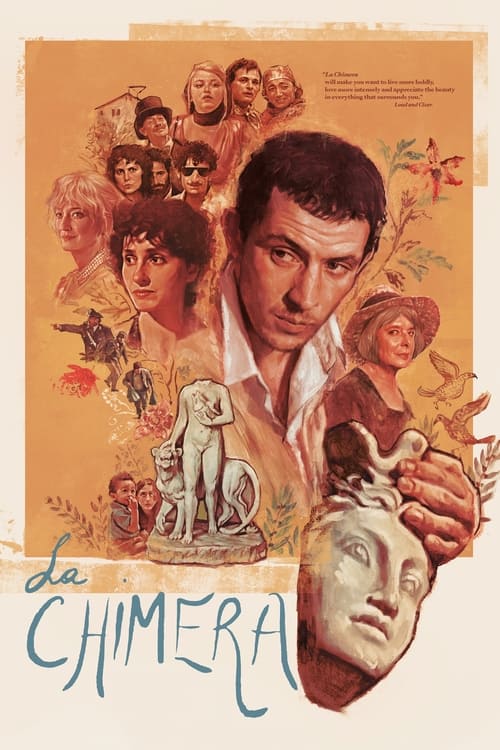
La Chimera
Just out of jail, rumpled English archaeologist Arthur reconnects with his wayward crew of tombaroli accomplices – a happy-go-lucky collective of itinerant grave-robbers who survive by looting Etruscan tombs and fencing the ancient treasures they dig up.
The film earned $4.9M at the global box office.
14 wins & 53 nominations


Plot Structure
Story beats plotted across runtime


Narrative Arc
Emotional journey through the story's key moments
Story Circle
Blueprint 15-beat structure
Arcplot Score Breakdown
Weighted: Precision (70%) + Arc (15%) + Theme (15%)
La Chimera (2023) exemplifies strategically placed narrative design, characteristic of Alice Rohrwacher's storytelling approach. This structural analysis examines how the film's 15-point plot structure maps to proven narrative frameworks across 2 hours and 11 minutes. With an Arcplot score of 6.8, the film balances conventional beats with creative variation.
Characters
Cast & narrative archetypes

Arthur
Italia
Flora
Pirro
Spartaco
Main Cast & Characters
Arthur
Played by Josh O'Brien
A melancholic British archaeologist and tomb raider haunted by his past, gifted with the ability to find Etruscan tombs.
Italia
Played by Carol Duarte
A young woman who works with a group of elderly women, searching for connection and belonging in rural Tuscany.
Flora
Played by Isabella Rossellini
Arthur's former lover's aristocratic mother, living in a decaying villa, who maintains hope for Arthur's return.
Pirro
Played by Vincenzo Nemolato
The leader of the tombaroli gang, pragmatic and business-minded in the illegal antiquities trade.
Spartaco
Played by Alba Rohrwacher
A member of the tomb raiding gang, loyal to the group and their underground operations.
Structural Analysis
The Status Quo at 1 minutes (1% through the runtime) establishes Arthur sleeps restlessly on a train, dreaming of his lost love Beniamina in a sun-drenched field. He awakens alone, disheveled, and clearly haunted—a man suspended between worlds, unable to let go of the past.. The analysis reveals that this early placement immediately immerses viewers in the story world.
The inciting incident occurs at 16 minutes when The tombaroli pressure Arthur to use his gift again—to locate buried Etruscan tombs. Despite his reluctance and the pain it causes him, Arthur feels the pull of the earth and agrees to join them, unable to resist the connection to the underground world where he imagines Beniamina exists.. At 12% through the film, this Disruption aligns precisely with traditional story structure. This beat shifts the emotional landscape, launching the protagonist into the central conflict.
The First Threshold at 33 minutes marks the transition into Act II, occurring at 25% of the runtime. This shows the protagonist's commitment to Arthur uses his divining gift for the first time since prison, lying on the ground and feeling the pull toward buried treasure. He chooses to lead the tombaroli to a tomb, fully committing to the underworld both literally and figuratively—crossing into a realm of theft and obsession., moving from reaction to action.
At 66 minutes, the Midpoint arrives at 50% of the runtime—precisely centered, creating perfect narrative symmetry. Of particular interest, this crucial beat The tombaroli discover an intact Etruscan tomb with a magnificent statue of a reclining couple—a chimera of eternal love. This false victory represents the ultimate find, but Arthur stares at the embracing figures and sees only what he has lost. The statue embodies his impossible dream of reunion with Beniamina., fundamentally raising what's at risk. The emotional intensity shifts, dividing the narrative into clear before-and-after phases.
The Collapse moment at 98 minutes (75% through) represents the emotional nadir. Here, Arthur descends into a tomb alone and has a devastating vision of Beniamina that makes clear she is truly gone—not waiting for him in some underworld, but simply absent. The whiff of death becomes literal as he nearly suffocates in the collapsing earth. He confronts that his chimera—the dream of recovering her—was always impossible., shows the protagonist at their lowest point. This beat's placement in the final quarter sets up the climactic reversal.
The Second Threshold at 105 minutes initiates the final act resolution at 80% of the runtime. Italia's direct challenge breaks through to Arthur. She represents what he needs—not a chimera of the past but genuine human connection in the present. Arthur begins to see that his gift for finding buried things has been a curse keeping him tethered to death rather than life., demonstrating the transformation achieved throughout the journey.
Emotional Journey
La Chimera's emotional architecture traces a deliberate progression across 15 carefully calibrated beats.
Narrative Framework
This structural analysis employs systematic plot point analysis that identifies crucial turning points. By mapping La Chimera against these established plot points, we can identify how Alice Rohrwacher utilizes or subverts traditional narrative conventions. The plot point approach reveals not only adherence to structural principles but also creative choices that distinguish La Chimera within the drama genre.
Comparative Analysis
Additional drama films include After Thomas, South Pacific and Dirty Dancing: Havana Nights.
Plot Points by Act
Act I
SetupStatus Quo
Arthur sleeps restlessly on a train, dreaming of his lost love Beniamina in a sun-drenched field. He awakens alone, disheveled, and clearly haunted—a man suspended between worlds, unable to let go of the past.
Theme
Flora, Beniamina's mother, tells Arthur that some things once lost cannot be recovered—"The dead should stay buried." This encapsulates the film's meditation on whether we can ever reclaim the past or if such pursuit only leads to destruction.
Worldbuilding
Arthur returns to the Tuscan town where he once lived with Beniamina. We meet the tombaroli gang who eagerly await his return, Flora in her decaying villa clinging to aristocratic dignity, and Italia, the young woman who works for Flora. The world of archaeological looting and its moral ambiguity is established.
Disruption
The tombaroli pressure Arthur to use his gift again—to locate buried Etruscan tombs. Despite his reluctance and the pain it causes him, Arthur feels the pull of the earth and agrees to join them, unable to resist the connection to the underground world where he imagines Beniamina exists.
Resistance
Arthur debates returning to grave robbing while staying at Flora's villa. He visits Beniamina's preserved room, speaks with her ghost-like presence in his mind. The tombaroli show him how the operation works with Spartaco the fence. Arthur wrestles with whether to fully re-engage with this underworld.
Act II
ConfrontationFirst Threshold
Arthur uses his divining gift for the first time since prison, lying on the ground and feeling the pull toward buried treasure. He chooses to lead the tombaroli to a tomb, fully committing to the underworld both literally and figuratively—crossing into a realm of theft and obsession.
Mirror World
Italia emerges as a grounding presence for Arthur. Unlike his ghostly obsession with Beniamina, Italia represents life, the present moment, and the possibility of connection with the living. She challenges his retreat into death and memory.
Premise
Arthur and the tombaroli conduct raids on Etruscan tombs in sequences that blend heist energy with melancholy. They unearth vases, jewelry, and artifacts. Arthur descends into tombs painted with ancient frescoes, each descent mirroring his psychological journey toward death and the past. The moral complexity of cultural theft versus survival economics unfolds.
Midpoint
The tombaroli discover an intact Etruscan tomb with a magnificent statue of a reclining couple—a chimera of eternal love. This false victory represents the ultimate find, but Arthur stares at the embracing figures and sees only what he has lost. The statue embodies his impossible dream of reunion with Beniamina.
Opposition
The consequences of tomb raiding intensify. Police investigation closes in. The tombaroli become paranoid and fractious over money. Arthur grows increasingly detached from reality, spending more time in visions of Beniamina. Italia tries to pull him back to the living world, but he resists. The statue's sale to wealthy collectors exposes the corruption connecting grave robbers to high society.
Collapse
Arthur descends into a tomb alone and has a devastating vision of Beniamina that makes clear she is truly gone—not waiting for him in some underworld, but simply absent. The whiff of death becomes literal as he nearly suffocates in the collapsing earth. He confronts that his chimera—the dream of recovering her—was always impossible.
Crisis
Arthur wanders in a fugue state, alienated from the tombaroli, from Flora, from the possibility of life. He sits in Beniamina's room surrounded by her belongings—artifacts of a person who cannot be excavated back into existence. Italia finds him there and confronts him about his choice to live among the dead.
Act III
ResolutionSecond Threshold
Italia's direct challenge breaks through to Arthur. She represents what he needs—not a chimera of the past but genuine human connection in the present. Arthur begins to see that his gift for finding buried things has been a curse keeping him tethered to death rather than life.
Synthesis
Arthur makes a final descent—but this time emerges transformed. He abandons the tombaroli and their world of extraction. In a dreamlike sequence, he and Italia connect across the boundary between his death-obsession and her vitality. Arthur finally releases Beniamina, accepting loss rather than endlessly pursuing its reversal.
Transformation
The final image mirrors the opening: Arthur on a train, but now awake and present rather than lost in dreams. The Tuscan landscape passes by—a world of the living. Whether he has found peace or simply accepted the impossibility of his chimera, he has crossed from the realm of the dead back to the surface.