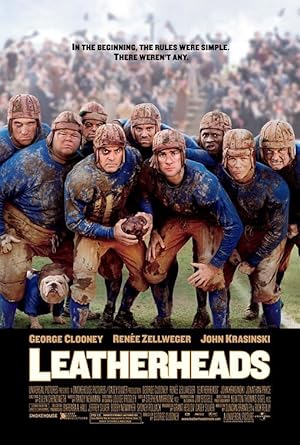
Leatherheads
A romantic comedy set against the backdrop of America's nascent pro-football league in 1925. Dodge Connelly (George Clooney), a charming, brash football hero, is determined to guide his team from bar brawls to packed stadiums. But after the players lose their sponsor and the entire league faces certain collapse, Dodge convinces a college football star to join his ragtag ranks. The Captain hopes his latest move will help the struggling sport finally capture the country's attention. Welcome to the team Carter Rutherford (John Krasinski), America's favorite son. A golden-boy war hero who single-handedly forced multiple German soldiers to surrender in The Great War, Carter has dashing good looks and unparalleled speed on the field. This new champ is almost too good to be true, and Lexie Littleton (Renée Zellweger) aims to prove that's the case. A cub journalist playing in the big leagues, Lexie is a spitfire newswoman who suspects there are holes in Carter's war story. But while she digs, the two teammates start to become serious off-field rivals for her fickle affections. As the new game of pro-football becomes less like the freewheeling sport he knew and loved, Dodge must fight to keep his guys together and to get the girl of his dreams. Finding that love and football have a surprisingly similar playbook, however, he has one maneuver he will save just for the fourth quarter.
The film disappointed at the box office against its mid-range budget of $58.0M, earning $41.3M globally (-29% loss). While initial box office returns were modest, the film has gained appreciation for its compelling narrative within the comedy genre.
1 win & 3 nominations


Plot Structure
Story beats plotted across runtime


Narrative Arc
Emotional journey through the story's key moments
Story Circle
Blueprint 15-beat structure
Arcplot Score Breakdown
Weighted: Precision (70%) + Arc (15%) + Theme (15%)
Leatherheads (2008) showcases strategically placed narrative architecture, characteristic of George Clooney's storytelling approach. This structural analysis examines how the film's 15-point plot structure maps to proven narrative frameworks across 1 hour and 54 minutes. With an Arcplot score of 7.4, the film balances conventional beats with creative variation.
Characters
Cast & narrative archetypes

Jimmy "Dodge" Connelly
Lexie Littleton
Carter "The Bullet" Rutherford
CC Frazier
Suds
Main Cast & Characters
Jimmy "Dodge" Connelly
Played by George Clooney
Aging football player and team captain trying to save professional football and legitimize the sport in 1925 America.
Lexie Littleton
Played by Renée Zellweger
Sharp-witted Chicago newspaper reporter investigating war hero Carter Rutherford while navigating romantic tensions.
Carter "The Bullet" Rutherford
Played by John Krasinski
Princeton football star and decorated war hero recruited to legitimize professional football, harboring a secret about his past.
CC Frazier
Played by Jonathan Pryce
Wealthy businessman and football team owner who wants to professionalize and commercialize the sport.
Suds
Played by Stephen Root
Dodge's loyal best friend and teammate on the Duluth Bulldogs, provides comic relief and unwavering support.
Structural Analysis
The Status Quo at 1 minutes (1% through the runtime) establishes Dodge Connolly leads the Duluth Bulldogs in a chaotic, barnstorming professional football game, showing the rough-and-tumble, unregulated state of 1920s pro football where players use questionable tactics and charm to survive.. Significantly, this early placement immediately immerses viewers in the story world.
The inciting incident occurs at 13 minutes when Dodge reads about Carter Rutherford, the Princeton football hero and war medal recipient. He realizes recruiting this celebrity could save professional football and his team.. At 12% through the film, this Disruption aligns precisely with traditional story structure. This beat shifts the emotional landscape, launching the protagonist into the central conflict.
The First Threshold at 28 minutes marks the transition into Act II, occurring at 25% of the runtime. This indicates the protagonist's commitment to Carter officially joins the Bulldogs and plays his first professional game. Dodge's gamble pays off as the crowd surges and professional football suddenly has legitimacy and public interest., moving from reaction to action.
At 57 minutes, the Midpoint arrives at 50% of the runtime—precisely centered, creating perfect narrative symmetry. Of particular interest, this crucial beat Lexie discovers the truth: Carter didn't earn his war medal heroically. She has the story that will destroy him and potentially professional football. The stakes raise as truth threatens everything Dodge has built., fundamentally raising what's at risk. The emotional intensity shifts, dividing the narrative into clear before-and-after phases.
The Collapse moment at 84 minutes (73% through) represents the emotional nadir. Here, Lexie's newspaper publishes the truth about Carter's false heroism. Carter is humiliated, professional football's legitimacy is destroyed, and Dodge loses both Lexie (who leaves disgusted by everyone's lies) and his dream. Everything collapses., illustrates the protagonist at their lowest point. This beat's placement in the final quarter sets up the climactic reversal.
The Second Threshold at 91 minutes initiates the final act resolution at 80% of the runtime. Carter reveals to Dodge the real truth about his war story - a more complex, human version. Dodge realizes authenticity matters more than the con. He chooses to play the championship game straight, with real rules and honest effort., demonstrating the transformation achieved throughout the journey.
Emotional Journey
Leatherheads's emotional architecture traces a deliberate progression across 15 carefully calibrated beats.
Narrative Framework
This structural analysis employs proven narrative structure principles that track dramatic progression. By mapping Leatherheads against these established plot points, we can identify how George Clooney utilizes or subverts traditional narrative conventions. The plot point approach reveals not only adherence to structural principles but also creative choices that distinguish Leatherheads within the comedy genre.
George Clooney's Structural Approach
Among the 7 George Clooney films analyzed on Arcplot, the average structural score is 6.9, demonstrating varied approaches to story architecture. Leatherheads represents one of the director's most structurally precise works. For comparative analysis, explore the complete George Clooney filmography.
Comparative Analysis
Additional comedy films include The Bad Guys, Ella Enchanted and The Evening Star. For more George Clooney analyses, see The Ides of March, Good Night, and Good Luck. and The Boys in the Boat.
Plot Points by Act
Act I
SetupStatus Quo
Dodge Connolly leads the Duluth Bulldogs in a chaotic, barnstorming professional football game, showing the rough-and-tumble, unregulated state of 1920s pro football where players use questionable tactics and charm to survive.
Theme
Team owner tells Dodge the league is folding because "nobody cares about professional football." The theme emerges: Can something built on charm and improvisation survive when legitimacy and rules are demanded?
Worldbuilding
Establishing the dying state of professional football in 1925. Dodge refuses to let his team fold, recruits war hero Carter "The Bullet" Rutherford to legitimize the sport, while reporter Lexie Littleton is assigned to investigate Carter's war record.
Disruption
Dodge reads about Carter Rutherford, the Princeton football hero and war medal recipient. He realizes recruiting this celebrity could save professional football and his team.
Resistance
Dodge travels to Princeton to recruit Carter. He debates with his friend Curly about the morality of using Carter. Dodge convinces Carter's agent to bring the young star to the pros, promising glory and money. Lexie begins her investigation.
Act II
ConfrontationFirst Threshold
Carter officially joins the Bulldogs and plays his first professional game. Dodge's gamble pays off as the crowd surges and professional football suddenly has legitimacy and public interest.
Mirror World
Dodge and Lexie meet properly and share a charged conversation. She represents everything he's not: educated, sophisticated, rule-following. Their romantic subplot begins, carrying the theme of old ways versus new legitimacy.
Premise
The fun of 1920s pro football with Carter as the star. Dodge and Lexie flirt and spar. Football games montage showing growing success. The love triangle develops as both Dodge and Carter pursue Lexie. Comic set pieces include speakeasy sequences and screwball antics.
Midpoint
Lexie discovers the truth: Carter didn't earn his war medal heroically. She has the story that will destroy him and potentially professional football. The stakes raise as truth threatens everything Dodge has built.
Opposition
Tension escalates as Lexie wrestles with publishing the truth. Dodge and Carter's rivalry intensifies both on the field and for Lexie's affection. The Chicago promoter pushes for a championship game. Rules are proposed for football, threatening Dodge's freewheeling style.
Collapse
Lexie's newspaper publishes the truth about Carter's false heroism. Carter is humiliated, professional football's legitimacy is destroyed, and Dodge loses both Lexie (who leaves disgusted by everyone's lies) and his dream. Everything collapses.
Crisis
Dodge and Carter both process their losses. The championship game looms but feels meaningless. Dodge confronts that his charm and tricks can't sustain what football needs. Dark night before the final game.
Act III
ResolutionSecond Threshold
Carter reveals to Dodge the real truth about his war story - a more complex, human version. Dodge realizes authenticity matters more than the con. He chooses to play the championship game straight, with real rules and honest effort.
Synthesis
The championship game played with new rules and honest competition. Dodge and Carter reconcile and play as true teammates. Dodge wins back Lexie by embracing legitimacy over charm. The game is brutal, authentic, and establishes real professional football.
Transformation
Dodge, battered and genuine, walks off the field with Lexie. Professional football survives not through tricks but through authentic competition and rules. The charming rogue has become a legitimate sportsman.