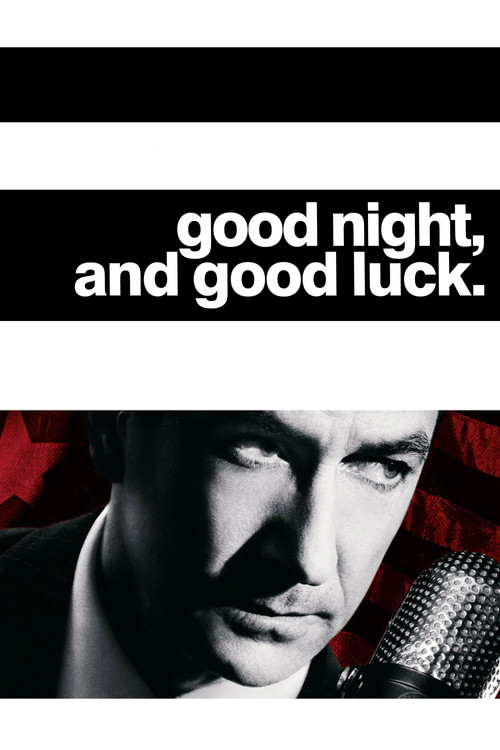
Good Night, and Good Luck.
The story of journalist Edward R. Murrow's stand against Senator Joseph McCarthy's anti-communist witch-hunts in the early 1950s.
Despite its limited budget of $7.0M, Good Night, and Good Luck. became a commercial juggernaut, earning $54.6M worldwide—a remarkable 680% return. The film's distinctive approach found its audience, illustrating how strong storytelling can transcend budget limitations.
Nominated for 6 Oscars. 38 wins & 129 nominations


Plot Structure
Story beats plotted across runtime


Narrative Arc
Emotional journey through the story's key moments
Story Circle
Blueprint 15-beat structure
Arcplot Score Breakdown
Weighted: Precision (70%) + Arc (15%) + Theme (15%)
Good Night, and Good Luck. (2005) exhibits deliberately positioned story structure, characteristic of George Clooney's storytelling approach. This structural analysis examines how the film's 15-point plot structure maps to proven narrative frameworks across 1 hour and 32 minutes. With an Arcplot score of 7.1, the film balances conventional beats with creative variation.
Characters
Cast & narrative archetypes

Edward R. Murrow
Fred Friendly
William Paley
Don Hollenbeck
Joseph McCarthy
Shirley Wershba
Joe Wershba
Main Cast & Characters
Edward R. Murrow
Played by David Strathairn
CBS News journalist who challenges Senator McCarthy's anti-communist witch hunts through his See It Now broadcasts.
Fred Friendly
Played by George Clooney
Producer and close collaborator of Murrow who supports the risky McCarthy broadcasts despite network pressure.
William Paley
Played by Frank Langella
CBS chairman who balances corporate interests with journalistic integrity, ultimately allowing but constraining Murrow's work.
Don Hollenbeck
Played by Ray Wise
CBS journalist struggling with attacks from conservative press, representing the personal cost of principled reporting.
Joseph McCarthy
Played by Joseph McCarthy
U.S. Senator conducting anti-communist investigations, shown only through archival footage as the antagonist.
Shirley Wershba
Played by Patricia Clarkson
CBS associate producer in a secret marriage with colleague Joe Wershba due to network anti-nepotism policies.
Joe Wershba
Played by Robert Downey Jr.
CBS reporter and producer secretly married to Shirley, part of Murrow's investigative team.
Structural Analysis
The Status Quo at 1 minutes (1% through the runtime) establishes Flash-forward to 1958: Edward R. Murrow receives an award at an RTNDA banquet. He appears weary yet distinguished, foreshadowing the toll his crusade will take. The somber tone of his speech hints at battles fought and costs paid.. Structural examination shows that this early placement immediately immerses viewers in the story world.
The inciting incident occurs at 11 minutes when The team learns about the case of Milo Radulovich, an Air Force officer discharged because his father and sister allegedly read "subversive" newspapers. This injustice catalyzes Murrow's decision to challenge McCarthy's methods through investigative journalism.. At 12% through the film, this Disruption aligns precisely with traditional story structure. This beat shifts the emotional landscape, launching the protagonist into the central conflict.
The First Threshold at 23 minutes marks the transition into Act II, occurring at 25% of the runtime. This indicates the protagonist's commitment to Murrow and Friendly decide to self-fund the advertisement for the Radulovich episode after sponsors pull out. This active choice to risk their own money represents their irreversible commitment to journalistic integrity over corporate safety., moving from reaction to action.
At 46 minutes, the Midpoint arrives at 50% of the runtime—precisely centered, creating perfect narrative symmetry. Significantly, this crucial beat The McCarthy broadcast airs. Murrow lets McCarthy's own footage indict him, famously concluding: "The fault, dear Brutus, is not in our stars but in ourselves." This is a false victory—the exposé lands powerfully, but retaliation is inevitable., fundamentally raising what's at risk. The emotional intensity shifts, dividing the narrative into clear before-and-after phases.
The Collapse moment at 69 minutes (75% through) represents the emotional nadir. Here, Don Hollenbeck commits suicide, broken by the relentless attacks labeling him a Communist. His death embodies the "whiff of death"—the human cost of the climate of fear. Murrow is shattered; a colleague has died in the crossfire of the battle he initiated., indicates the protagonist at their lowest point. This beat's placement in the final quarter sets up the climactic reversal.
The Second Threshold at 74 minutes initiates the final act resolution at 80% of the runtime. News breaks that the Senate has voted to censure Joseph McCarthy. The external validation arrives—McCarthy's power is broken not by Murrow alone but by the collective weight of democratic institutions finally responding. The tide has turned., demonstrating the transformation achieved throughout the journey.
Emotional Journey
Good Night, and Good Luck.'s emotional architecture traces a deliberate progression across 15 carefully calibrated beats.
Narrative Framework
This structural analysis employs proven narrative structure principles that track dramatic progression. By mapping Good Night, and Good Luck. against these established plot points, we can identify how George Clooney utilizes or subverts traditional narrative conventions. The plot point approach reveals not only adherence to structural principles but also creative choices that distinguish Good Night, and Good Luck. within the drama genre.
George Clooney's Structural Approach
Among the 7 George Clooney films analyzed on Arcplot, the average structural score is 6.9, demonstrating varied approaches to story architecture. Good Night, and Good Luck. represents one of the director's most structurally precise works. For comparative analysis, explore the complete George Clooney filmography.
Comparative Analysis
Additional drama films include After Thomas, South Pacific and Dirty Dancing: Havana Nights. For more George Clooney analyses, see The Ides of March, Leatherheads and The Boys in the Boat.
Plot Points by Act
Act I
SetupStatus Quo
Flash-forward to 1958: Edward R. Murrow receives an award at an RTNDA banquet. He appears weary yet distinguished, foreshadowing the toll his crusade will take. The somber tone of his speech hints at battles fought and costs paid.
Theme
In the 1958 speech, Murrow declares: "This instrument can teach, it can illuminate; yes, and even it can inspire. But it can do so only to the extent that humans are determined to use it to those ends." The theme of journalism's moral responsibility is stated directly.
Worldbuilding
The CBS newsroom in 1953 is established: the smoke-filled control rooms, the jazz interludes, the atmosphere of professional tension. We meet the See It Now team—Fred Friendly, Joe and Shirley Wershba, Don Hollenbeck. The culture of fear under McCarthyism pervades everything; CBS employees must sign loyalty oaths.
Disruption
The team learns about the case of Milo Radulovich, an Air Force officer discharged because his father and sister allegedly read "subversive" newspapers. This injustice catalyzes Murrow's decision to challenge McCarthy's methods through investigative journalism.
Resistance
Murrow and Friendly debate the risks of covering Radulovich. CBS brass warns of sponsor pressure and political retaliation. Paley expresses concern but doesn't forbid the story. The team grapples with the personal and professional dangers of speaking out against McCarthy's witch hunt.
Act II
ConfrontationFirst Threshold
Murrow and Friendly decide to self-fund the advertisement for the Radulovich episode after sponsors pull out. This active choice to risk their own money represents their irreversible commitment to journalistic integrity over corporate safety.
Mirror World
Joe and Shirley Wershba's secret marriage is highlighted—CBS policy forbids married couples from working together. Their hidden relationship mirrors the broader theme: the personal costs of living authentically under institutional fear and surveillance.
Premise
The "See It Now" broadcast on Radulovich airs and succeeds. Murrow's team gains confidence, and they begin preparing a direct expose on McCarthy himself. They methodically compile footage of McCarthy contradicting himself, building their case through his own words and actions.
Midpoint
The McCarthy broadcast airs. Murrow lets McCarthy's own footage indict him, famously concluding: "The fault, dear Brutus, is not in our stars but in ourselves." This is a false victory—the exposé lands powerfully, but retaliation is inevitable.
Opposition
McCarthy responds with a filmed rebuttal, personally attacking Murrow as a Communist sympathizer. Sponsors flee. CBS executives grow nervous. Don Hollenbeck faces savage attacks from rival columnist Jack O'Brian. The institutional pressure against Murrow's team intensifies from all directions.
Collapse
Don Hollenbeck commits suicide, broken by the relentless attacks labeling him a Communist. His death embodies the "whiff of death"—the human cost of the climate of fear. Murrow is shattered; a colleague has died in the crossfire of the battle he initiated.
Crisis
Murrow processes Hollenbeck's death in stunned grief. The newsroom falls silent. Questions arise: Was it worth it? Can journalism survive in this climate? The personal toll of their crusade weighs heavily on the entire team.
Act III
ResolutionSecond Threshold
News breaks that the Senate has voted to censure Joseph McCarthy. The external validation arrives—McCarthy's power is broken not by Murrow alone but by the collective weight of democratic institutions finally responding. The tide has turned.
Synthesis
Despite the victory over McCarthy, CBS moves "See It Now" to a less prominent time slot. Paley informs Murrow the show will be reduced. The Wershbas must leave CBS due to their marriage. Murrow wins the battle but loses the war—television chooses entertainment over journalism.
Transformation
We return to the 1958 banquet. Murrow's speech concludes with a warning that television will fail democracy if used only for "distraction, deception, and insulation." The final image mirrors the opening but now carries the weight of all we've witnessed—a pyrrhic victory for journalism.