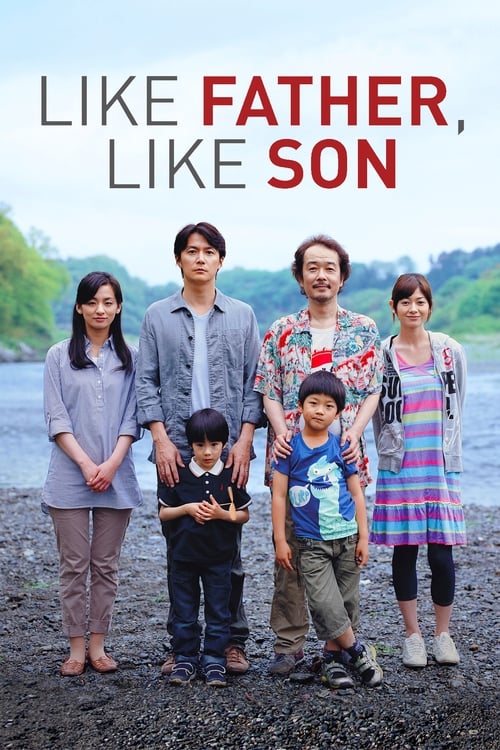
Like Father, Like Son
Ryota Nonomiya is a successful businessman driven by money. He learns that his biological son was switched with another child after birth. He must make a life-changing decision and choose his true son or the boy he raised as his own.
The film earned $20.0M at the global box office.
23 wins & 47 nominations


Plot Structure
Story beats plotted across runtime


Narrative Arc
Emotional journey through the story's key moments
Story Circle
Blueprint 15-beat structure
Arcplot Score Breakdown
Weighted: Precision (70%) + Arc (15%) + Theme (15%)
Like Father, Like Son (2013) exemplifies carefully calibrated story structure, characteristic of Hirokazu Kore-eda's storytelling approach. This structural analysis examines how the film's 15-point plot structure maps to proven narrative frameworks across 2 hours. With an Arcplot score of 7.4, the film balances conventional beats with creative variation.
Characters
Cast & narrative archetypes

Ryota Nonomiya
Midori Nonomiya
Yudai Saiki
Yukari Saiki
Keita Nonomiya
Ryusei Saiki
Ryota's Father
Main Cast & Characters
Ryota Nonomiya
Played by Masaharu Fukuyama
A driven, perfectionist architect who discovers his son was switched at birth and must choose between bloodline and bonds.
Midori Nonomiya
Played by Machiko Ono
Ryota's gentle, nurturing wife who prioritizes emotional connection and opposes the switch.
Yudai Saiki
Played by Lily Franky
A working-class electrician and father of Ryota's biological son, warm and hands-on with his children.
Yukari Saiki
Played by Yoko Maki
Yudai's caring wife and mother who embraces the chaos of raising multiple children.
Keita Nonomiya
Played by Keita Ninomiya
The 6-year-old boy raised by the Nomomiyas, sensitive and attached to his parents.
Ryusei Saiki
Played by Shogen Hwang
The 6-year-old biological son of the Nomomiyas, raised by the Saikis in a lively household.
Ryota's Father
Played by Isao Natsuyagi
Ryota's elderly father who shares wisdom about what truly makes a father.
Structural Analysis
The Status Quo at 1 minutes (1% through the runtime) establishes Ryota Nonomiya conducts a rehearsed interview with his 6-year-old son Keita for an elite private school admission, demonstrating his structured, achievement-focused parenting approach and seemingly perfect upper-middle-class family life.. The analysis reveals that this early placement immediately immerses viewers in the story world.
The inciting incident occurs at 14 minutes when The hospital director informs Ryota and Midori that their son Keita was switched at birth with another baby six years ago due to a nurse's actions, shattering their understanding of their family and identity.. At 12% through the film, this Disruption aligns precisely with traditional story structure. This beat shifts the emotional landscape, launching the protagonist into the central conflict.
The First Threshold at 30 minutes marks the transition into Act II, occurring at 25% of the runtime. This demonstrates the protagonist's commitment to Both families agree to gradually exchange their sons, beginning with weekend visits. Ryota chooses to pursue his biological son Ryusei despite having raised Keita, believing blood connection will naturally create the proper bond., moving from reaction to action.
At 61 minutes, the Midpoint arrives at 50% of the runtime—precisely centered, creating perfect narrative symmetry. Of particular interest, this crucial beat The families agree to complete the exchange permanently, each taking their biological child full-time. What appears to be the "logical solution" is actually a false victory that will lead to emotional devastation., fundamentally raising what's at risk. The emotional intensity shifts, dividing the narrative into clear before-and-after phases.
The Collapse moment at 89 minutes (74% through) represents the emotional nadir. Here, Keita runs away from the Saiki home back to the Nonomiyas. When Ryota coldly tells him to return to his "real" family, Keita breaks down asking, "Why don't you like me anymore?" The death of their father-son relationship becomes devastatingly real., illustrates the protagonist at their lowest point. This beat's placement in the final quarter sets up the climactic reversal.
The Second Threshold at 98 minutes initiates the final act resolution at 82% of the runtime. Ryota discovers photographs Keita took of him throughout his childhood—silent documentation of a son seeking his father's attention. He finally understands that fatherhood is built through time, presence, and love, not biology., demonstrating the transformation achieved throughout the journey.
Emotional Journey
Like Father, Like Son's emotional architecture traces a deliberate progression across 15 carefully calibrated beats.
Narrative Framework
This structural analysis employs a 15-point narrative structure framework that maps key story moments. By mapping Like Father, Like Son against these established plot points, we can identify how Hirokazu Kore-eda utilizes or subverts traditional narrative conventions. The plot point approach reveals not only adherence to structural principles but also creative choices that distinguish Like Father, Like Son within the drama genre.
Hirokazu Kore-eda's Structural Approach
Among the 4 Hirokazu Kore-eda films analyzed on Arcplot, the average structural score is 7.4, reflecting strong command of classical structure. Like Father, Like Son takes a more unconventional approach compared to the director's typical style. For comparative analysis, explore the complete Hirokazu Kore-eda filmography.
Comparative Analysis
Additional drama films include After Thomas, South Pacific and Dirty Dancing: Havana Nights. For more Hirokazu Kore-eda analyses, see Nobody Knows, The Truth and Still Walking.
Plot Points by Act
Act I
SetupStatus Quo
Ryota Nonomiya conducts a rehearsed interview with his 6-year-old son Keita for an elite private school admission, demonstrating his structured, achievement-focused parenting approach and seemingly perfect upper-middle-class family life.
Theme
Ryota's father tells him at a family gathering, "You can't buy the time you've spent with someone," hinting at the film's central question about what makes a parent-child relationship: biology or shared experience.
Worldbuilding
Establishment of the Nonomiya family's privileged Tokyo life: Ryota's successful architecture career, his focus on Keita's academic achievement, wife Midori's gentler approach, and the competitive private school entrance process that dominates their world.
Disruption
The hospital director informs Ryota and Midori that their son Keita was switched at birth with another baby six years ago due to a nurse's actions, shattering their understanding of their family and identity.
Resistance
The Nonomiyas grapple with the revelation, meet the other family (the working-class Saikis), and debate what to do. Ryota initially resists emotional engagement, focusing on legal and practical considerations while observing vast class differences between families.
Act II
ConfrontationFirst Threshold
Both families agree to gradually exchange their sons, beginning with weekend visits. Ryota chooses to pursue his biological son Ryusei despite having raised Keita, believing blood connection will naturally create the proper bond.
Mirror World
Yudai Saiki, the biological father, represents the thematic opposite of Ryota—he's poor, relaxed, playful with children, and values time spent together over achievement, embodying the film's question about what makes good parenting.
Premise
The "premise" of two families attempting to exchange sons plays out: awkward visits, children struggling to adapt, growing bonds with biological children, and the painful reality that love cannot be simply transferred or manufactured through blood relation.
Midpoint
The families agree to complete the exchange permanently, each taking their biological child full-time. What appears to be the "logical solution" is actually a false victory that will lead to emotional devastation.
Opposition
Life with their biological sons proves difficult: Ryusei doesn't respond to Ryota's rigid parenting style, Keita struggles with the Saikis, Midori grieves deeply, and Ryota's emotional walls begin cracking as he realizes his approach is failing.
Collapse
Keita runs away from the Saiki home back to the Nonomiyas. When Ryota coldly tells him to return to his "real" family, Keita breaks down asking, "Why don't you like me anymore?" The death of their father-son relationship becomes devastatingly real.
Crisis
Ryota confronts his own childhood: his father reveals he too isn't Ryota's biological father, yet raised him as his own. Ryota realizes his entire identity crisis is based on valuing blood over love, and he has repeated his distant father's emotional failings.
Act III
ResolutionSecond Threshold
Ryota discovers photographs Keita took of him throughout his childhood—silent documentation of a son seeking his father's attention. He finally understands that fatherhood is built through time, presence, and love, not biology.
Synthesis
Ryota drives through the night to the Saiki home to reclaim Keita. He apologizes, acknowledges Keita as his son regardless of biology, and both families implicitly understand the children belong with those who raised them, beginning a new shared custody arrangement.
Transformation
Ryota plays with Keita and Ryusei together outdoors, laughing and present in the moment—mirroring the opening scene's rigidity but now showing a father who has learned to value connection over achievement, time over perfection.