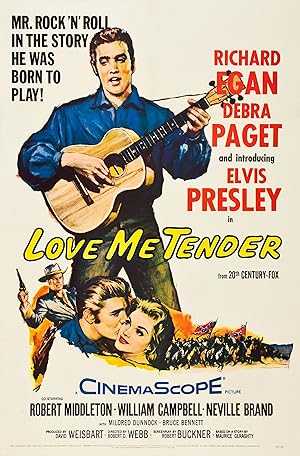
Love Me Tender
Elvis plays Clint Reno, one of the Reno brothers who stayed home while his brother went to fight in the Civil War for the Confederate army. When his brother Vance comes back from the war, he finds that his old girlfriend Cathy has married Clint. The family has to struggle to reach stability with this issue. Vance is involved in a train robbery, while a Confederate soldier, of Federal Government money. There is a conflict of interest, when Vance tries to return the money, against the wishes of some of his fellow Confederates.
Despite its modest budget of $1.0M, Love Me Tender became a box office phenomenon, earning $9.0M worldwide—a remarkable 800% return. The film's fresh perspective found its audience, demonstrating that strong storytelling can transcend budget limitations.


Plot Structure
Story beats plotted across runtime


Narrative Arc
Emotional journey through the story's key moments
Story Circle
Blueprint 15-beat structure
Arcplot Score Breakdown
Weighted: Precision (70%) + Arc (15%) + Theme (15%)
Love Me Tender (1956) exhibits strategically placed narrative design, characteristic of Robert D. Webb's storytelling approach. This structural analysis examines how the film's 15-point plot structure maps to proven narrative frameworks across 1 hour and 29 minutes. With an Arcplot score of 7.1, the film balances conventional beats with creative variation.
Characters
Cast & narrative archetypes

Clint Reno
Cathy Reno
Vance Reno
Brett Reno
Ray Reno
Martha Reno
Mike Gavin
Main Cast & Characters
Clint Reno
Played by Richard Egan
The eldest Reno brother who returns from the Civil War to find his younger brother married to his former sweetheart. Struggles with betrayal and moral choices.
Cathy Reno
Played by Debra Paget
The woman caught between two brothers - married to Vance but formerly in love with Clint. Torn between duty and past feelings.
Vance Reno
Played by Elvis Presley
The youngest Reno brother who married Cathy believing Clint was dead. Deeply insecure about his wife's feelings and his brother's return.
Brett Reno
Played by William Campbell
Middle Reno brother who mediates family conflicts. Loyal to both brothers but increasingly troubled by their choices.
Ray Reno
Played by James Drury
The second eldest Reno brother who sides with Clint. Tough and pragmatic, willing to use violence.
Martha Reno
Played by Mildred Dunnock
The Reno family matriarch who tries to hold her sons together. Wise and loving but heartbroken by family divisions.
Mike Gavin
Played by Bruce Bennett
Leader of the Confederate veterans pursuing Clint and his brothers for their robbery. Represents justice and the law.
Structural Analysis
The Status Quo at 1 minutes (1% through the runtime) establishes Clint Reno and his Confederate raider brothers rob a Union train carrying a payroll near the end of the Civil War. The family farm is shown as a peaceful place where younger brother Vance tends the land with his mother.. Structural examination shows that this early placement immediately immerses viewers in the story world.
The inciting incident occurs at 10 minutes when Clint and the other Reno brothers return home alive from the war, disrupting Vance and Cathy's marriage. Clint discovers that his former fiancée Cathy has married his younger brother Vance.. At 12% through the film, this Disruption aligns precisely with traditional story structure. This beat shifts the emotional landscape, launching the protagonist into the central conflict.
The First Threshold at 22 minutes marks the transition into Act II, occurring at 24% of the runtime. This illustrates the protagonist's commitment to Federal agents arrive looking for the stolen payroll money. Clint decides to keep the money hidden rather than return it, choosing to protect his brothers and commit to a morally compromised path., moving from reaction to action.
At 45 minutes, the Midpoint arrives at 50% of the runtime—precisely centered, creating perfect narrative symmetry. Structural examination shows that this crucial beat Vance confronts Cathy about her past with Clint, and the truth about their prior engagement is fully revealed. False defeat as the family unity fractures and Vance's jealousy consumes him., fundamentally raising what's at risk. The emotional intensity shifts, dividing the narrative into clear before-and-after phases.
The Collapse moment at 65 minutes (73% through) represents the emotional nadir. Here, Vance betrays his brothers to the federals, revealing the location of the stolen money. His jealousy has destroyed the family bond. The whiff of death as brotherhood dies and violence becomes inevitable., indicates the protagonist at their lowest point. This beat's placement in the final quarter sets up the climactic reversal.
The Second Threshold at 70 minutes initiates the final act resolution at 79% of the runtime. Vance realizes he must make amends and chooses to help his brothers escape, even at great personal cost. He understands that true love means sacrifice, not possession., demonstrating the transformation achieved throughout the journey.
Emotional Journey
Love Me Tender's emotional architecture traces a deliberate progression across 15 carefully calibrated beats.
Narrative Framework
This structural analysis employs proven narrative structure principles that track dramatic progression. By mapping Love Me Tender against these established plot points, we can identify how Robert D. Webb utilizes or subverts traditional narrative conventions. The plot point approach reveals not only adherence to structural principles but also creative choices that distinguish Love Me Tender within the drama genre.
Comparative Analysis
Additional drama films include After Thomas, South Pacific and Dirty Dancing: Havana Nights.
Plot Points by Act
Act I
SetupStatus Quo
Clint Reno and his Confederate raider brothers rob a Union train carrying a payroll near the end of the Civil War. The family farm is shown as a peaceful place where younger brother Vance tends the land with his mother.
Theme
Vance and his mother discuss loyalty and family bonds. Ma Reno says something about family sticking together no matter what, establishing the central conflict between brotherhood and romantic love.
Worldbuilding
Post-Civil War Texas setting is established. Vance has married Cathy, who was engaged to his older brother Clint before the war. The family believes Clint and the other brothers died in the war. Vance and Cathy's happy life on the farm is shown.
Disruption
Clint and the other Reno brothers return home alive from the war, disrupting Vance and Cathy's marriage. Clint discovers that his former fiancée Cathy has married his younger brother Vance.
Resistance
Clint struggles with the revelation but decides to step aside for his brother's happiness. Cathy is torn but committed to Vance. The brothers debate what to do with the stolen Union money. Tension builds as Vance senses something between Clint and Cathy.
Act II
ConfrontationFirst Threshold
Federal agents arrive looking for the stolen payroll money. Clint decides to keep the money hidden rather than return it, choosing to protect his brothers and commit to a morally compromised path.
Mirror World
The relationship between Clint and Cathy becomes the emotional center. Their interactions reveal what Vance needs to learn about selflessness versus possessiveness, love versus ownership.
Premise
The brothers try to sell the stolen money and build new lives. Vance becomes increasingly jealous and suspicious of Clint and Cathy. The premise explores the triangle and family loyalty being tested.
Midpoint
Vance confronts Cathy about her past with Clint, and the truth about their prior engagement is fully revealed. False defeat as the family unity fractures and Vance's jealousy consumes him.
Opposition
Federal pressure intensifies. Vance's jealousy drives him to increasingly destructive behavior. He turns against Clint and considers betraying his brothers. The family fractures under the weight of secrets and resentment.
Collapse
Vance betrays his brothers to the federals, revealing the location of the stolen money. His jealousy has destroyed the family bond. The whiff of death as brotherhood dies and violence becomes inevitable.
Crisis
Vance realizes the magnitude of his betrayal. The brothers are cornered. He must confront what his jealousy and selfishness have cost him and his family. Dark reflection before the final confrontation.
Act III
ResolutionSecond Threshold
Vance realizes he must make amends and chooses to help his brothers escape, even at great personal cost. He understands that true love means sacrifice, not possession.
Synthesis
A violent confrontation ensues. Vance tries to protect Clint and redeem himself. In the climactic shootout, Vance is mortally wounded while saving Clint. The brothers reconcile as Vance dies, having learned that love requires sacrifice.
Transformation
Vance dies in Cathy's arms, having redeemed himself through sacrifice. Clint and Cathy are left to mourn. The family is broken but honor is restored. Vance transforms from jealous boy to selfless man through death.