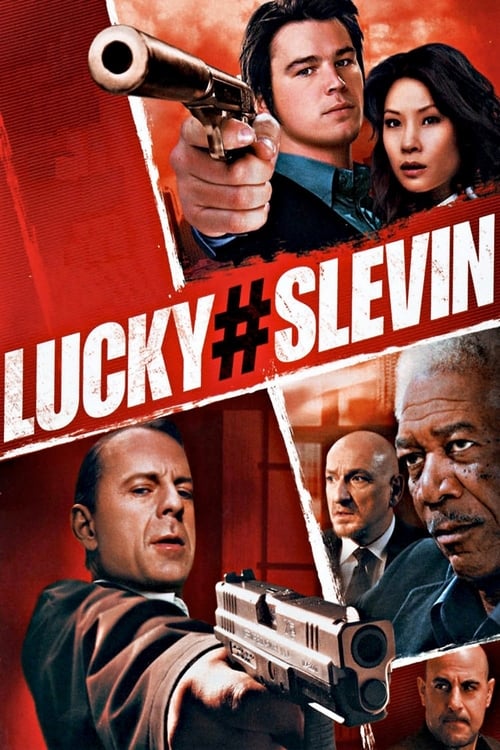
Lucky Number Slevin
Slevin is mistakenly put in the middle of a personal war between the city’s biggest criminal bosses. Under constant watch, Slevin must try not to get killed by an infamous assassin and come up with an idea of how to get out of his current dilemma.
Despite a moderate budget of $27.0M, Lucky Number Slevin became a box office success, earning $56.3M worldwide—a 109% return.


Plot Structure
Story beats plotted across runtime


Narrative Arc
Emotional journey through the story's key moments
Story Circle
Blueprint 15-beat structure
Arcplot Score Breakdown
Weighted: Precision (70%) + Arc (15%) + Theme (15%)
Lucky Number Slevin (2006) exemplifies carefully calibrated plot construction, characteristic of Paul McGuigan's storytelling approach. This structural analysis examines how the film's 15-point plot structure maps to proven narrative frameworks across 1 hour and 50 minutes. With an Arcplot score of 7.8, the film showcases strong structural fundamentals.
Characters
Cast & narrative archetypes

Slevin Kelevra
Lindsey
Mr. Goodkat
The Boss
The Rabbi
Detective Brikowski
Main Cast & Characters
Slevin Kelevra
Played by Josh Hartnett
A man caught in the middle of a war between two crime bosses after a case of mistaken identity
Lindsey
Played by Lucy Liu
A coroner and Slevin's neighbor who becomes romantically involved with him while helping unravel the mystery
Mr. Goodkat
Played by Bruce Willis
A professional assassin and orchestrator of an elaborate revenge scheme spanning decades
The Boss
Played by Morgan Freeman
A powerful New York crime lord who demands Slevin kill his rival's son to settle a debt
The Rabbi
Played by Ben Kingsley
A rival crime lord who forces Slevin to repay money owed by his missing friend
Detective Brikowski
Played by Stanley Tucci
A cynical cop investigating the escalating violence between the two crime families
Structural Analysis
The Status Quo at 1 minutes (1% through the runtime) establishes Mr. Goodkat sits in a wheelchair at an airport terminal, beginning to tell a stranger the story of a fixed horse race and the Kansas City Shuffle - establishing the film's noir world of deception and revenge.. The analysis reveals that this early placement immediately immerses viewers in the story world.
The inciting incident occurs at 14 minutes when Slevin is violently abducted from Nick's apartment by thugs who mistake him for Nick. He's dragged before The Boss, who demands $96,000 that Nick owes - or Slevin must kill The Rabbi's son as payment.. At 13% through the film, this Disruption is delayed, allowing extended setup of the story world. This beat shifts the emotional landscape, launching the protagonist into the central conflict.
The First Threshold at 28 minutes marks the transition into Act II, occurring at 25% of the runtime. This illustrates the protagonist's commitment to Slevin agrees to The Boss's terms - he will assassinate The Rabbi's son, Yitzchok, to clear Nick's debt. This irreversible choice plunges him deeper into the criminal underworld with no way back to normalcy., moving from reaction to action.
At 55 minutes, the Midpoint arrives at 50% of the runtime—precisely centered, creating perfect narrative symmetry. Of particular interest, this crucial beat Slevin executes the hit on Yitzchok, suffocating him with a plastic bag. This false defeat reveals Slevin is not the innocent victim he appears to be - he's capable of cold-blooded murder. The game fundamentally changes as the audience realizes they've been misdirected., fundamentally raising what's at risk. The emotional intensity shifts, dividing the narrative into clear before-and-after phases.
The Collapse moment at 81 minutes (74% through) represents the emotional nadir. Here, Lindsey is captured and apparently killed by Goodkat after discovering too much about Nick's fate. Slevin finds her body and the polaroid suggesting her death. His one genuine connection in the present appears destroyed, and his cover seems blown., illustrates the protagonist at their lowest point. This beat's placement in the final quarter sets up the climactic reversal.
The Second Threshold at 89 minutes initiates the final act resolution at 81% of the runtime. The truth is revealed: Slevin is actually the son of the murdered Henry family. He has been working with Goodkat for twenty years to execute an elaborate revenge on The Boss and The Rabbi, who ordered his family's massacre. Everything has been part of his plan., demonstrating the transformation achieved throughout the journey.
Emotional Journey
Lucky Number Slevin's emotional architecture traces a deliberate progression across 15 carefully calibrated beats.
Narrative Framework
This structural analysis employs a 15-point narrative structure framework that maps key story moments. By mapping Lucky Number Slevin against these established plot points, we can identify how Paul McGuigan utilizes or subverts traditional narrative conventions. The plot point approach reveals not only adherence to structural principles but also creative choices that distinguish Lucky Number Slevin within the drama genre.
Paul McGuigan's Structural Approach
Among the 3 Paul McGuigan films analyzed on Arcplot, the average structural score is 7.0, reflecting strong command of classical structure. Lucky Number Slevin represents one of the director's most structurally precise works. For comparative analysis, explore the complete Paul McGuigan filmography.
Comparative Analysis
Additional drama films include After Thomas, South Pacific and Dirty Dancing: Havana Nights. For more Paul McGuigan analyses, see Wicker Park, Push.
Plot Points by Act
Act I
SetupStatus Quo
Mr. Goodkat sits in a wheelchair at an airport terminal, beginning to tell a stranger the story of a fixed horse race and the Kansas City Shuffle - establishing the film's noir world of deception and revenge.
Theme
Goodkat explains the Kansas City Shuffle: "They look right, and you go left." This encapsulates the film's core theme - everything in life is about misdirection, and the truth is hidden behind elaborate facades.
Worldbuilding
The film establishes its dual timeline: the 1979 massacre of the Henry family after a fixed horse race, and present-day Slevin arriving at his friend Nick's apartment in New York, caught between two warring crime bosses - The Boss and The Rabbi - who live in twin penthouses across from each other.
Disruption
Slevin is violently abducted from Nick's apartment by thugs who mistake him for Nick. He's dragged before The Boss, who demands $96,000 that Nick owes - or Slevin must kill The Rabbi's son as payment.
Resistance
Slevin navigates between the two crime lords. He's also taken to The Rabbi who claims Nick owes him $33,000. Detective Brikowski investigates, and Slevin meets Lindsey, Nick's neighbor, who becomes intrigued by his predicament and offers to help him.
Act II
ConfrontationFirst Threshold
Slevin agrees to The Boss's terms - he will assassinate The Rabbi's son, Yitzchok, to clear Nick's debt. This irreversible choice plunges him deeper into the criminal underworld with no way back to normalcy.
Mirror World
Lindsey and Slevin's relationship deepens as she becomes his unofficial partner in investigating the mystery. Their playful, romantic dynamic serves as the thematic counterpoint to the violence surrounding them - genuine human connection amid deception.
Premise
Slevin plays both crime bosses while apparently bumbling through the situation. He attends a gay nightclub to locate Yitzchok, builds his relationship with Lindsey, and navigates increasingly dangerous encounters with Mr. Goodkat, the legendary assassin working for both sides.
Midpoint
Slevin executes the hit on Yitzchok, suffocating him with a plastic bag. This false defeat reveals Slevin is not the innocent victim he appears to be - he's capable of cold-blooded murder. The game fundamentally changes as the audience realizes they've been misdirected.
Opposition
The walls close in. Detective Brikowski intensifies his investigation, connecting dots between the murders. The Rabbi mourns his son and seeks vengeance. Lindsey discovers disturbing evidence about Nick's disappearance. Mr. Goodkat's true allegiances become increasingly unclear.
Collapse
Lindsey is captured and apparently killed by Goodkat after discovering too much about Nick's fate. Slevin finds her body and the polaroid suggesting her death. His one genuine connection in the present appears destroyed, and his cover seems blown.
Crisis
The dark night intensifies as the full conspiracy seems to unravel. Brikowski closes in on the truth. Slevin must process Lindsey's apparent death while maintaining his elaborate charade. The Kansas City Shuffle appears to be failing.
Act III
ResolutionSecond Threshold
The truth is revealed: Slevin is actually the son of the murdered Henry family. He has been working with Goodkat for twenty years to execute an elaborate revenge on The Boss and The Rabbi, who ordered his family's massacre. Everything has been part of his plan.
Synthesis
The Kansas City Shuffle reaches its climax. Slevin and Goodkat have lured both crime lords to the same location. Brikowski is revealed as the corrupt cop who killed Slevin's father. One by one, Slevin executes his vengeance - killing The Boss, The Rabbi, and finally Brikowski - completing his twenty-year mission.
Transformation
Slevin reunites with Lindsey, who was never killed - her death was staged as part of the plan. Having achieved his revenge and freed himself from the past, Slevin walks away with genuine love, transformed from a victim into someone who has reclaimed his identity and found peace.