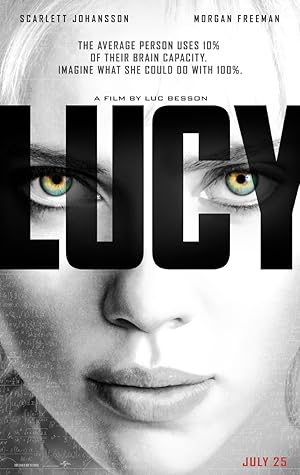
Lucy
It was supposed to be a simple job. All Lucy had to do was deliver a mysterious briefcase to Mr. Jang. But immediately Lucy is caught up in a nightmarish deal where she is captured and turned into a drug mule for a new and powerful synthetic drug. When the bag she is carrying inside of her stomach leaks, Lucy's body undergoes unimaginable changes that begins to unlock her mind's full potential. With her new-found powers, Lucy turns into a merciless warrior intent on getting back at her captors. She receives invaluable help from Professor Norman, the leading authority on the human mind, and French police captain Pierre Del Rio.
Despite a mid-range budget of $40.0M, Lucy became a commercial juggernaut, earning $469.1M worldwide—a remarkable 1073% return.
1 win & 12 nominations


Plot Structure
Story beats plotted across runtime


Narrative Arc
Emotional journey through the story's key moments
Story Circle
Blueprint 15-beat structure
Arcplot Score Breakdown
Weighted: Precision (70%) + Arc (15%) + Theme (15%)
Lucy (2014) reveals meticulously timed dramatic framework, characteristic of Luc Besson's storytelling approach. This structural analysis examines how the film's 15-point plot structure maps to proven narrative frameworks across 1 hour and 29 minutes. With an Arcplot score of 7.3, the film balances conventional beats with creative variation.
Characters
Cast & narrative archetypes

Lucy Miller
Professor Samuel Norman
Mr. Jang
Pierre Del Rio
Main Cast & Characters
Lucy Miller
Played by Scarlett Johansson
A young American woman forced to become a drug mule who gains superhuman cognitive abilities when the synthetic drug leaks into her system.
Professor Samuel Norman
Played by Morgan Freeman
A renowned neuroscientist specializing in brain capacity research who becomes Lucy's guide as she transcends human limitations.
Mr. Jang
Played by Choi Min-sik
A ruthless Taiwanese crime lord who controls the drug operation and pursues Lucy after she escapes with the valuable synthetic drug.
Pierre Del Rio
Played by Amr Waked
A French police captain who assists Lucy and provides protection during her transformation.
Structural Analysis
The Status Quo at 1 minutes (1% through the runtime) establishes Lucy stands outside a Taipei hotel with her sketchy boyfriend Richard, reluctant to deliver a mysterious briefcase. She's an ordinary American student abroad, naive and trusting, living a small life unaware of her potential.. Significantly, this early placement immediately immerses viewers in the story world.
The inciting incident occurs at 11 minutes when Lucy is captured by Mr. Jang's gangsters after Richard is killed. She's brought before the terrifying crime lord and forced to become an unwilling drug mule, with a bag of experimental synthetic drug CPH4 surgically implanted in her abdomen.. At 12% through the film, this Disruption aligns precisely with traditional story structure. This beat shifts the emotional landscape, launching the protagonist into the central conflict.
The First Threshold at 21 minutes marks the transition into Act II, occurring at 24% of the runtime. This demonstrates the protagonist's commitment to With her brain now at 20% capacity, Lucy escapes her captors with newfound superhuman abilities. She chooses to pursue the remaining drug mules and contact Professor Norman, actively embracing her transformation rather than fleeing to safety., moving from reaction to action.
At 43 minutes, the Midpoint arrives at 49% of the runtime—precisely centered, creating perfect narrative symmetry. Notably, this crucial beat Lucy's body begins destabilizing on the airplane as her cellular structure breaks down. She desperately consumes more CPH4 to stabilize herself—a false defeat revealing that her transformation comes at the cost of her humanity and physical existence., fundamentally raising what's at risk. The emotional intensity shifts, dividing the narrative into clear before-and-after phases.
The Collapse moment at 65 minutes (73% through) represents the emotional nadir. Here, Lucy tells Pierre that as she approaches 100% brain capacity, she is literally disappearing—losing her physical form and humanity. She kisses him as a final human connection, acknowledging she will cease to exist as a person. Her human self is dying., demonstrates the protagonist at their lowest point. This beat's placement in the final quarter sets up the climactic reversal.
The Second Threshold at 69 minutes initiates the final act resolution at 77% of the runtime. Lucy decides to ingest all remaining CPH4 to reach 100% capacity. Rather than trying to preserve herself, she commits to passing on everything she has learned. She tells Norman: "I will give you all my knowledge—pass it on."., demonstrating the transformation achieved throughout the journey.
Emotional Journey
Lucy's emotional architecture traces a deliberate progression across 15 carefully calibrated beats.
Narrative Framework
This structural analysis employs structural analysis methodology used to understand storytelling architecture. By mapping Lucy against these established plot points, we can identify how Luc Besson utilizes or subverts traditional narrative conventions. The plot point approach reveals not only adherence to structural principles but also creative choices that distinguish Lucy within the action genre.
Luc Besson's Structural Approach
Among the 12 Luc Besson films analyzed on Arcplot, the average structural score is 7.0, reflecting strong command of classical structure. Lucy represents one of the director's most structurally precise works. For comparative analysis, explore the complete Luc Besson filmography.
Comparative Analysis
Additional action films include The Bad Guys, Puss in Boots and Venom: The Last Dance. For more Luc Besson analyses, see The Fifth Element, The Family and Léon: The Professional.
Plot Points by Act
Act I
SetupStatus Quo
Lucy stands outside a Taipei hotel with her sketchy boyfriend Richard, reluctant to deliver a mysterious briefcase. She's an ordinary American student abroad, naive and trusting, living a small life unaware of her potential.
Theme
Professor Norman lectures: "It is estimated most human beings only use 10 percent of their brain's capacity. Imagine if we could access 100 percent." This intercut exposition establishes the film's central question about human evolution and consciousness.
Worldbuilding
Lucy's ordinary world as a party girl in Taiwan is established alongside Professor Norman's academic lecture on brain capacity. The parallel editing contrasts her mundane existence with theoretical discussions of human potential, foreshadowing her transformation.
Disruption
Lucy is captured by Mr. Jang's gangsters after Richard is killed. She's brought before the terrifying crime lord and forced to become an unwilling drug mule, with a bag of experimental synthetic drug CPH4 surgically implanted in her abdomen.
Resistance
Lucy is held captive and beaten by her captors. When a guard kicks her in the stomach, the drug bag ruptures and CPH4 floods her system. She begins experiencing rapid cognitive enhancement, her brain capacity climbing beyond normal human limits.
Act II
ConfrontationFirst Threshold
With her brain now at 20% capacity, Lucy escapes her captors with newfound superhuman abilities. She chooses to pursue the remaining drug mules and contact Professor Norman, actively embracing her transformation rather than fleeing to safety.
Mirror World
Lucy contacts Professor Norman, establishing a connection with the one person who can understand what's happening to her. Their relationship becomes the thematic vessel for exploring consciousness and humanity's purpose as she ascends beyond human experience.
Premise
Lucy demonstrates escalating superpowers as her brain capacity increases: telepathy, telekinesis, control over matter and electronics. She recruits French police captain Pierre Del Rio, removes the drug packet from her body, and tracks the other mules across the globe.
Midpoint
Lucy's body begins destabilizing on the airplane as her cellular structure breaks down. She desperately consumes more CPH4 to stabilize herself—a false defeat revealing that her transformation comes at the cost of her humanity and physical existence.
Opposition
Mr. Jang and his men pursue Lucy across continents. As her powers grow, Lucy loses emotional connection to humanity—she no longer feels pain, fear, or love. She tells her mother she can remember everything, including being in the womb, highlighting her isolation.
Collapse
Lucy tells Pierre that as she approaches 100% brain capacity, she is literally disappearing—losing her physical form and humanity. She kisses him as a final human connection, acknowledging she will cease to exist as a person. Her human self is dying.
Crisis
Lucy arrives at the Sorbonne to meet Professor Norman as Mr. Jang closes in. She must choose how to use her remaining time—to transcend completely or try to preserve something for humanity. The clock is ticking on her physical existence.
Act III
ResolutionSecond Threshold
Lucy decides to ingest all remaining CPH4 to reach 100% capacity. Rather than trying to preserve herself, she commits to passing on everything she has learned. She tells Norman: "I will give you all my knowledge—pass it on."
Synthesis
Lucy's body transforms into an organic supercomputer as she travels through space and time, witnessing the Big Bang and the origins of life. Meanwhile, Pierre and the police battle Jang's forces. Lucy creates a flash drive containing all universal knowledge.
Transformation
Lucy's physical body vanishes as she reaches 100% brain capacity, transcending matter and time. She leaves behind the flash drive of knowledge and sends Pierre a text: "I AM EVERYWHERE." She has evolved beyond humanity into omnipresent consciousness.