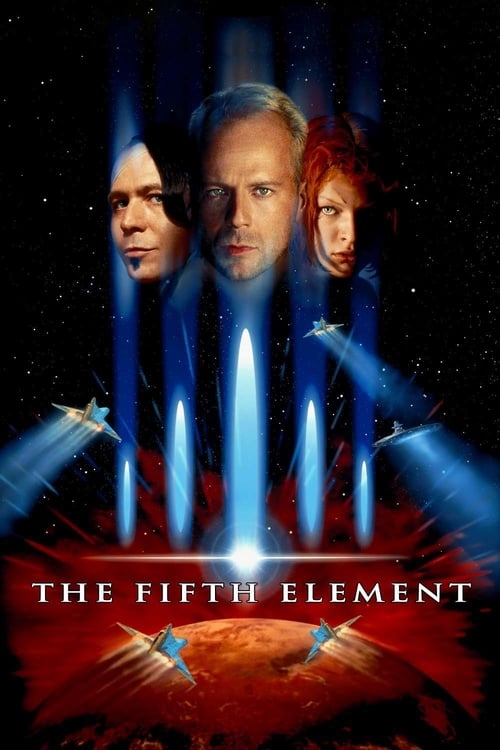
The Fifth Element
In 2257, a taxi driver is unintentionally given the task of saving a young girl who is part of the key that will ensure the survival of humanity.
Despite a considerable budget of $90.0M, The Fifth Element became a solid performer, earning $263.9M worldwide—a 193% return.
Nominated for 1 Oscar. 10 wins & 39 nominations


Plot Structure
Story beats plotted across runtime


Narrative Arc
Emotional journey through the story's key moments
Story Circle
Blueprint 15-beat structure
Arcplot Score Breakdown
Weighted: Precision (70%) + Arc (15%) + Theme (15%)
The Fifth Element (1997) exhibits precise dramatic framework, characteristic of Luc Besson's storytelling approach. This structural analysis examines how the film's 15-point plot structure maps to proven narrative frameworks across 2 hours and 6 minutes. With an Arcplot score of 7.4, the film balances conventional beats with creative variation.
Characters
Cast & narrative archetypes

Korben Dallas
Leeloo
Jean-Baptiste Emanuel Zorg
Cornelius
Ruby Rhod
General Munro
President Lindberg
Diva Plavalaguna
Main Cast & Characters
Korben Dallas
Played by Bruce Willis
A former special forces operative turned reluctant cab driver who becomes humanity's unlikely savior.
Leeloo
Played by Milla Jovovich
The Supreme Being and Fifth Element, a perfect human weapon created to save the universe.
Jean-Baptiste Emanuel Zorg
Played by Gary Oldman
A ruthless corporate executive aligned with the Great Evil, driven by profit and chaos.
Cornelius
Played by Ian Holm
A Mondoshawan priest and scholar who protects ancient knowledge about the Fifth Element.
Ruby Rhod
Played by Chris Tucker
A flamboyant radio host and celebrity whose broadcast covers the Fhloston Paradise cruise.
General Munro
Played by Brion James
Military leader coordinating Earth's defense against the approaching Great Evil.
President Lindberg
Played by Tommy Lister Jr.
The President of Earth's Federated Territories facing an existential threat.
Diva Plavalaguna
Played by Maïwenn
An alien opera singer who carries the elemental stones needed to save the universe.
Structural Analysis
The Status Quo at 2 minutes (1% through the runtime) establishes Egypt 1914: Scientists discover the temple chamber containing the four elemental stones and the sarcophagus of the Fifth Element, establishing the ancient weapon against evil that will protect Earth.. Significantly, this early placement immediately immerses viewers in the story world.
The inciting incident occurs at 14 minutes when Leeloo, the reconstructed Fifth Element, escapes the government facility and crashes through Korben's cab ceiling. His ordinary cab-driver life is shattered by the literal arrival of the perfect being - bleeding, terrified, and speaking an ancient language.. At 11% through the film, this Disruption aligns precisely with traditional story structure. This beat shifts the emotional landscape, launching the protagonist into the central conflict.
The First Threshold at 31 minutes marks the transition into Act II, occurring at 24% of the runtime. This illustrates the protagonist's commitment to Korben actively chooses to accept the mission to Fhloston Paradise, using the won tickets. He commits to protecting Leeloo and securing the stones, leaving his mundane existence behind to become a hero again. "I'll take the case."., moving from reaction to action.
At 64 minutes, the Midpoint arrives at 50% of the runtime—precisely centered, creating perfect narrative symmetry. Notably, this crucial beat False victory: Korben has all four elemental stones secured from the Diva. The team escapes Fhloston Paradise alive. It seems the mission is accomplished - but the Great Evil is still approaching and they don't yet understand how to activate the weapon. Stakes raised: time is running out., fundamentally raising what's at risk. The emotional intensity shifts, dividing the narrative into clear before-and-after phases.
The Collapse moment at 94 minutes (75% through) represents the emotional nadir. Here, Leeloo's emotional death: "Everything you create, you use to destroy." Having learned all of human history, she sees only war and violence. She loses faith in humanity and refuses to help activate the stones. Without her willing participation, the weapon cannot function. All hope seems lost., reveals the protagonist at their lowest point. This beat's placement in the final quarter sets up the climactic reversal.
The Second Threshold at 102 minutes initiates the final act resolution at 81% of the runtime. Korben's synthesis realization: "I know. But life is beautiful." He doesn't argue with Leeloo's evidence - he acknowledges humanity's darkness but offers love as the counterargument. He kisses her, showing rather than telling. This combines his warrior skills (Act 1) with the love he learned from her (Mirror World)., demonstrating the transformation achieved throughout the journey.
Emotional Journey
The Fifth Element's emotional architecture traces a deliberate progression across 15 carefully calibrated beats.
Narrative Framework
This structural analysis employs a 15-point narrative structure framework that maps key story moments. By mapping The Fifth Element against these established plot points, we can identify how Luc Besson utilizes or subverts traditional narrative conventions. The plot point approach reveals not only adherence to structural principles but also creative choices that distinguish The Fifth Element within the science fiction genre.
Luc Besson's Structural Approach
Among the 12 Luc Besson films analyzed on Arcplot, the average structural score is 7.0, reflecting strong command of classical structure. The Fifth Element represents one of the director's most structurally precise works. For comparative analysis, explore the complete Luc Besson filmography.
Comparative Analysis
Additional science fiction films include The Postman, Mad Max 2 and AVP: Alien vs. Predator. For more Luc Besson analyses, see The Family, Léon: The Professional and Arthur 3: The War of the Two Worlds.
Plot Points by Act
Act I
SetupStatus Quo
Egypt 1914: Scientists discover the temple chamber containing the four elemental stones and the sarcophagus of the Fifth Element, establishing the ancient weapon against evil that will protect Earth.
Theme
Cornelius explains to the scientists: "When the three planets are in eclipse, the ultimate evil appears." The theme of love as the ultimate force against darkness is planted - what force can defeat pure evil?
Worldbuilding
300 years later in 2263 New York. Korben Dallas, ex-special forces operative now cab driver, navigates a cynical overpopulated world. President establishes the approaching Great Evil. Zorg introduced as corporate villain working with the Evil. The world is technological, crowded, and spiritually empty.
Disruption
Leeloo, the reconstructed Fifth Element, escapes the government facility and crashes through Korben's cab ceiling. His ordinary cab-driver life is shattered by the literal arrival of the perfect being - bleeding, terrified, and speaking an ancient language.
Resistance
Korben debates getting involved while sheltering Leeloo. Cornelius deciphers her identity as the Fifth Element. Government pursues. Leeloo studies human history at rapid speed. Korben is fired from his cab job. He resists the call to adventure, wanting his simple life back, but circumstances push him forward.
Act II
ConfrontationFirst Threshold
Korben actively chooses to accept the mission to Fhloston Paradise, using the won tickets. He commits to protecting Leeloo and securing the stones, leaving his mundane existence behind to become a hero again. "I'll take the case."
Mirror World
On the flight to Fhloston, Korben and Leeloo share an intimate moment. She represents perfect, innocent love - everything his cynical world lacks. Their relationship becomes the thematic heart: can love truly be the fifth element that saves humanity?
Premise
The fun the audience came for: elaborate Fhloston Paradise sequence with Diva concert, action aboard the luxury ship, shootouts with Mangalores, Ruby Rhod's manic energy, and the spectacle of the sci-fi world at its most entertaining. Korben in action-hero mode, protecting Leeloo and retrieving stones.
Midpoint
False victory: Korben has all four elemental stones secured from the Diva. The team escapes Fhloston Paradise alive. It seems the mission is accomplished - but the Great Evil is still approaching and they don't yet understand how to activate the weapon. Stakes raised: time is running out.
Opposition
Return to Egypt. The Evil grows closer and more powerful, destroying everything in its path. Military strikes fail completely. Pressure mounts as time runs out. Leeloo researches human history and discovers humanity's capacity for violence and war, shaking her faith. The setup for the final confrontation becomes desperate.
Collapse
Leeloo's emotional death: "Everything you create, you use to destroy." Having learned all of human history, she sees only war and violence. She loses faith in humanity and refuses to help activate the stones. Without her willing participation, the weapon cannot function. All hope seems lost.
Crisis
Korben processes Leeloo's despair. The evil approaches Earth's atmosphere. Humanity has minutes left. Cornelius tries to activate the stones alone but fails. The temple stones light up but Leeloo - the fifth element - remains dormant and unwilling. Dark night before the synthesis.
Act III
ResolutionSecond Threshold
Korben's synthesis realization: "I know. But life is beautiful." He doesn't argue with Leeloo's evidence - he acknowledges humanity's darkness but offers love as the counterargument. He kisses her, showing rather than telling. This combines his warrior skills (Act 1) with the love he learned from her (Mirror World).
Synthesis
The finale: Leeloo, restored by love, combines with the four stones. A beam of divine light shoots from the temple into space, stopping and destroying the Great Evil. The weapon activates not through violence but through love - the fifth element. Humanity is saved. Korben and Leeloo unite in the restoration chamber.
Transformation
Closing image mirrors opening: where we began with ancient stones in a temple of war, we end with Korben and Leeloo making love in a chamber watched by authorities - life and love, not violence, are what matter. The cynical ex-soldier has transformed into a man who chooses love over violence.