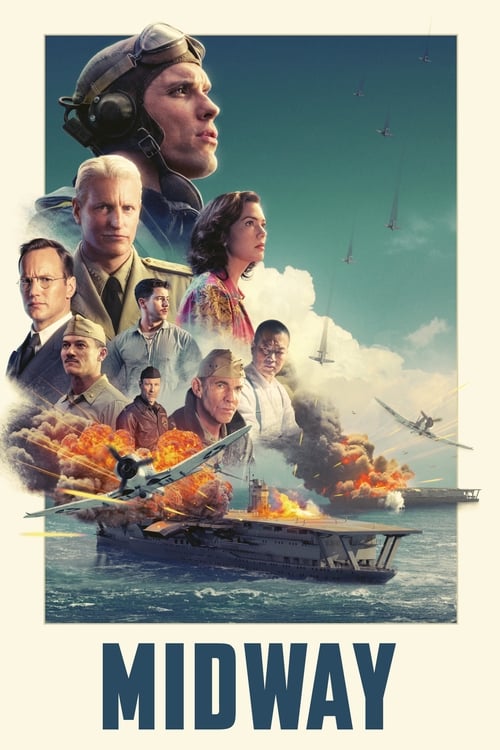
Midway
The story of the Battle of Midway, and the leaders and soldiers who used their instincts, fortitude and bravery to overcome massive odds.
Working with a substantial budget of $100.0M, the film achieved a steady performer with $127.4M in global revenue (+27% profit margin).


Plot Structure
Story beats plotted across runtime


Narrative Arc
Emotional journey through the story's key moments
Story Circle
Blueprint 15-beat structure
Arcplot Score Breakdown
Weighted: Precision (70%) + Arc (15%) + Theme (15%)
Midway (2019) reveals meticulously timed narrative architecture, characteristic of Roland Emmerich's storytelling approach. This structural analysis examines how the film's 15-point plot structure maps to proven narrative frameworks across 2 hours and 18 minutes. With an Arcplot score of 7.4, the film balances conventional beats with creative variation.
Characters
Cast & narrative archetypes

Dick Best
Edwin Layton
Chester Nimitz
Wade McClusky
Bruno Gaido
Jimmy Doolittle
William 'Bull' Halsey
Isoroku Yamamoto
Roy Pearce
Main Cast & Characters
Dick Best
Played by Ed Skrein
Aggressive and skilled dive bomber pilot who becomes key to victory at Midway despite clashing with superiors.
Edwin Layton
Played by Patrick Wilson
Intelligence officer who accurately predicts Japanese movements and fights to have his analysis taken seriously.
Chester Nimitz
Played by Woody Harrelson
Commander of the Pacific Fleet who must balance risk with strategic wisdom in defending Midway.
Wade McClusky
Played by Luke Evans
Air Group Commander who makes the critical decision to extend his search that leads to finding the Japanese fleet.
Bruno Gaido
Played by Nick Jonas
Brave enlisted gunner who shows exceptional courage and eventually becomes a pilot despite his working-class background.
Jimmy Doolittle
Played by Aaron Eckhart
Bold aviator who leads the daring raid on Tokyo that changes the course of the Pacific War.
William 'Bull' Halsey
Played by Dennis Quaid
Aggressive carrier commander sidelined by illness at the crucial moment, mentoring younger officers.
Isoroku Yamamoto
Played by Etsushi Toyokawa
Japanese Admiral who orchestrated Pearl Harbor but warns of awakening a sleeping giant.
Roy Pearce
Played by Alexander Ludwig
Aviation squadron commander and Best's friend who struggles with the burdens of leadership in combat.
Structural Analysis
The Status Quo at 2 minutes (2% through the runtime) establishes Pre-war intelligence gathering. Edwin Layton observes Japanese naval movements in 1937, establishing the brewing conflict and America's intelligence operations in the Pacific.. Of particular interest, this early placement immediately immerses viewers in the story world.
The inciting incident occurs at 16 minutes when Pearl Harbor attack begins. The Japanese strike devastates the Pacific Fleet, killing thousands and destroying battleships. The status quo is shattered, forcing America into total war.. At 11% through the film, this Disruption aligns precisely with traditional story structure. This beat shifts the emotional landscape, launching the protagonist into the central conflict.
The First Threshold at 34 minutes marks the transition into Act II, occurring at 25% of the runtime. This illustrates the protagonist's commitment to Decision to launch the Doolittle Raid on Tokyo. America actively chooses to go on the offensive despite overwhelming odds, committing to strike back at the Japanese homeland. Point of no return., moving from reaction to action.
At 68 minutes, the Midpoint arrives at 50% of the runtime—precisely centered, creating perfect narrative symmetry. Significantly, this crucial beat Intelligence breakthrough: Layton confirms Midway as the Japanese target through codebreaking. False victory - they know where the enemy will strike, but are still vastly outnumbered. Stakes raised, ticking clock activated., fundamentally raising what's at risk. The emotional intensity shifts, dividing the narrative into clear before-and-after phases.
The Collapse moment at 103 minutes (74% through) represents the emotional nadir. Here, Torpedo Squadron 8 massacred - almost entirely wiped out without scoring a single hit. Yorktown damaged. The attack appears to be failing catastrophically. Whiff of death: heroic pilots dying in flames, mission seemingly lost., reveals the protagonist at their lowest point. This beat's placement in the final quarter sets up the climactic reversal.
The Second Threshold at 109 minutes initiates the final act resolution at 79% of the runtime. Japanese fleet spotted. McClusky's decision to keep searching pays off. The dive bombers arrive at the exact moment Japanese carriers are vulnerable (aircraft refueling on deck). Synthesis: sacrifice of torpedo squadrons drew fighters low, enabling dive bomber success., demonstrating the transformation achieved throughout the journey.
Emotional Journey
Midway's emotional architecture traces a deliberate progression across 15 carefully calibrated beats.
Narrative Framework
This structural analysis employs systematic plot point analysis that identifies crucial turning points. By mapping Midway against these established plot points, we can identify how Roland Emmerich utilizes or subverts traditional narrative conventions. The plot point approach reveals not only adherence to structural principles but also creative choices that distinguish Midway within the action genre.
Roland Emmerich's Structural Approach
Among the 12 Roland Emmerich films analyzed on Arcplot, the average structural score is 7.0, demonstrating varied approaches to story architecture. Midway represents one of the director's most structurally precise works. For comparative analysis, explore the complete Roland Emmerich filmography.
Comparative Analysis
Additional action films include The Bad Guys, Puss in Boots and Venom: The Last Dance. For more Roland Emmerich analyses, see The Day After Tomorrow, White House Down and 10,000 BC.
Plot Points by Act
Act I
SetupStatus Quo
Pre-war intelligence gathering. Edwin Layton observes Japanese naval movements in 1937, establishing the brewing conflict and America's intelligence operations in the Pacific.
Theme
Admiral Nimitz or intelligence officers discuss the nature of war and sacrifice: "We must be willing to pay the price for freedom." Theme of courage through overwhelming odds stated.
Worldbuilding
Establishing the key players: Dick Best and pilot squadrons, Layton's intelligence work, Admiral Nimitz's command, the Japanese fleet buildup, and the deteriorating diplomatic situation leading to Pearl Harbor.
Disruption
Pearl Harbor attack begins. The Japanese strike devastates the Pacific Fleet, killing thousands and destroying battleships. The status quo is shattered, forcing America into total war.
Resistance
Aftermath and debate phase. Assessing catastrophic losses, Nimitz takes command, Layton struggles with guilt over not predicting the attack, strategists debate defensive vs. offensive posture. Preparation and doubt dominate.
Act II
ConfrontationFirst Threshold
Decision to launch the Doolittle Raid on Tokyo. America actively chooses to go on the offensive despite overwhelming odds, committing to strike back at the Japanese homeland. Point of no return.
Mirror World
Personal relationships deepen - pilots with families, Best with his wife Ann, camaraderie among squadron members. These bonds represent what they're fighting for and carry the human cost theme.
Premise
The promise of aerial warfare delivered: Doolittle Raid execution, Battle of Coral Sea engagement, codebreaking sequences, tactical planning sessions, carrier operations, and pilot training. The war movie the audience came for.
Midpoint
Intelligence breakthrough: Layton confirms Midway as the Japanese target through codebreaking. False victory - they know where the enemy will strike, but are still vastly outnumbered. Stakes raised, ticking clock activated.
Opposition
Bad guys close in: Japanese fleet approaches with superior forces (four carriers vs. three American). Final preparations reveal America's desperate position. Personal doubts surface. Torpedo squadrons launch into overwhelming enemy defenses.
Collapse
Torpedo Squadron 8 massacred - almost entirely wiped out without scoring a single hit. Yorktown damaged. The attack appears to be failing catastrophically. Whiff of death: heroic pilots dying in flames, mission seemingly lost.
Crisis
Dark night: McClusky and Best face the decision to continue searching or retreat. Fuel running low, fleet location unknown, watching comrades die. The emotional valley before the breakthrough.
Act III
ResolutionSecond Threshold
Japanese fleet spotted. McClusky's decision to keep searching pays off. The dive bombers arrive at the exact moment Japanese carriers are vulnerable (aircraft refueling on deck). Synthesis: sacrifice of torpedo squadrons drew fighters low, enabling dive bomber success.
Synthesis
The finale: Coordinated dive bomber attacks destroy Akagi, Kaga, and Soryu in minutes. Best personally bombs two carriers. Hiryu counterattacks. Final air battle eliminates the fourth carrier. American victory secured through courage, intelligence, and sacrifice.
Transformation
Victory aftermath and epilogue. The Pacific Fleet, once devastated at Pearl Harbor, has turned the tide. Text reveals historical impact: Japan never recovered, Midway marked the turning point. Heroes return transformed, having paid the price for freedom.