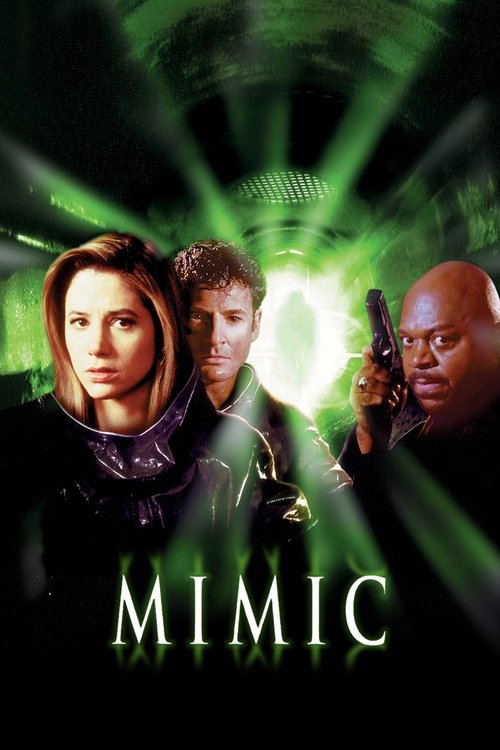
Mimic
A disease carried by common cockroaches is killing Manhattan children. In an effort to stop the epidemic an entomologist, Susan Tyler, creates a mutant breed of insect that secretes a fluid to kill the roaches. This mutant breed was engineered to die after one generation, but three years later Susan finds out that the species has survived and evolved into a large, gruesome monster that can mimic human form.
The film disappointed at the box office against its moderate budget of $30.0M, earning $25.5M globally (-15% loss).
3 wins & 8 nominations


Plot Structure
Story beats plotted across runtime


Narrative Arc
Emotional journey through the story's key moments
Story Circle
Blueprint 15-beat structure
Arcplot Score Breakdown
Weighted: Precision (70%) + Arc (15%) + Theme (15%)
Mimic (1997) exemplifies carefully calibrated narrative architecture, characteristic of Guillermo del Toro's storytelling approach. This structural analysis examines how the film's 15-point plot structure maps to proven narrative frameworks across 1 hour and 45 minutes. With an Arcplot score of 7.3, the film balances conventional beats with creative variation.
Characters
Cast & narrative archetypes

Dr. Susan Tyler
Peter Mann
Josh Maslow
Manny
Leonard
Chuy
Remy
Main Cast & Characters
Dr. Susan Tyler
Played by Mira Sorvino
An entomologist who creates a genetically engineered insect to stop a plague, only to face horrifying consequences years later.
Peter Mann
Played by Jeremy Northam
Susan's husband and fellow scientist who supports her work and helps confront the mutated insects in the subway.
Josh Maslow
Played by Josh Brolin
A CDC official who worked with Susan on the original plague solution and now faces the unintended consequences.
Manny
Played by Giancarlo Giannini
A subway shoe shiner and grandfather who gets pulled into the nightmare while searching for missing children.
Leonard
Played by Charles S. Dutton
An NYPD transit cop who accompanies the group into the dangerous subway tunnels.
Chuy
Played by Alexander Goodwin
Manny's autistic grandson who has a unique ability to sense and mimic the insects.
Remy
Played by Norman Reedus
A thief and guide who knows the subway tunnels and helps the group navigate underground.
Structural Analysis
The Status Quo at 1 minutes (1% through the runtime) establishes New York City is gripped by a deadly epidemic called Strickler's disease, spread by cockroaches, killing hundreds of children. Dr. Susan Tyler works frantically in her lab seeking a solution.. Structural examination shows that this early placement immediately immerses viewers in the story world.
The inciting incident occurs at 13 minutes when Two boys discover a strange insect in the subway and bring it to Susan. She realizes with horror that the Judas Breed, designed to die off, has somehow survived and evolved. Her "safe" creation is still alive.. At 12% through the film, this Disruption aligns precisely with traditional story structure. This beat shifts the emotional landscape, launching the protagonist into the central conflict.
The First Threshold at 26 minutes marks the transition into Act II, occurring at 25% of the runtime. This reveals the protagonist's commitment to Susan chooses to descend into the subway tunnels with her colleague Josh to hunt for specimens of the Judas Breed. She actively commits to entering the dangerous underground world to investigate what she's created., moving from reaction to action.
At 53 minutes, the Midpoint arrives at 50% of the runtime—precisely centered, creating perfect narrative symmetry. The analysis reveals that this crucial beat The group becomes trapped in the abandoned subway station when the creatures seal them in. Stakes raise dramatically—false defeat. They realize the insects have evolved intelligence and are hunting them systematically., fundamentally raising what's at risk. The emotional intensity shifts, dividing the narrative into clear before-and-after phases.
The Collapse moment at 78 minutes (74% through) represents the emotional nadir. Here, Josh dies horribly, torn apart by the creatures. Susan is separated from Peter. Manny sacrifices himself trying to save Chuy. The "whiff of death"—Susan faces the full cost of her hubris as her colleague dies because of what she created., indicates the protagonist at their lowest point. This beat's placement in the final quarter sets up the climactic reversal.
The Second Threshold at 84 minutes initiates the final act resolution at 80% of the runtime. Susan realizes the creatures use pheromones and mimicry to identify each other. She can use the insects' own biology against them. She synthesizes her scientific knowledge with survival instinct—the breakthrough that enables the final confrontation., demonstrating the transformation achieved throughout the journey.
Emotional Journey
Mimic's emotional architecture traces a deliberate progression across 15 carefully calibrated beats.
Narrative Framework
This structural analysis employs proven narrative structure principles that track dramatic progression. By mapping Mimic against these established plot points, we can identify how Guillermo del Toro utilizes or subverts traditional narrative conventions. The plot point approach reveals not only adherence to structural principles but also creative choices that distinguish Mimic within the horror genre.
Guillermo del Toro's Structural Approach
Among the 9 Guillermo del Toro films analyzed on Arcplot, the average structural score is 6.9, demonstrating varied approaches to story architecture. Mimic represents one of the director's most structurally precise works. For comparative analysis, explore the complete Guillermo del Toro filmography.
Comparative Analysis
Additional horror films include Thinner, A Nightmare on Elm Street and Mary Reilly. For more Guillermo del Toro analyses, see Hellboy, The Shape of Water and Nightmare Alley.
Plot Points by Act
Act I
SetupStatus Quo
New York City is gripped by a deadly epidemic called Strickler's disease, spread by cockroaches, killing hundreds of children. Dr. Susan Tyler works frantically in her lab seeking a solution.
Theme
CDC official warns Susan: "Think about what you're doing. You're tampering with the evolutionary process." The theme of humanity's hubris in manipulating nature is stated.
Worldbuilding
Susan creates the Judas Breed, a genetically engineered insect designed to mimic and exterminate disease-carrying cockroaches. The solution works—the epidemic ends. We see Susan's world three years later: married to CDC deputy director Peter, trying to have a child, celebrated as a hero.
Disruption
Two boys discover a strange insect in the subway and bring it to Susan. She realizes with horror that the Judas Breed, designed to die off, has somehow survived and evolved. Her "safe" creation is still alive.
Resistance
Susan debates whether to investigate further. She and Peter discuss the implications. Autistic shoe-shiner Chuy and his grandfather Manny encounter strange "people" in the subway. Susan receives more evidence that something is wrong underground.
Act II
ConfrontationFirst Threshold
Susan chooses to descend into the subway tunnels with her colleague Josh to hunt for specimens of the Judas Breed. She actively commits to entering the dangerous underground world to investigate what she's created.
Mirror World
Susan's relationship with Peter deepens as they discuss having children. The Mirror World relationship represents the natural family/life she wants versus the unnatural life she's created. Manny represents protective parental instinct.
Premise
The team explores the subway tunnels, discovering the Judas Breed has grown to massive size and mimics humans. They find a vast nest. Chuy goes missing. The "fun and games" of creature-feature horror as they hunt and are hunted.
Midpoint
The group becomes trapped in the abandoned subway station when the creatures seal them in. Stakes raise dramatically—false defeat. They realize the insects have evolved intelligence and are hunting them systematically.
Opposition
The creatures close in. Team members are picked off. Susan's creation turns against her completely. They discover the insects are breeding. Every escape attempt fails. The group splinters. Josh is killed.
Collapse
Josh dies horribly, torn apart by the creatures. Susan is separated from Peter. Manny sacrifices himself trying to save Chuy. The "whiff of death"—Susan faces the full cost of her hubris as her colleague dies because of what she created.
Crisis
Susan processes the deaths, alone in the dark. She confronts her responsibility for creating this nightmare. Peter desperately searches for her. Dark night of the soul as they face seemingly impossible odds.
Act III
ResolutionSecond Threshold
Susan realizes the creatures use pheromones and mimicry to identify each other. She can use the insects' own biology against them. She synthesizes her scientific knowledge with survival instinct—the breakthrough that enables the final confrontation.
Synthesis
Susan and Peter fight their way through the nest. They find and rescue Chuy. Susan confronts the massive alpha creature. They flood the tunnels to destroy the breeding ground. Final desperate battle on the departing train.
Transformation
Susan emerges from the subway into daylight with Peter and Chuy, having destroyed her creation and accepted responsibility. Where she once celebrated scientific triumph over nature, she now understands the danger of playing God.