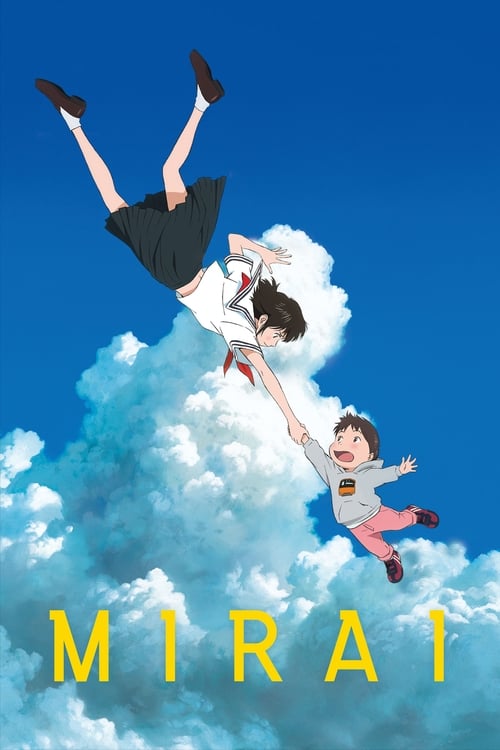
Mirai
Unhappy after his new baby sister displaces him, four-year-old Kun begins meeting people and pets from his family's history in their unique house in order to help him become the big brother he was meant to be.
The film earned $29.9M at the global box office.
Nominated for 1 Oscar. 5 wins & 36 nominations


Plot Structure
Story beats plotted across runtime


Narrative Arc
Emotional journey through the story's key moments
Story Circle
Blueprint 15-beat structure
Arcplot Score Breakdown
Weighted: Precision (70%) + Arc (15%) + Theme (15%)
Mirai (2018) showcases precise story structure, characteristic of Mamoru Hosoda's storytelling approach. This structural analysis examines how the film's 15-point plot structure maps to proven narrative frameworks across 1 hour and 38 minutes. With an Arcplot score of 7.3, the film balances conventional beats with creative variation.
Characters
Cast & narrative archetypes

Kun
Mirai
Mother
Father
Yukko
Great-Grandfather
Main Cast & Characters
Kun
Played by Moka Kamishiraishi
A four-year-old boy struggling with jealousy after his baby sister is born, who embarks on magical journeys through time.
Mirai
Played by Haru Kuroki
Kun's baby sister from the future who appears as a teenager to help him understand family and growth.
Mother
Played by Kumiko Aso
Kun's exhausted working mother trying to balance career and family life while caring for a newborn.
Father
Played by Gen Hoshino
Kun's well-meaning but inexperienced stay-at-home father learning to manage household duties.
Yukko
Played by Mitsuo Yoshihara
The family dog who appears in human form from the past, formerly the center of attention before Kun was born.
Great-Grandfather
Played by Koji Yakusho
A young man from the past who helps Kun understand courage and family legacy through wartime memories.
Structural Analysis
The Status Quo at 1 minutes (1% through the runtime) establishes Kun plays happily as an only child in his family's modern home, receiving all his parents' attention and love.. The analysis reveals that this early placement immediately immerses viewers in the story world.
The inciting incident occurs at 11 minutes when Baby Mirai arrives home from the hospital. Kun immediately feels displaced as all attention shifts to his new sister.. At 12% through the film, this Disruption aligns precisely with traditional story structure. This beat shifts the emotional landscape, launching the protagonist into the central conflict.
The First Threshold at 23 minutes marks the transition into Act II, occurring at 23% of the runtime. This reveals the protagonist's commitment to Kun meets teenage Mirai from the future in the garden. He chooses to accept this magical reality and begins his journey through time and family history., moving from reaction to action.
At 48 minutes, the Midpoint arrives at 49% of the runtime—precisely centered, creating perfect narrative symmetry. Of particular interest, this crucial beat Kun successfully learns to ride his bike through his mother's childhood courage. False victory: he thinks he's learned his lesson, but still struggles with selfishness and jealousy., fundamentally raising what's at risk. The emotional intensity shifts, dividing the narrative into clear before-and-after phases.
The Collapse moment at 72 minutes (73% through) represents the emotional nadir. Here, After a tantrum at the train station, Kun gets lost in a dark, dystopian Tokyo Station - a metaphorical death where he faces complete abandonment and the loss of his family identity., indicates the protagonist at their lowest point. This beat's placement in the final quarter sets up the climactic reversal.
The Second Threshold at 77 minutes initiates the final act resolution at 79% of the runtime. Kun encounters the Tree of Family and sees his entire lineage. He finally understands he is part of something bigger - a continuous chain of love and sacrifice. He can now name his family with pride., demonstrating the transformation achieved throughout the journey.
Emotional Journey
Mirai's emotional architecture traces a deliberate progression across 15 carefully calibrated beats.
Narrative Framework
This structural analysis employs systematic plot point analysis that identifies crucial turning points. By mapping Mirai against these established plot points, we can identify how Mamoru Hosoda utilizes or subverts traditional narrative conventions. The plot point approach reveals not only adherence to structural principles but also creative choices that distinguish Mirai within the animation genre.
Mamoru Hosoda's Structural Approach
Among the 5 Mamoru Hosoda films analyzed on Arcplot, the average structural score is 7.3, reflecting strong command of classical structure. Mirai represents one of the director's most structurally precise works. For comparative analysis, explore the complete Mamoru Hosoda filmography.
Comparative Analysis
Additional animation films include The Bad Guys, Puss in Boots and Violet Evergarden: Eternity and the Auto Memory Doll. For more Mamoru Hosoda analyses, see Summer Wars, Belle and The Boy and the Beast.
Plot Points by Act
Act I
SetupStatus Quo
Kun plays happily as an only child in his family's modern home, receiving all his parents' attention and love.
Theme
Kun's mother explains that family is about making room for new members and sharing love, not losing it.
Worldbuilding
Establishment of Kun's world: his relationship with parents, his dog Yukko, and the magical courtyard garden that will become the portal to his adventures.
Disruption
Baby Mirai arrives home from the hospital. Kun immediately feels displaced as all attention shifts to his new sister.
Resistance
Kun struggles with jealousy and acts out. His parents debate how to help him adjust. Kun's first magical encounter with Yukko as a prince teaches him about displacement.
Act II
ConfrontationFirst Threshold
Kun meets teenage Mirai from the future in the garden. He chooses to accept this magical reality and begins his journey through time and family history.
Mirror World
Future Mirai becomes Kun's guide and thematic mirror - she shows him what it means to be a caring older sibling and family member.
Premise
Kun experiences magical adventures: he learns to ride a bike with his mother as a young girl, encounters his great-grandfather as a young man during wartime. Each adventure teaches him about family sacrifice and love.
Midpoint
Kun successfully learns to ride his bike through his mother's childhood courage. False victory: he thinks he's learned his lesson, but still struggles with selfishness and jealousy.
Opposition
Kun continues to act out and throw tantrums. His parents' patience wears thin. His bad behavior escalates, and he refuses to understand his place in the family.
Collapse
After a tantrum at the train station, Kun gets lost in a dark, dystopian Tokyo Station - a metaphorical death where he faces complete abandonment and the loss of his family identity.
Crisis
Kun wanders alone through the nightmarish station, unable to identify his family. He faces the Bullet Train of Lost Children, risking being taken to a place of loneliness forever.
Act III
ResolutionSecond Threshold
Kun encounters the Tree of Family and sees his entire lineage. He finally understands he is part of something bigger - a continuous chain of love and sacrifice. He can now name his family with pride.
Synthesis
Baby Mirai from the future rescues Kun, bringing him home. Kun returns with new maturity, ready to be a caring big brother and accept his role in the family.
Transformation
Kun lovingly helps baby Mirai, mirroring the opening image but now showing growth, patience, and understanding. He has become the caring older brother.