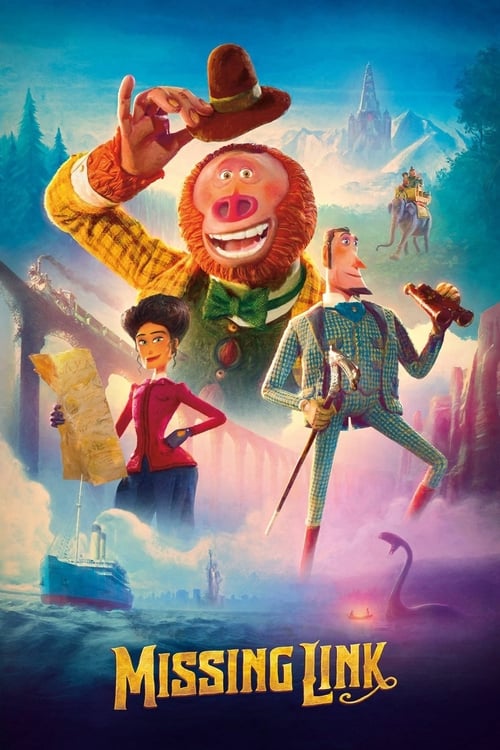
Missing Link
The charismatic Sir Lionel Frost considers himself to be the world's foremost investigator of myths and monsters. Trouble is, none of his small-minded, high-society peers seems to recognize this. Hoping to finally gain acceptance from these fellow adventurers, Sir Lionel travels to the Pacific Northwest to prove the existence of a legendary creature known as the missing link.
The film box office disappointment against its substantial budget of $100.0M, earning $26.6M globally (-73% loss). While initial box office returns were modest, the film has gained appreciation for its unique voice within the family genre.
Nominated for 1 Oscar. 5 wins & 43 nominations


Plot Structure
Story beats plotted across runtime


Narrative Arc
Emotional journey through the story's key moments
Story Circle
Blueprint 15-beat structure
Arcplot Score Breakdown
Weighted: Precision (70%) + Arc (15%) + Theme (15%)
Missing Link (2019) exhibits meticulously timed narrative architecture, characteristic of Chris Butler's storytelling approach. This structural analysis examines how the film's 15-point plot structure maps to proven narrative frameworks across 1 hour and 34 minutes. With an Arcplot score of 7.4, the film balances conventional beats with creative variation.
Characters
Cast & narrative archetypes

Sir Lionel Frost
Mr. Link (Susan)
Adelina Fortnight
Lord Piggot-Dunceby
Willard Stenk
Main Cast & Characters
Sir Lionel Frost
Played by Hugh Jackman
An ambitious Victorian-era explorer seeking validation from the establishment by proving the existence of mythical creatures.
Mr. Link (Susan)
Played by Zach Galifianakis
A gentle Sasquatch who seeks Frost's help to find his distant relatives in the Himalayas and discover where he belongs.
Adelina Fortnight
Played by Zoe Saldana
A fiercely independent adventurer and widow who reluctantly aids Frost on his journey while guarding her late husband's legacy.
Lord Piggot-Dunceby
Played by Stephen Fry
The pompous head of the explorer's club who represents the old guard and refuses to accept Frost as an equal.
Willard Stenk
Played by Timothy Olyphant
A ruthless bounty hunter hired to stop Frost's expedition at any cost.
Structural Analysis
The Status Quo at 1 minutes (1% through the runtime) establishes Sir Lionel Frost hunts the Loch Ness Monster in Scotland, desperate to prove himself to the elite explorers club. His obsession with fame and validation defines his lonely, self-serving existence.. Significantly, this early placement immediately immerses viewers in the story world.
The inciting incident occurs at 11 minutes when Frost makes a wager with Lord Piggot-Dunceby: if he brings back proof of the Sasquatch, he'll be admitted to the club. This external goal propels him into the adventure.. At 12% through the film, this Disruption aligns precisely with traditional story structure. This beat shifts the emotional landscape, launching the protagonist into the central conflict.
The First Threshold at 23 minutes marks the transition into Act II, occurring at 24% of the runtime. This reveals the protagonist's commitment to Frost agrees to help Mr. Link reach Shangri-La in exchange for proof of his existence. They become partners and set off together, leaving the familiar world behind for a shared quest., moving from reaction to action.
At 47 minutes, the Midpoint arrives at 51% of the runtime—precisely centered, creating perfect narrative symmetry. Structural examination shows that this crucial beat Willard Stenk, hired by Piggot-Dunceby, attacks the ship. The stakes raise as Frost realizes the Society will kill to stop him. The fun journey becomes dangerous, and Frost must choose between his goals and his companions., fundamentally raising what's at risk. The emotional intensity shifts, dividing the narrative into clear before-and-after phases.
The Collapse moment at 69 minutes (74% through) represents the emotional nadir. Here, Mr. Link is utterly rejected by the Yeti tribe and has nowhere to belong. Adelina confronts Frost about his selfishness, revealing he cares more about fame than friendship. The team fractures at their lowest point., reveals the protagonist at their lowest point. This beat's placement in the final quarter sets up the climactic reversal.
The Second Threshold at 75 minutes initiates the final act resolution at 80% of the runtime. Stenk attacks, forcing a final confrontation. Frost chooses to save his friends over preserving proof of his discovery. He sacrifices his lifelong goal for genuine connection, embracing who he's become., demonstrating the transformation achieved throughout the journey.
Emotional Journey
Missing Link's emotional architecture traces a deliberate progression across 15 carefully calibrated beats.
Narrative Framework
This structural analysis employs structural analysis methodology used to understand storytelling architecture. By mapping Missing Link against these established plot points, we can identify how Chris Butler utilizes or subverts traditional narrative conventions. The plot point approach reveals not only adherence to structural principles but also creative choices that distinguish Missing Link within the family genre.
Comparative Analysis
Additional family films include The Black Stallion, The Bad Guys and Ella Enchanted.
Plot Points by Act
Act I
SetupStatus Quo
Sir Lionel Frost hunts the Loch Ness Monster in Scotland, desperate to prove himself to the elite explorers club. His obsession with fame and validation defines his lonely, self-serving existence.
Theme
Lord Piggot-Dunceby dismisses Frost's discoveries, stating that true worth isn't about individual glory but about contribution to something greater. The theme of connection vs. isolation is established.
Worldbuilding
Frost is rejected by the Society of Great Men despite his discoveries. He's vain, self-centered, and friendless. He receives a mysterious letter about a Sasquatch in the Pacific Northwest, seeing it as his chance for acceptance.
Disruption
Frost makes a wager with Lord Piggot-Dunceby: if he brings back proof of the Sasquatch, he'll be admitted to the club. This external goal propels him into the adventure.
Resistance
Frost travels to America and tracks the Sasquatch. He meets the creature who reveals he wrote the letter and can speak English. Mr. Link wants Frost's help finding his relatives, the Yeti, in the Himalayas.
Act II
ConfrontationFirst Threshold
Frost agrees to help Mr. Link reach Shangri-La in exchange for proof of his existence. They become partners and set off together, leaving the familiar world behind for a shared quest.
Mirror World
Adelina Fortnight, Frost's former flame, is introduced. She possesses the map to Shangri-La and reluctantly joins the journey. She represents genuine connection and challenges Frost's selfishness.
Premise
The trio journeys across the world - train rides, ocean voyages, and exotic locations. Fun adventure sequences as the unlikely team bonds. Mr. Link explores humanity while Frost slowly begins to see beyond himself.
Midpoint
Willard Stenk, hired by Piggot-Dunceby, attacks the ship. The stakes raise as Frost realizes the Society will kill to stop him. The fun journey becomes dangerous, and Frost must choose between his goals and his companions.
Opposition
The group reaches the Himalayas and finds Shangri-La. Mr. Link meets the Yeti but is rejected for being different. Frost's selfishness becomes more apparent to Adelina. Internal and external conflicts intensify.
Collapse
Mr. Link is utterly rejected by the Yeti tribe and has nowhere to belong. Adelina confronts Frost about his selfishness, revealing he cares more about fame than friendship. The team fractures at their lowest point.
Crisis
Frost faces his emptiness - his quest for validation has left him truly alone. Mr. Link confronts his own loneliness and lack of belonging. Both must decide what truly matters: acceptance or authentic connection.
Act III
ResolutionSecond Threshold
Stenk attacks, forcing a final confrontation. Frost chooses to save his friends over preserving proof of his discovery. He sacrifices his lifelong goal for genuine connection, embracing who he's become.
Synthesis
Climactic battle on a rope bridge over an icy chasm. Frost risks everything for his friends. They defeat Stenk together. Frost loses his proof but gains something more valuable: true friendship and family.
Transformation
The trio settles together in a seaside home as a chosen family. Frost is no longer chasing validation from others. Mr. Link (now "Susan") has found belonging. They've all transformed from isolated individuals into a connected family.