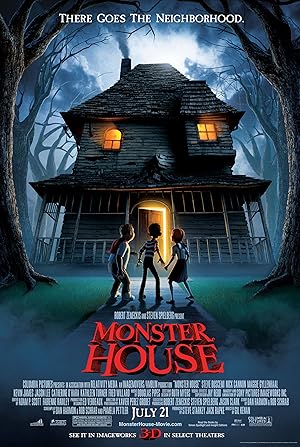
Monster House
13-year-old DJ is observing his neighbor Nebbercracker on the other side of the street in the suburb that destroys tricycles of children that trespass his lawn. When DJ's parents travel on the eve of Halloween and the abusive babysitter Zee stays with him, he calls his clumsy best friend Chowder to play basketball. But when the ball falls in Nebbercracker's lawn, the old man has a heart attack, and soon they find that the house is a monster. Later the boys rescue the smart Jenny from the house and the trio unsuccessfully tries to convince the babysitter, her boyfriend Bones and two police officers that the haunted house is a monster, but nobody believes them. The teenagers ask their video-game addicted acquaintance Skull how to destroy the house, and they disclose its secret on the Halloween night.
Working with a considerable budget of $75.0M, the film achieved a steady performer with $140.2M in global revenue (+87% profit margin).
Nominated for 1 Oscar. 4 wins & 23 nominations


Plot Structure
Story beats plotted across runtime


Narrative Arc
Emotional journey through the story's key moments
Story Circle
Blueprint 15-beat structure
Arcplot Score Breakdown
Weighted: Precision (70%) + Arc (15%) + Theme (15%)
Monster House (2006) reveals carefully calibrated plot construction, characteristic of Gil Kenan's storytelling approach. This structural analysis examines how the film's 15-point plot structure maps to proven narrative frameworks across 1 hour and 31 minutes. With an Arcplot score of 7.0, the film balances conventional beats with creative variation.
Characters
Cast & narrative archetypes

DJ
Chowder
Jenny
Mr. Nebbercracker
Constance Nebbercracker
Zee
Bones
Main Cast & Characters
DJ
Played by Mitchel Musso
A curious and intelligent 12-year-old boy who becomes obsessed with the mystery of the possessed house across the street.
Chowder
Played by Sam Lerner
DJ's loyal and goofy best friend who provides comic relief while helping investigate the house.
Jenny
Played by Spencer Locke
A smart and resourceful girl who joins DJ and Chowder in their quest to stop the monster house.
Mr. Nebbercracker
Played by Steve Buscemi
The elderly, angry neighbor whose mysterious connection to the house holds the key to stopping it.
Constance Nebbercracker
Played by Kathleen Turner
The tragic spirit of Nebbercracker's deceased wife whose soul possesses the house.
Zee
Played by Maggie Gyllenhaal
DJ's apathetic teenage babysitter who is more interested in her boyfriend than watching him.
Bones
Played by Jason Lee
Zee's punk rock boyfriend who bullies the kids and becomes an early victim of the house.
Structural Analysis
The Status Quo at 1 minutes (1% through the runtime) establishes DJ watches obsessively from his bedroom window as the creepy Nebbercracker house looms across the street, establishing his fearful surveillance of the mysterious home and his pre-adolescent anxieties.. Notably, this early placement immediately immerses viewers in the story world.
The inciting incident occurs at 11 minutes when Nebbercracker collapses and apparently dies while confronting DJ and Chowder over a basketball, and the ambulance takes him away - but the house remains alive and hungry, swallowing Chowder's basketball.. At 12% through the film, this Disruption aligns precisely with traditional story structure. This beat shifts the emotional landscape, launching the protagonist into the central conflict.
The First Threshold at 22 minutes marks the transition into Act II, occurring at 24% of the runtime. This indicates the protagonist's commitment to After the house nearly devours Jenny (a prep school girl selling candy), DJ, Chowder, and Jenny form an alliance and actively decide to investigate and stop the house rather than ignore it - committing to face their fears., moving from reaction to action.
At 46 minutes, the Midpoint arrives at 50% of the runtime—precisely centered, creating perfect narrative symmetry. Notably, this crucial beat Their plan to feed the house cold medicine fails spectacularly. The house awakens fully and the three kids are swallowed inside, transitioning from hunters to trapped prey within the monster itself., fundamentally raising what's at risk. The emotional intensity shifts, dividing the narrative into clear before-and-after phases.
The Collapse moment at 68 minutes (74% through) represents the emotional nadir. Here, The house fully awakens and tears itself from its foundation, becoming a mobile monster that pursues the children through the neighborhood on Halloween night. The cops who could have helped are incapacitated, leaving the kids truly alone., shows the protagonist at their lowest point. This beat's placement in the final quarter sets up the climactic reversal.
The Second Threshold at 72 minutes initiates the final act resolution at 79% of the runtime. Nebbercracker appears alive and reveals the truth about Constance - she wasn't evil, just protective. DJ realizes the house must be destroyed at its heart, and he volunteers to be the one to do it, embracing adult responsibility., demonstrating the transformation achieved throughout the journey.
Emotional Journey
Monster House's emotional architecture traces a deliberate progression across 15 carefully calibrated beats.
Narrative Framework
This structural analysis employs systematic plot point analysis that identifies crucial turning points. By mapping Monster House against these established plot points, we can identify how Gil Kenan utilizes or subverts traditional narrative conventions. The plot point approach reveals not only adherence to structural principles but also creative choices that distinguish Monster House within the animation genre.
Gil Kenan's Structural Approach
Among the 4 Gil Kenan films analyzed on Arcplot, the average structural score is 7.3, reflecting strong command of classical structure. Monster House takes a more unconventional approach compared to the director's typical style. For comparative analysis, explore the complete Gil Kenan filmography.
Comparative Analysis
Additional animation films include The Bad Guys, Puss in Boots and Violet Evergarden: Eternity and the Auto Memory Doll. For more Gil Kenan analyses, see City of Ember, Poltergeist and Ghostbusters: Frozen Empire.
Plot Points by Act
Act I
SetupStatus Quo
DJ watches obsessively from his bedroom window as the creepy Nebbercracker house looms across the street, establishing his fearful surveillance of the mysterious home and his pre-adolescent anxieties.
Theme
DJ's parents tell him he's too old for trick-or-treating and needs to grow up, while Zee the babysitter later mocks his childish fears - establishing that maturity means facing what scares you.
Worldbuilding
DJ's suburban world is established: his parents leave for a dental convention, the cruel babysitter Zee arrives with boyfriend Bones, and DJ's surveillance of Nebbercracker's house reveals its pattern of consuming toys and terrorizing children.
Disruption
Nebbercracker collapses and apparently dies while confronting DJ and Chowder over a basketball, and the ambulance takes him away - but the house remains alive and hungry, swallowing Chowder's basketball.
Resistance
DJ becomes consumed with guilt over Nebbercracker's death and grows increasingly convinced the house is alive. He and Chowder witness the house consume Bones' car. Adults dismiss their warnings as childish imagination.
Act II
ConfrontationFirst Threshold
After the house nearly devours Jenny (a prep school girl selling candy), DJ, Chowder, and Jenny form an alliance and actively decide to investigate and stop the house rather than ignore it - committing to face their fears.
Mirror World
Jenny joins the team as the smart, capable girl who believes them when adults won't. She represents maturity and courage, showing DJ that growing up means taking responsibility rather than running from problems.
Premise
The trio researches how to kill a house, consults video game expert Skull, learns the house is a living organism with a heart, and devises plans to destroy it - experiencing the fun and terror of their monster-hunting adventure.
Midpoint
Their plan to feed the house cold medicine fails spectacularly. The house awakens fully and the three kids are swallowed inside, transitioning from hunters to trapped prey within the monster itself.
Opposition
Trapped inside the house, the kids discover its horrifying interior, find Constance's shrine in the basement, and learn the tragic truth: the house is possessed by Nebbercracker's circus-freak wife who died during construction and whose spirit inhabits the structure.
Collapse
The house fully awakens and tears itself from its foundation, becoming a mobile monster that pursues the children through the neighborhood on Halloween night. The cops who could have helped are incapacitated, leaving the kids truly alone.
Crisis
The monstrous house chases the children through the streets as trick-or-treaters scatter in terror. DJ must confront his guilt and fear while the seemingly unstoppable house bears down on them.
Act III
ResolutionSecond Threshold
Nebbercracker appears alive and reveals the truth about Constance - she wasn't evil, just protective. DJ realizes the house must be destroyed at its heart, and he volunteers to be the one to do it, embracing adult responsibility.
Synthesis
The final confrontation at the construction site: DJ lures the house to the crane, climbs inside the monster, and with Chowder and Jenny's help, destroys Constance's heart with dynamite, finally freeing her tortured spirit and ending the threat.
Transformation
Constance's ghost rises peacefully and departs with a grateful Nebbercracker's blessing. DJ, no longer afraid, joins his friends to finally go trick-or-treating - not as a scared child, but as someone who has faced real monsters and grown up.