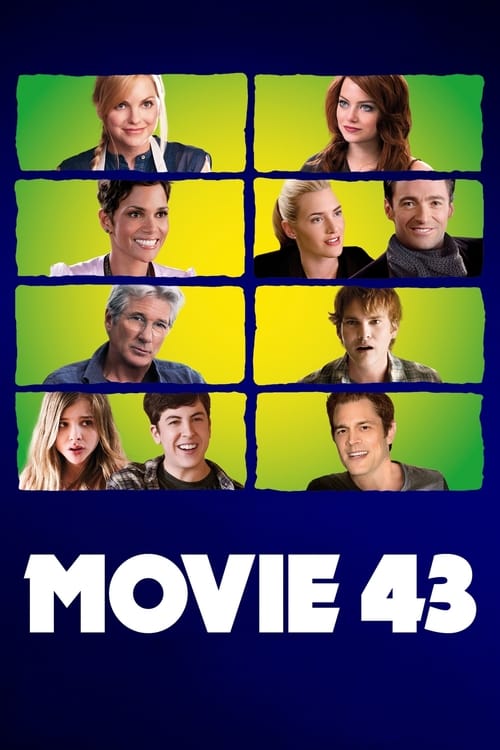
Movie 43
A series of interconnected short films are the backdrop for a maniac screenwriter who pitches insane storylines featuring some of Hollywood's biggest and brightest.
Despite its small-scale budget of $6.0M, Movie 43 became a financial success, earning $32.4M worldwide—a 441% return. The film's innovative storytelling connected with viewers, showing that strong storytelling can transcend budget limitations.
4 wins & 5 nominations


Plot Structure
Story beats plotted across runtime


Narrative Arc
Emotional journey through the story's key moments
Story Circle
Blueprint 15-beat structure
Arcplot Score Breakdown
Weighted: Precision (70%) + Arc (15%) + Theme (15%)
Movie 43 (2013) showcases precise narrative design, characteristic of Steven Brill's storytelling approach. This structural analysis examines how the film's 15-point plot structure maps to proven narrative frameworks across 1 hour and 34 minutes. With an Arcplot score of 7.3, the film balances conventional beats with creative variation.
Structural Analysis
The Status Quo at 1 minutes (1% through the runtime) establishes Charlie Wessler arrives at the studio as a hopeful screenwriter with what he believes are groundbreaking movie ideas, presenting himself professionally in the lobby.. Of particular interest, this early placement immediately immerses viewers in the story world.
The inciting incident occurs at 12 minutes when Griffin begins showing clear skepticism and resistance to Charlie's pitches, threatening to end the meeting and reject the ideas, disrupting Charlie's hopeful expectations.. At 13% through the film, this Disruption is delayed, allowing extended setup of the story world. This beat shifts the emotional landscape, launching the protagonist into the central conflict.
The First Threshold at 24 minutes marks the transition into Act II, occurring at 26% of the runtime. This shows the protagonist's commitment to Charlie makes the active choice to prevent Griffin from leaving, crossing a line from professional pitch meeting into something more desperate and confrontational., moving from reaction to action.
At 48 minutes, the Midpoint arrives at 51% of the runtime—precisely centered, creating perfect narrative symmetry. The analysis reveals that this crucial beat The power dynamic fully shifts as Charlie's desperation becomes threatening; Griffin realizes he's essentially being held hostage, raising the stakes from awkward pitch meeting to dangerous confrontation., fundamentally raising what's at risk. The emotional intensity shifts, dividing the narrative into clear before-and-after phases.
The Collapse moment at 71 minutes (76% through) represents the emotional nadir. Here, Charlie's complete mental breakdown as his final pitches are rejected; his dream of getting a movie made dies, and the situation reaches its most dangerous or pathetic point., indicates the protagonist at their lowest point. This beat's placement in the final quarter sets up the climactic reversal.
The Second Threshold at 77 minutes initiates the final act resolution at 82% of the runtime. A final realization or confrontation occurs; Charlie either accepts his fate, makes one last desperate move, or the situation is resolved by outside forces (security, police, or studio intervention)., demonstrating the transformation achieved throughout the journey.
Emotional Journey
Movie 43's emotional architecture traces a deliberate progression across 15 carefully calibrated beats.
Narrative Framework
This structural analysis employs proven narrative structure principles that track dramatic progression. By mapping Movie 43 against these established plot points, we can identify how Steven Brill utilizes or subverts traditional narrative conventions. The plot point approach reveals not only adherence to structural principles but also creative choices that distinguish Movie 43 within the comedy genre.
Steven Brill's Structural Approach
Among the 7 Steven Brill films analyzed on Arcplot, the average structural score is 7.1, reflecting strong command of classical structure. Movie 43 represents one of the director's most structurally precise works. For comparative analysis, explore the complete Steven Brill filmography.
Comparative Analysis
Additional comedy films include The Bad Guys, Ella Enchanted and The Evening Star. For more Steven Brill analyses, see Little Nicky, Heavyweights and Without a Paddle.
Plot Points by Act
Act I
SetupStatus Quo
Charlie Wessler arrives at the studio as a hopeful screenwriter with what he believes are groundbreaking movie ideas, presenting himself professionally in the lobby.
Theme
Griffin or another character comments on the desperate lengths people go to in Hollywood to get movies made, foreshadowing Charlie's descent.
Worldbuilding
Charlie settles into the pitch meeting with Griffin, establishing the office setting, their dynamic, and the initial sketches being pitched as movie ideas. The world of desperate Hollywood pitches is established.
Disruption
Griffin begins showing clear skepticism and resistance to Charlie's pitches, threatening to end the meeting and reject the ideas, disrupting Charlie's hopeful expectations.
Resistance
Charlie debates whether to continue pitching or give up, but persists with increasingly outrageous ideas, trying to convince Griffin while growing more anxious about potential rejection.
Act II
ConfrontationFirst Threshold
Charlie makes the active choice to prevent Griffin from leaving, crossing a line from professional pitch meeting into something more desperate and confrontational.
Mirror World
The relationship between Charlie and Griffin shifts, with Griffin becoming both audience surrogate and unwilling participant in Charlie's creative desperation, mirroring the film's theme of Hollywood dysfunction.
Premise
The bulk of the outrageous comedy sketches are presented as Charlie's pitches, delivering on the film's promise of boundary-pushing, shocking comedy while the frame story escalates.
Midpoint
The power dynamic fully shifts as Charlie's desperation becomes threatening; Griffin realizes he's essentially being held hostage, raising the stakes from awkward pitch meeting to dangerous confrontation.
Opposition
Griffin tries various tactics to escape or end the meeting while Charlie becomes increasingly unhinged, pitching more extreme ideas. Security and other staff may get involved, intensifying the conflict.
Collapse
Charlie's complete mental breakdown as his final pitches are rejected; his dream of getting a movie made dies, and the situation reaches its most dangerous or pathetic point.
Crisis
Charlie processes the reality of his failure in Hollywood, sitting in the darkness of his crushed dreams while the chaos of his actions surrounds him.
Act III
ResolutionSecond Threshold
A final realization or confrontation occurs; Charlie either accepts his fate, makes one last desperate move, or the situation is resolved by outside forces (security, police, or studio intervention).
Synthesis
The resolution of the frame story plays out with the final sketch(es), leading to the conclusion of Charlie's pitch session and whatever consequences follow his desperate actions.
Transformation
Final image shows the aftermath of Charlie's failed pitch meeting, likely depicting him in a worse state than when he began, transformed by desperation into something pathetic or dangerous.