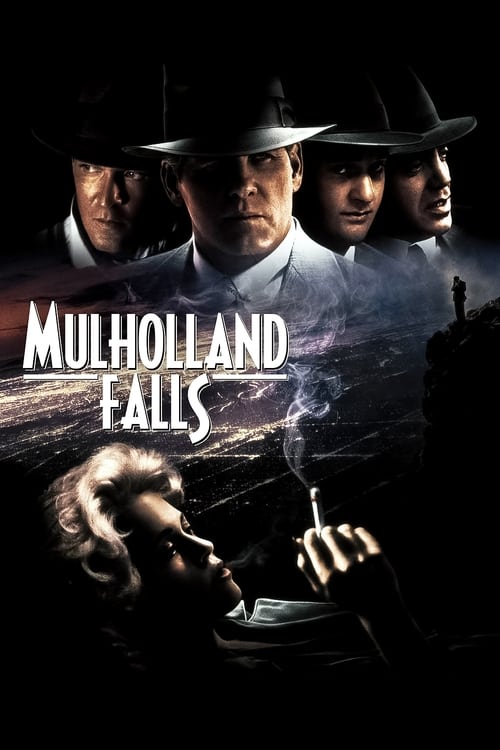
Mulholland Falls
In 1950s Los Angeles, a special crime squad of the LAPD investigates the murder of a young woman.
The film commercial failure against its moderate budget of $29.0M, earning $11.5M globally (-60% loss). While initial box office returns were modest, the film has gained appreciation for its compelling narrative within the drama genre.
1 win & 1 nomination


Plot Structure
Story beats plotted across runtime


Narrative Arc
Emotional journey through the story's key moments
Story Circle
Blueprint 15-beat structure
Arcplot Score Breakdown
Weighted: Precision (70%) + Arc (15%) + Theme (15%)
Mulholland Falls (1996) reveals carefully calibrated narrative architecture, characteristic of Lee Tamahori's storytelling approach. This structural analysis examines how the film's 15-point plot structure maps to proven narrative frameworks across 1 hour and 47 minutes. With an Arcplot score of 7.1, the film balances conventional beats with creative variation.
Characters
Cast & narrative archetypes

Max Hoover
Katherine Hoover
Allison Pond
General Thomas Timms
Ellery Coolidge
Eddie Hall
Arthur Relyea
Main Cast & Characters
Max Hoover
Played by Nick Nolte
Lead detective of the LAPD's elite "Hat Squad" who investigates the murder of his former mistress in 1950s Los Angeles.
Katherine Hoover
Played by Melanie Griffith
Max's loyal wife who struggles with her husband's infidelity and the dangerous world he inhabits.
Allison Pond
Played by Jennifer Connelly
Max's murdered mistress, a mysterious woman whose death reveals connections to nuclear testing and government conspiracy.
General Thomas Timms
Played by John Malkovich
Ruthless military officer involved in nuclear weapons testing who becomes the antagonist when Max investigates too deeply.
Ellery Coolidge
Played by Chazz Palminteri
Max's partner in the Hat Squad, a tough and loyal detective who stands by Max through the investigation.
Eddie Hall
Played by Michael Madsen
Member of the Hat Squad known for his violent tendencies and unwavering loyalty to the team.
Arthur Relyea
Played by Chris Penn
The cerebral member of the Hat Squad who provides analytical support to the team.
Structural Analysis
The Status Quo at 1 minutes (1% through the runtime) establishes The Hat Squad's brutal extrajudicial methods are established as they beat and intimidate criminals, showcasing Max Hoover's dominance and the squad's untouchable status in 1950s Los Angeles.. Significantly, this early placement immediately immerses viewers in the story world.
The inciting incident occurs at 13 minutes when A woman's body is discovered at a construction site, having been thrown from an airplane. Hoover arrives at the scene and recognizes her as Allison Pond—his former mistress—sending him into private turmoil.. At 12% through the film, this Disruption aligns precisely with traditional story structure. This beat shifts the emotional landscape, launching the protagonist into the central conflict.
The First Threshold at 27 minutes marks the transition into Act II, occurring at 25% of the runtime. This demonstrates the protagonist's commitment to Hoover commits to a full investigation despite warnings to back off, choosing to pursue justice for Allison even though it means risking exposure of his affair and confronting powerful military interests., moving from reaction to action.
At 54 minutes, the Midpoint arrives at 50% of the runtime—precisely centered, creating perfect narrative symmetry. Notably, this crucial beat Hoover confronts General Timms at the atomic testing facility and learns that Allison witnessed radiation experiments on soldiers. The conspiracy is far larger than murder—it's a government cover-up of human experimentation., fundamentally raising what's at risk. The emotional intensity shifts, dividing the narrative into clear before-and-after phases.
The Collapse moment at 80 minutes (75% through) represents the emotional nadir. Here, Squad member Eddie Hall is murdered by Timms's men—thrown from a plane like Allison. Hoover loses a brother-in-arms, his affair is exposed to Kate, and he stands utterly alone against an enemy with unlimited power., demonstrates the protagonist at their lowest point. This beat's placement in the final quarter sets up the climactic reversal.
The Second Threshold at 86 minutes initiates the final act resolution at 80% of the runtime. Hoover realizes that the only justice available exists outside the system. He chooses to pursue Timms directly, accepting that he must become the very vigilante force he's always been to achieve any form of justice., demonstrating the transformation achieved throughout the journey.
Emotional Journey
Mulholland Falls's emotional architecture traces a deliberate progression across 15 carefully calibrated beats.
Narrative Framework
This structural analysis employs a 15-point narrative structure framework that maps key story moments. By mapping Mulholland Falls against these established plot points, we can identify how Lee Tamahori utilizes or subverts traditional narrative conventions. The plot point approach reveals not only adherence to structural principles but also creative choices that distinguish Mulholland Falls within the drama genre.
Lee Tamahori's Structural Approach
Among the 9 Lee Tamahori films analyzed on Arcplot, the average structural score is 7.2, reflecting strong command of classical structure. Mulholland Falls takes a more unconventional approach compared to the director's typical style. For comparative analysis, explore the complete Lee Tamahori filmography.
Comparative Analysis
Additional drama films include After Thomas, South Pacific and Dirty Dancing: Havana Nights. For more Lee Tamahori analyses, see The Devil's Double, Once Were Warriors and The Convert.
Plot Points by Act
Act I
SetupStatus Quo
The Hat Squad's brutal extrajudicial methods are established as they beat and intimidate criminals, showcasing Max Hoover's dominance and the squad's untouchable status in 1950s Los Angeles.
Theme
A fellow detective remarks about the dangers of men who believe they're above the law—foreshadowing how Hoover's own secret affair and the military's unchecked power will converge destructively.
Worldbuilding
The world of 1950s LA noir is established: the Hat Squad's violent justice, Hoover's loving marriage to Kate, the squad's camaraderie, and the post-war atmosphere of atomic age paranoia.
Disruption
A woman's body is discovered at a construction site, having been thrown from an airplane. Hoover arrives at the scene and recognizes her as Allison Pond—his former mistress—sending him into private turmoil.
Resistance
Hoover wrestles with whether to reveal his connection to the victim. He investigates Allison's background while concealing his affair, discovering she was involved with powerful men and had connections to classified government projects.
Act II
ConfrontationFirst Threshold
Hoover commits to a full investigation despite warnings to back off, choosing to pursue justice for Allison even though it means risking exposure of his affair and confronting powerful military interests.
Mirror World
The discovery of film reels showing Allison's intimate encounters with multiple powerful men, including Hoover himself, creates a parallel world of surveillance and hidden sins that mirrors the atomic testing cover-up.
Premise
The investigation unfolds as classic noir procedural: Hoover and the squad trace Allison's connections through Hollywood, the FBI, and eventually to atomic bomb testing sites, while Hoover struggles to keep his secret.
Midpoint
Hoover confronts General Timms at the atomic testing facility and learns that Allison witnessed radiation experiments on soldiers. The conspiracy is far larger than murder—it's a government cover-up of human experimentation.
Opposition
General Timms deploys military resources against Hoover. The FBI intervenes, the squad faces pressure to drop the case, and Hoover's marriage is threatened when Kate begins to suspect his connection to the victim.
Collapse
Squad member Eddie Hall is murdered by Timms's men—thrown from a plane like Allison. Hoover loses a brother-in-arms, his affair is exposed to Kate, and he stands utterly alone against an enemy with unlimited power.
Crisis
Hoover grieves for Eddie while confronting the collapse of his marriage. Kate struggles with his betrayal. The remaining squad members question whether justice is possible against the military-industrial complex.
Act III
ResolutionSecond Threshold
Hoover realizes that the only justice available exists outside the system. He chooses to pursue Timms directly, accepting that he must become the very vigilante force he's always been to achieve any form of justice.
Synthesis
Hoover and the surviving squad members track Timms to the desert. In a confrontation at the atomic testing grounds, Hoover forces Timms onto a plane and delivers brutal frontier justice—throwing him to his death just as Timms did to Allison and Eddie.
Transformation
Hoover returns home, forever changed. He's achieved a pyrrhic victory—justice served through the same violence that defined him, his marriage fractured, his innocence about American institutions destroyed. The Hat Squad continues, but the men are haunted.