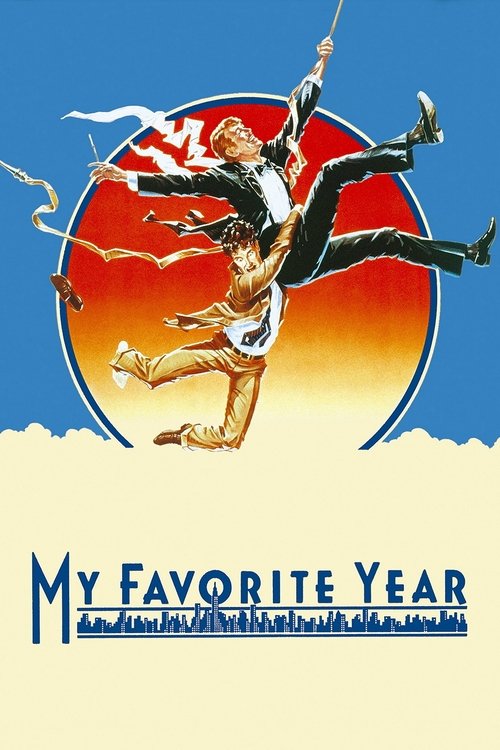
My Favorite Year
Fledgling comic Benjy Stone can't believe his luck when his childhood hero, the swashbuckling matinee idol Alan Swann, gets booked to appear on the variety show he writes for. But when Swann arrives, he fails to live up to his silver screen image. Instead, he's a drunken womanizer who suffers from stage fright. Benjy is assigned to look after him before the show, and it's all he can do to keep his former idol from going completely off the rails.
Despite its modest budget of $7.9M, My Favorite Year became a solid performer, earning $20.1M worldwide—a 155% return.
Nominated for 1 Oscar. 2 wins & 8 nominations


Plot Structure
Story beats plotted across runtime


Narrative Arc
Emotional journey through the story's key moments
Story Circle
Blueprint 15-beat structure
Arcplot Score Breakdown
Weighted: Precision (70%) + Arc (15%) + Theme (15%)
My Favorite Year (1982) showcases precise narrative architecture, characteristic of Richard Benjamin's storytelling approach. This structural analysis examines how the film's 15-point plot structure maps to proven narrative frameworks across 1 hour and 32 minutes. With an Arcplot score of 7.6, the film showcases strong structural fundamentals.
Characters
Cast & narrative archetypes

Benjy Stone
Alan Swann
K.C. Downing
King Kaiser
Belle Carroca
Sy Benson
Alice Miller
Rookie Carroca
Main Cast & Characters
Benjy Stone
Played by Mark Linn-Baker
A young comedy writer tasked with babysitting his idol, learning to balance professional responsibilities with personal growth.
Alan Swann
Played by Peter O'Toole
A charming but alcoholic former swashbuckling movie star who must confront his failures and rediscover his courage.
K.C. Downing
Played by Jessica Harper
The no-nonsense head writer who keeps the show running with sharp wit and firm leadership.
King Kaiser
Played by Joseph Bologna
A volatile, egotistical TV comedy star who runs his show like a tyrant but has genuine comedic talent.
Belle Carroca
Played by Jessica Harper
Benjy's strong-willed, working-class girlfriend who challenges him to grow up and take responsibility.
Sy Benson
Played by Bill Macy
The anxious, sweating producer trying to keep the chaotic live TV show from falling apart.
Alice Miller
Played by Lainie Kazan
Benjy's overbearing Jewish mother who embarrasses him but loves him fiercely.
Rookie Carroca
Played by Lou Jacobi
Belle's intimidating stepfather, a union man with traditional values and a gruff exterior.
Structural Analysis
The Status Quo at 1 minutes (1% through the runtime) establishes Benjy Stone works as a junior writer on King Kaiser's live TV variety show in 1954, scrambling to please his demanding boss while dreaming of being taken seriously.. Structural examination shows that this early placement immediately immerses viewers in the story world.
The inciting incident occurs at 11 minutes when Benjy learns that his childhood hero, swashbuckling movie star Alan Swann, will guest on the show. His excitement is palpable as this represents meeting his idol.. At 12% through the film, this Disruption aligns precisely with traditional story structure. This beat shifts the emotional landscape, launching the protagonist into the central conflict.
The First Threshold at 22 minutes marks the transition into Act II, occurring at 24% of the runtime. This shows the protagonist's commitment to Benjy actively chooses to take full responsibility for keeping Swann sober and functional, despite realizing his hero is deeply flawed. He commits to the task, entering Act 2., moving from reaction to action.
At 46 minutes, the Midpoint arrives at 51% of the runtime—precisely centered, creating perfect narrative symmetry. Structural examination shows that this crucial beat False defeat: Swann discovers the show will be broadcast live (not filmed) and panics. He reveals his terror of live performance and attempts to flee, raising the stakes dramatically., fundamentally raising what's at risk. The emotional intensity shifts, dividing the narrative into clear before-and-after phases.
The Collapse moment at 68 minutes (74% through) represents the emotional nadir. Here, Swann gets drunk and ruins a rehearsal completely, embarrassing himself and Benjy. Benjy's hero is truly dead - he must face that Alan Swann is just a broken, frightened man., demonstrates the protagonist at their lowest point. This beat's placement in the final quarter sets up the climactic reversal.
The Second Threshold at 73 minutes initiates the final act resolution at 79% of the runtime. Swann has a breakthrough: he realizes he can be brave for someone else (his daughter, Benjy). Benjy sees that real heroism is showing up despite fear. Both find new resolve., demonstrating the transformation achieved throughout the journey.
Emotional Journey
My Favorite Year's emotional architecture traces a deliberate progression across 15 carefully calibrated beats.
Narrative Framework
This structural analysis employs a 15-point narrative structure framework that maps key story moments. By mapping My Favorite Year against these established plot points, we can identify how Richard Benjamin utilizes or subverts traditional narrative conventions. The plot point approach reveals not only adherence to structural principles but also creative choices that distinguish My Favorite Year within the comedy genre.
Richard Benjamin's Structural Approach
Among the 7 Richard Benjamin films analyzed on Arcplot, the average structural score is 7.1, reflecting strong command of classical structure. My Favorite Year represents one of the director's most structurally precise works. For comparative analysis, explore the complete Richard Benjamin filmography.
Comparative Analysis
Additional comedy films include The Bad Guys, Ella Enchanted and The Evening Star. For more Richard Benjamin analyses, see Mrs. Winterbourne, City Heat and Milk Money.
Plot Points by Act
Act I
SetupStatus Quo
Benjy Stone works as a junior writer on King Kaiser's live TV variety show in 1954, scrambling to please his demanding boss while dreaming of being taken seriously.
Theme
King Kaiser tells Benjy about the importance of live television: "If you're good, you're remembered. If you're great, you're a legend." The theme of heroes versus human beings is planted.
Worldbuilding
Introduction to the chaotic world of 1950s live television, the comedy writers' room, King Kaiser's temperament, and Benjy's position as the low man trying to prove himself.
Disruption
Benjy learns that his childhood hero, swashbuckling movie star Alan Swann, will guest on the show. His excitement is palpable as this represents meeting his idol.
Resistance
Benjy is assigned to be Swann's babysitter and keep him sober until showtime. Initial meetings reveal Swann as a drunken, womanizing has-been, not the hero Benjy imagined. Benjy debates whether he can handle this responsibility.
Act II
ConfrontationFirst Threshold
Benjy actively chooses to take full responsibility for keeping Swann sober and functional, despite realizing his hero is deeply flawed. He commits to the task, entering Act 2.
Mirror World
Benjy brings Swann to meet his family in Brooklyn. His relationship with K.C. Downing (his love interest) deepens, and this subplot will teach him about authenticity versus image.
Premise
The fun of watching Benjy try to control the uncontrollable Swann. Adventures around New York, Swann's charm offensive, romantic mishaps, and growing bond between the mismatched pair.
Midpoint
False defeat: Swann discovers the show will be broadcast live (not filmed) and panics. He reveals his terror of live performance and attempts to flee, raising the stakes dramatically.
Opposition
Everything gets harder: Swann tries to escape multiple times, mobster Boss Hijack threatens violence on live TV, Benjy's relationship with K.C. is strained, and show week pressures mount.
Collapse
Swann gets drunk and ruins a rehearsal completely, embarrassing himself and Benjy. Benjy's hero is truly dead - he must face that Alan Swann is just a broken, frightened man.
Crisis
Benjy's dark night: he contemplates giving up on Swann entirely. Swann confronts his own failures, including his estranged daughter. Both men face their inadequacies.
Act III
ResolutionSecond Threshold
Swann has a breakthrough: he realizes he can be brave for someone else (his daughter, Benjy). Benjy sees that real heroism is showing up despite fear. Both find new resolve.
Synthesis
The live show: Swann overcomes his terror and performs brilliantly. When mobsters invade the studio, Swann becomes a real hero, using his swashbuckling skills to save King Kaiser. Benjy's faith is vindicated.
Transformation
Benjy, now confident and mature, narrates that this was indeed his favorite year - not because his hero was perfect, but because he learned what real courage looks like.