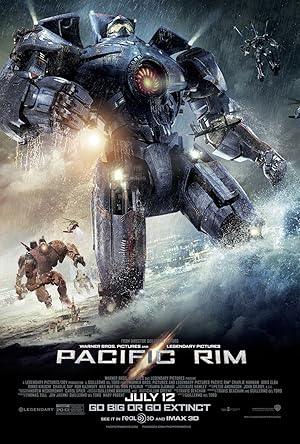
Pacific Rim
When monstrous creatures, known as Kaiju, started rising from the sea, a war began that would take millions of lives and consume humanity's resources for years on end. To combat the giant Kaiju, a special type of weapon was devised: massive robots, called Jaegers, which are controlled simultaneously by two pilots whose minds are locked in a neural bridge. But even the Jaegers are proving nearly defenseless in the face of the relentless Kaiju. On the verge of defeat, the forces defending mankind have no choice but to turn to two unlikely heroes - a washed up former pilot (Charlie Hunnam) and an untested trainee (Rinko Kikuchi) - who are teamed to drive a legendary but seemingly obsolete Jaeger from the past. Together, they stand as mankind's last hope against the mounting apocalypse.
Despite a massive budget of $180.0M, Pacific Rim became a commercial success, earning $411.0M worldwide—a 128% return. This commercial performance validated the ambitious narrative scope, showing that audiences embrace distinctive approach even at blockbuster scale.
Nominated for 1 BAFTA Award7 wins & 48 nominations


Plot Structure
Story beats plotted across runtime


Narrative Arc
Emotional journey through the story's key moments
Story Circle
Blueprint 15-beat structure
Arcplot Score Breakdown
Weighted: Precision (70%) + Arc (15%) + Theme (15%)
Pacific Rim (2013) showcases strategically placed narrative architecture, characteristic of Guillermo del Toro's storytelling approach. This structural analysis examines how the film's 15-point plot structure maps to proven narrative frameworks across 2 hours and 11 minutes. With an Arcplot score of 7.0, the film balances conventional beats with creative variation.
Characters
Cast & narrative archetypes

Raleigh Becket
Stacker Pentecost
Mako Mori
Dr. Newton Geiszler
Dr. Hermann Gottlieb
Hannibal Chau
Herc Hansen
Chuck Hansen
Main Cast & Characters
Raleigh Becket
Played by Charlie Hunnam
A former Jaeger pilot haunted by his brother's death who is pulled back into service to help save humanity from the Kaiju threat.
Stacker Pentecost
Played by Idris Elba
The commanding officer of the Pan Pacific Defense Corps who leads humanity's last stand against the Kaiju with unwavering resolve.
Mako Mori
Played by Rinko Kikuchi
A skilled pilot candidate whose childhood trauma from a Kaiju attack drives her determination to fight alongside Raleigh.
Dr. Newton Geiszler
Played by Charlie Day
An eccentric Kaiju researcher who seeks to understand the creatures through unorthodox neural drift experiments.
Dr. Hermann Gottlieb
Played by Burn Gorman
A rigid mathematician and physicist who predicts Kaiju attacks through calculations and constantly clashes with his colleague Newton.
Hannibal Chau
Played by Ron Perlman
A flamboyant black market dealer who trades in Kaiju organs and body parts, operating in the shadows of Hong Kong.
Herc Hansen
Played by Max Martini
An experienced Australian Jaeger pilot who must cope with the loss of his co-pilot while continuing to fight.
Chuck Hansen
Played by Robert Kazinsky
Herc's arrogant but skilled son and co-pilot who views Raleigh as a washed-up has-been.
Structural Analysis
The Status Quo at 1 minutes (1% through the runtime) establishes Raleigh and Yancy Becket pilot Gipsy Danger as celebrated Jaeger heroes, brothers in perfect neural sync, defending Anchorage from Kaiju attacks in humanity's golden age of winning the war.. Structural examination shows that this early placement immediately immerses viewers in the story world.
The inciting incident occurs at 15 minutes when Knifehead tears apart Gipsy Danger's cockpit and kills Yancy while still neurally linked to Raleigh. Raleigh experiences his brother's death directly through the drift, shattering him emotionally and ending his Jaeger career.. At 11% through the film, this Disruption aligns precisely with traditional story structure. This beat shifts the emotional landscape, launching the protagonist into the central conflict.
The First Threshold at 32 minutes marks the transition into Act II, occurring at 25% of the runtime. This reveals the protagonist's commitment to Raleigh chooses to actively return to the Shatterdome and rejoin the Jaeger program, walking into the Hong Kong base and committing to pilot again despite his trauma - an irreversible choice to re-enter the war., moving from reaction to action.
At 66 minutes, the Midpoint arrives at 50% of the runtime—precisely centered, creating perfect narrative symmetry. Notably, this crucial beat Double Event and Category 4 Kaiju attack Hong Kong. Gipsy Danger (Raleigh and Mako's first real combat together) defeats both Kaiju using a cargo ship as a bat and plasma cannon - false victory proving they can fight together, but stakes raise as attacks intensify., fundamentally raising what's at risk. The emotional intensity shifts, dividing the narrative into clear before-and-after phases.
The Collapse moment at 97 minutes (74% through) represents the emotional nadir. Here, Striker Eureka is destroyed and Pentecost is mortally wounded (literal death approaching). Only Gipsy Danger remains functional. The final plan requires a nuclear sacrifice to blow the Breach from inside - all seems lost as humanity's last defense crumbles., illustrates the protagonist at their lowest point. This beat's placement in the final quarter sets up the climactic reversal.
The Second Threshold at 104 minutes initiates the final act resolution at 79% of the runtime. Pentecost sacrifices himself to clear the path, telling Raleigh "Fortune favors the brave" and detonating Striker Eureka. This sacrifice and Newton's Kaiju-brain knowledge gives Raleigh and Mako the opening and information needed to execute the final mission., demonstrating the transformation achieved throughout the journey.
Emotional Journey
Pacific Rim's emotional architecture traces a deliberate progression across 15 carefully calibrated beats.
Narrative Framework
This structural analysis employs a 15-point narrative structure framework that maps key story moments. By mapping Pacific Rim against these established plot points, we can identify how Guillermo del Toro utilizes or subverts traditional narrative conventions. The plot point approach reveals not only adherence to structural principles but also creative choices that distinguish Pacific Rim within the action genre.
Guillermo del Toro's Structural Approach
Among the 9 Guillermo del Toro films analyzed on Arcplot, the average structural score is 6.9, demonstrating varied approaches to story architecture. Pacific Rim represents one of the director's most structurally precise works. For comparative analysis, explore the complete Guillermo del Toro filmography.
Comparative Analysis
Additional action films include The Bad Guys, Puss in Boots and Venom: The Last Dance. For more Guillermo del Toro analyses, see Hellboy, The Shape of Water and Nightmare Alley.
Plot Points by Act
Act I
SetupStatus Quo
Raleigh and Yancy Becket pilot Gipsy Danger as celebrated Jaeger heroes, brothers in perfect neural sync, defending Anchorage from Kaiju attacks in humanity's golden age of winning the war.
Theme
Yancy tells Raleigh "We have to take this hit together" during the Knifehead battle - establishing the film's central theme that individual strength fails, but connection and trust in others creates true power.
Worldbuilding
Narration and montage establish the Kaiju War: monsters from dimensional rift, Jaegers built to fight them, neural handshake drift technology, early victories turning to stalemate. Shows Raleigh and Yancy's partnership and the cost of neural connection.
Disruption
Knifehead tears apart Gipsy Danger's cockpit and kills Yancy while still neurally linked to Raleigh. Raleigh experiences his brother's death directly through the drift, shattering him emotionally and ending his Jaeger career.
Resistance
Five years later, Raleigh works construction on the Anti-Kaiju Wall, isolated and traumatized. Stacker Pentecost finds him and offers one last mission: join the final Jaeger offensive at the Shatterdome in Hong Kong. Raleigh resists but is drawn by unfinished business.
Act II
ConfrontationFirst Threshold
Raleigh chooses to actively return to the Shatterdome and rejoin the Jaeger program, walking into the Hong Kong base and committing to pilot again despite his trauma - an irreversible choice to re-enter the war.
Mirror World
Raleigh meets Mako Mori, who watches him with intensity and clear personal investment. Their immediate connection and Mako's own trauma (childhood Kaiju attack) creates the relationship that will teach Raleigh to trust and connect again.
Premise
Giant robots fighting giant monsters - the promise of the premise delivered. Includes: Raleigh testing potential co-pilots, choosing Mako, their disastrous drift compatibility test where Mako's memories nearly destroy the base, and preparation for the final assault plan.
Midpoint
Double Event and Category 4 Kaiju attack Hong Kong. Gipsy Danger (Raleigh and Mako's first real combat together) defeats both Kaiju using a cargo ship as a bat and plasma cannon - false victory proving they can fight together, but stakes raise as attacks intensify.
Opposition
The Hong Kong battle costs them Crimson Typhoon and Cherno Alpha (both Jaegers destroyed). Newton drifts with Kaiju brain and discovers the aliens' plan. Kaiju are evolving and learning. Plan to bomb the Breach fails - nothing can get through. Resources and options dwindle.
Collapse
Striker Eureka is destroyed and Pentecost is mortally wounded (literal death approaching). Only Gipsy Danger remains functional. The final plan requires a nuclear sacrifice to blow the Breach from inside - all seems lost as humanity's last defense crumbles.
Crisis
Pentecost's dark night moment where he transfers the nuclear payload to Gipsy Danger and accepts his death. Raleigh and Mako face the impossibility of their mission: fight through three Category 4 Kaiju and breach an alien dimension to deliver the bomb.
Act III
ResolutionSecond Threshold
Pentecost sacrifices himself to clear the path, telling Raleigh "Fortune favors the brave" and detonating Striker Eureka. This sacrifice and Newton's Kaiju-brain knowledge gives Raleigh and Mako the opening and information needed to execute the final mission.
Synthesis
Gipsy Danger battles through remaining Kaiju, enters the Breach using a Kaiju as biological key, deploys the nuclear payload to destroy the portal from inside. Raleigh sacrifices his escape pod so Mako can survive, embodying the theme of connection over self.
Transformation
Raleigh surfaces alive and reunites with Mako in the ocean. The isolated, broken man from the beginning is now someone who trusts, connects, and lives for others. They embrace in the water - transformation from trauma and isolation to connection and hope.