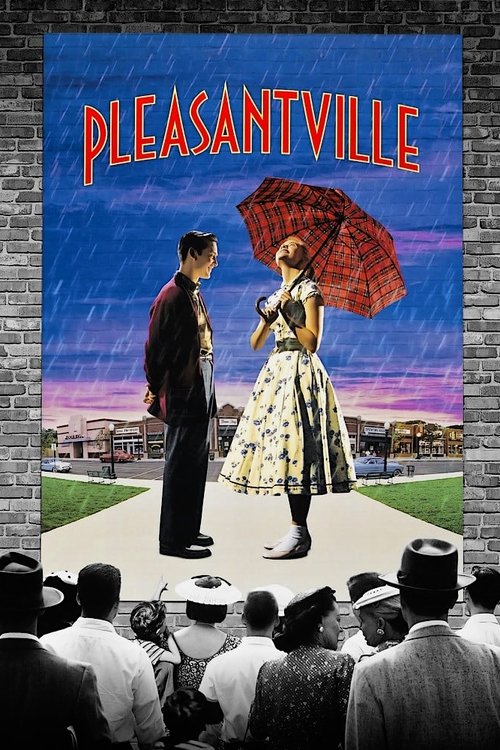
Pleasantville
Geeky teenager David and his popular twin sister, Jennifer, get sucked into the black-and-white world of a 1950s TV sitcom called "Pleasantville," and find a world where everything is peachy keen all the time. But when Jennifer's modern attitude disrupts Pleasantville's peaceful but boring routine, she literally brings color into its life.
The film disappointed at the box office against its mid-range budget of $60.0M, earning $49.8M globally (-17% loss).
Nominated for 3 Oscars. 18 wins & 45 nominations


Plot Structure
Story beats plotted across runtime


Narrative Arc
Emotional journey through the story's key moments
Story Circle
Blueprint 15-beat structure
Arcplot Score Breakdown
Weighted: Precision (70%) + Arc (15%) + Theme (15%)
Pleasantville (1998) exhibits precise dramatic framework, characteristic of Gary Ross's storytelling approach. This structural analysis examines how the film's 15-point plot structure maps to proven narrative frameworks across 2 hours and 4 minutes. With an Arcplot score of 7.4, the film balances conventional beats with creative variation.
Characters
Cast & narrative archetypes

David Wagner / Bud Parker
Jennifer Wagner / Mary Sue Parker
Betty Parker
George Parker
Bill Johnson
Big Bob
TV Repairman
Skip Martin
Main Cast & Characters
David Wagner / Bud Parker
Played by Tobey Maguire
A shy, socially awkward teenager obsessed with the 1950s TV show Pleasantville who becomes trapped inside the show as the character Bud Parker, ultimately learning to embrace change and authenticity.
Jennifer Wagner / Mary Sue Parker
Played by Reese Witherspoon
David's popular, sexually liberated twin sister who is transported into Pleasantville as Mary Sue, initially disrupting the town's innocence before discovering her own intellectual depth.
Betty Parker
Played by Joan Allen
The quintessential 1950s TV housewife and mother who awakens to passion and self-expression, becoming one of the first characters to transform into color.
George Parker
Played by William H. Macy
The traditional patriarch and husband who struggles to accept the changes happening in Pleasantville, representing the resistance to social progress and personal growth.
Bill Johnson
Played by Jeff Daniels
The gentle, repressed soda shop owner and artist who discovers his passion for painting through Betty, becoming a symbol of creative awakening and forbidden love.
Big Bob
Played by J.T. Walsh
The town mayor and leader of the reactionary movement against the "colored" citizens, embodying authoritarian resistance to change and social progress.
TV Repairman
Played by Don Knotts
A mysterious figure who gives David the magical remote control that transports the twins into Pleasantville, serving as the catalyst for the entire adventure.
Skip Martin
Played by Paul Walker
The captain of the basketball team and Mary Sue's love interest in Pleasantville, one of the first teenagers to experience emotional awakening.
Structural Analysis
The Status Quo at 1 minutes (1% through the runtime) establishes David watches Pleasantville reruns in his lonely room, escaping his troubled 1990s life through the perfect black-and-white 1950s sitcom world where nothing ever goes wrong.. Structural examination shows that this early placement immediately immerses viewers in the story world.
The inciting incident occurs at 16 minutes when The mysterious TV repairman appears with a magical remote that zaps David and Jennifer into the black-and-white world of Pleasantville as Bud and Mary Sue Parker.. At 13% through the film, this Disruption is delayed, allowing extended setup of the story world. This beat shifts the emotional landscape, launching the protagonist into the central conflict.
The First Threshold at 31 minutes marks the transition into Act II, occurring at 25% of the runtime. This reveals the protagonist's commitment to Jennifer chooses to have sex with Skip at Lover's Lane, actively breaking the sitcom script and introducing real human experience into Pleasantville — the first irreversible change that brings color., moving from reaction to action.
At 63 minutes, the Midpoint arrives at 50% of the runtime—precisely centered, creating perfect narrative symmetry. Structural examination shows that this crucial beat The fire at the soda shop reveals Pleasantville's division — "coloreds" versus black-and-white citizens. The false victory of awakening turns into conflict as Mayor Big Bob organizes resistance to change., fundamentally raising what's at risk. The emotional intensity shifts, dividing the narrative into clear before-and-after phases.
The Collapse moment at 94 minutes (76% through) represents the emotional nadir. Here, The mob vandalizes Mr. Johnson's mural and destroys the soda shop. David witnesses the death of innocence and safety, seeing that awakening brings real pain and conflict, not just liberation., shows the protagonist at their lowest point. This beat's placement in the final quarter sets up the climactic reversal.
The Second Threshold at 100 minutes initiates the final act resolution at 81% of the runtime. David chooses to defend the colored people at the town meeting, realizing that authentic life with pain is better than pleasant numbness. He accepts he can't go back to seeing the world in black and white., demonstrating the transformation achieved throughout the journey.
Emotional Journey
Pleasantville's emotional architecture traces a deliberate progression across 15 carefully calibrated beats.
Narrative Framework
This structural analysis employs proven narrative structure principles that track dramatic progression. By mapping Pleasantville against these established plot points, we can identify how Gary Ross utilizes or subverts traditional narrative conventions. The plot point approach reveals not only adherence to structural principles but also creative choices that distinguish Pleasantville within the fantasy genre.
Gary Ross's Structural Approach
Among the 5 Gary Ross films analyzed on Arcplot, the average structural score is 6.9, demonstrating varied approaches to story architecture. Pleasantville represents one of the director's most structurally precise works. For comparative analysis, explore the complete Gary Ross filmography.
Comparative Analysis
Additional fantasy films include Thinner, Ella Enchanted and Conan the Barbarian. For more Gary Ross analyses, see The Hunger Games, Ocean's Eight and Free State of Jones.
Plot Points by Act
Act I
SetupStatus Quo
David watches Pleasantville reruns in his lonely room, escaping his troubled 1990s life through the perfect black-and-white 1950s sitcom world where nothing ever goes wrong.
Theme
The TV repairman asks David, "What's the matter? Don't you like it here?" — establishing the central question about whether perfect conformity is preferable to messy authenticity.
Worldbuilding
Establishing David's obsession with Pleasantville as escape, his sister Jennifer's superficiality, their broken family, and the contrast between 90s dysfunction and 50s TV perfection.
Disruption
The mysterious TV repairman appears with a magical remote that zaps David and Jennifer into the black-and-white world of Pleasantville as Bud and Mary Sue Parker.
Resistance
David tries to maintain the show's script and keep everything "pleasant" while Jennifer rebels, both navigating the rules of the sitcom world and debating whether to stay or find a way home.
Act II
ConfrontationFirst Threshold
Jennifer chooses to have sex with Skip at Lover's Lane, actively breaking the sitcom script and introducing real human experience into Pleasantville — the first irreversible change that brings color.
Mirror World
David connects with Mr. Johnson the soda shop owner, who becomes his thematic mirror — an artist trapped in a colorless world, representing the cost of repressed creativity and passion.
Premise
The "fun and games" of watching Pleasantville transform: people discover color through passion, books fill with stories, rain falls for the first time, and art comes alive as characters awaken to real emotions.
Midpoint
The fire at the soda shop reveals Pleasantville's division — "coloreds" versus black-and-white citizens. The false victory of awakening turns into conflict as Mayor Big Bob organizes resistance to change.
Opposition
The town cracks down on colored people with rules and persecution. David must defend his mother and Mr. Johnson while the forces of conformity grow stronger and more violent.
Collapse
The mob vandalizes Mr. Johnson's mural and destroys the soda shop. David witnesses the death of innocence and safety, seeing that awakening brings real pain and conflict, not just liberation.
Crisis
David sits in the darkness after the destruction, processing whether change is worth the cost. He faces the fear that by bringing color and emotion, he's destroyed the very safety he loved about Pleasantville.
Act III
ResolutionSecond Threshold
David chooses to defend the colored people at the town meeting, realizing that authentic life with pain is better than pleasant numbness. He accepts he can't go back to seeing the world in black and white.
Synthesis
David's courtroom speech transforms Big Bob to color by making him feel real anger. The town accepts change, Jennifer chooses to stay and learn, David returns home ready to face real life, and Pleasantville becomes fully colored.
Transformation
David returns to the 90s in color, reunites with his mother, and comforts her with newfound emotional maturity — no longer escaping into TV but engaging with the beautiful mess of real life.