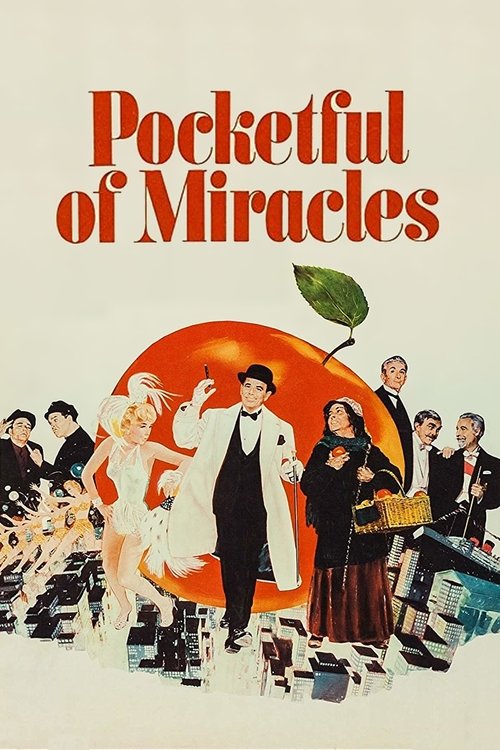
Pocketful of Miracles
A New York gangster and his girlfriend attempt to turn street beggar Apple Annie into a society lady when the peddler learns her daughter is marrying royalty.
Working with a tight budget of $2.9M, the film achieved a modest success with $5.0M in global revenue (+72% profit margin).
Nominated for 3 Oscars. 2 wins & 8 nominations


Plot Structure
Story beats plotted across runtime


Narrative Arc
Emotional journey through the story's key moments
Story Circle
Blueprint 15-beat structure
Arcplot Score Breakdown
Weighted: Precision (70%) + Arc (15%) + Theme (15%)
Pocketful of Miracles (1961) exemplifies deliberately positioned story structure, characteristic of Frank Capra's storytelling approach. This structural analysis examines how the film's 15-point plot structure maps to proven narrative frameworks across 2 hours and 16 minutes. With an Arcplot score of 7.1, the film balances conventional beats with creative variation.
Characters
Cast & narrative archetypes

Apple Annie
Dave the Dude
Queenie Martin
Joy Boy
Judge Henry G. Blake
Louise
Darcey
Steve Darcey
Main Cast & Characters
Apple Annie
Played by Bette Davis
An aging street vendor who sells apples in Times Square, secretly maintaining a fiction to her daughter in Spain that she is a wealthy society woman.
Dave the Dude
Played by Glenn Ford
A superstitious Broadway gangster who believes buying apples from Annie brings him luck, and orchestrates an elaborate scheme to help her maintain her deception.
Queenie Martin
Played by Hope Lange
Dave's loyal girlfriend and nightclub performer who helps with the transformation of Annie into a society lady.
Joy Boy
Played by Peter Falk
Dave's comical right-hand man and trusted associate who assists in the elaborate deception scheme.
Judge Henry G. Blake
Played by Thomas Mitchell
A down-on-his-luck pool hustler recruited to pose as Annie's husband, Count Alfonso Dolorosa Donatello Doolittle, for the visiting Spanish aristocrats.
Louise
Played by Ann-Margret
Annie's daughter who has been raised in a Spanish convent, believing her mother is a wealthy society matron, and is coming to New York with her fiance.
Darcey
Played by Edward Everett Horton
A persistent and skeptical newspaper reporter who senses something is amiss with the elaborate scheme.
Steve Darcey
Played by Sheldon Leonard
A rival gangster who poses a threat to Dave's operations and creates tension during the elaborate deception.
Structural Analysis
The Status Quo at 2 minutes (1% through the runtime) establishes Dave the Dude runs his bootlegging empire with superstitious dependence on Apple Annie, a street peddler he believes brings him luck.. The analysis reveals that this early placement immediately immerses viewers in the story world.
The inciting incident occurs at 16 minutes when Annie reveals her daughter Louise is coming to New York with her fiancé Carlos and his noble father Count Romero, expecting to meet her wealthy mother and high-society friends.. At 12% through the film, this Disruption aligns precisely with traditional story structure. This beat shifts the emotional landscape, launching the protagonist into the central conflict.
The First Threshold at 33 minutes marks the transition into Act II, occurring at 25% of the runtime. This indicates the protagonist's commitment to Dave fully commits to the masquerade, transforming Annie into "Mrs. E. Worthington Manville" and launching the elaborate deception with the mansion ready and staff in place., moving from reaction to action.
At 69 minutes, the Midpoint arrives at 50% of the runtime—precisely centered, creating perfect narrative symmetry. Notably, this crucial beat False victory: Count Romero approves the marriage and the Governor agrees to host a grand reception at his mansion, raising the stakes enormously but seeming like success is within reach., fundamentally raising what's at risk. The emotional intensity shifts, dividing the narrative into clear before-and-after phases.
The Collapse moment at 102 minutes (75% through) represents the emotional nadir. Here, The entire scheme threatens to unravel when society reporters and gossip columnists begin investigating Annie's background, and the rival mob moves to destroy Dave during his moment of vulnerability., demonstrates the protagonist at their lowest point. This beat's placement in the final quarter sets up the climactic reversal.
The Second Threshold at 108 minutes initiates the final act resolution at 80% of the runtime. Dave realizes the entire underworld and high society have come together to protect the illusion because they've all been touched by the genuine love and transformation at the heart of the deception., demonstrating the transformation achieved throughout the journey.
Emotional Journey
Pocketful of Miracles's emotional architecture traces a deliberate progression across 15 carefully calibrated beats.
Narrative Framework
This structural analysis employs systematic plot point analysis that identifies crucial turning points. By mapping Pocketful of Miracles against these established plot points, we can identify how Frank Capra utilizes or subverts traditional narrative conventions. The plot point approach reveals not only adherence to structural principles but also creative choices that distinguish Pocketful of Miracles within the comedy genre.
Frank Capra's Structural Approach
Among the 6 Frank Capra films analyzed on Arcplot, the average structural score is 6.1, demonstrating varied approaches to story architecture. Pocketful of Miracles represents one of the director's most structurally precise works. For comparative analysis, explore the complete Frank Capra filmography.
Comparative Analysis
Additional comedy films include The Bad Guys, Ella Enchanted and The Evening Star. For more Frank Capra analyses, see It's A Wonderful Life, You Can't Take It with You and Arsenic and Old Lace.
Plot Points by Act
Act I
SetupStatus Quo
Dave the Dude runs his bootlegging empire with superstitious dependence on Apple Annie, a street peddler he believes brings him luck.
Theme
Joy Boy suggests that maintaining illusions and helping others can bring unexpected rewards, hinting at the transformative power of compassion.
Worldbuilding
Introduction of 1930s New York underworld: Dave's operations, his relationship with Queenie Martin, the supporting cast of colorful gangsters, and Annie's desperate letters to her daughter in Spain about a fabricated wealthy lifestyle.
Disruption
Annie reveals her daughter Louise is coming to New York with her fiancé Carlos and his noble father Count Romero, expecting to meet her wealthy mother and high-society friends.
Resistance
Dave debates whether to help Annie despite risks to his business. He recruits his gang, acquires a mansion, hires actors, and convinces Judge Blake to pose as Annie's husband, all while dodging mob rival complications.
Act II
ConfrontationFirst Threshold
Dave fully commits to the masquerade, transforming Annie into "Mrs. E. Worthington Manville" and launching the elaborate deception with the mansion ready and staff in place.
Mirror World
Louise arrives and embraces her "mother," representing the authentic love and family connection that contrasts with Dave's cynical world of crime and deception.
Premise
The fun of the con: elaborate society parties, narrow escapes from exposure, gangsters posing as butlers, Dave managing both the masquerade and his underworld deals, and Annie blossoming into her role.
Midpoint
False victory: Count Romero approves the marriage and the Governor agrees to host a grand reception at his mansion, raising the stakes enormously but seeming like success is within reach.
Opposition
The pressure intensifies: preparations for the Governor's reception grow more complex, rival gangster threatens Dave's operation, Queenie grows jealous and suspicious, and the risk of exposure multiplies with each society figure involved.
Collapse
The entire scheme threatens to unravel when society reporters and gossip columnists begin investigating Annie's background, and the rival mob moves to destroy Dave during his moment of vulnerability.
Crisis
Dave faces losing everything: his reputation, his business, possibly his life, and the heartbreak of failing Annie and Louise. The weight of trying to do something good in his corrupt world crushes down.
Act III
ResolutionSecond Threshold
Dave realizes the entire underworld and high society have come together to protect the illusion because they've all been touched by the genuine love and transformation at the heart of the deception.
Synthesis
The grand reception succeeds spectacularly with all of New York society and the underworld united in supporting Annie. Louise and Carlos marry with blessings. Dave reconciles with Queenie and resolves his business troubles.
Transformation
Annie, now genuinely dignified and transformed by being believed in, bids farewell to her daughter while Dave demonstrates he's learned compassion has its own rewards, still buying apples from Annie for luck.