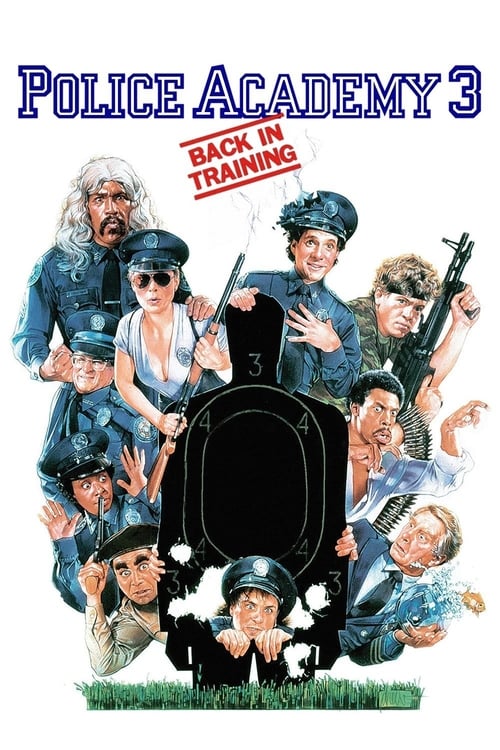
Police Academy 3: Back in Training
When police funding is cut, the Governor announces he must close one of the academies. To make it fair, the two police academies must compete against each other to stay in operation. Mauser persuades two officers in Lassard's academy to better his odds, but things don't quite turn out as expected...
Despite its tight budget of $12.0M, Police Academy 3: Back in Training became a massive hit, earning $107.6M worldwide—a remarkable 797% return. The film's fresh perspective found its audience, proving that strong storytelling can transcend budget limitations.


Plot Structure
Story beats plotted across runtime


Narrative Arc
Emotional journey through the story's key moments
Story Circle
Blueprint 15-beat structure
Arcplot Score Breakdown
Weighted: Precision (70%) + Arc (15%) + Theme (15%)
Police Academy 3: Back in Training (1986) showcases precise dramatic framework, characteristic of Jerry Paris's storytelling approach. This structural analysis examines how the film's 15-point plot structure maps to proven narrative frameworks across 1 hour and 24 minutes. With an Arcplot score of 7.3, the film balances conventional beats with creative variation.
Characters
Cast & narrative archetypes

Carey Mahoney
Commandant Eric Lassard
Moses Hightower
Eugene Tackleberry
Larvell Jones
Laverne Hooks
Douglas Fackler
Debbie Callahan
Commandant Mauser
Proctor
Cadet Karen Adams
Cadet Tomoko Nogata
Cadet Sweetchuck
Cadet Zed
Main Cast & Characters
Carey Mahoney
Played by Steve Guttenberg
A wise-cracking, resourceful police officer who returns to the academy as an instructor to help save Commandant Lassard's program from closure.
Commandant Eric Lassard
Played by George Gaynes
The kindly but oblivious head of the police academy who faces losing his institution in a competition against a rival academy.
Moses Hightower
Played by Bubba Smith
A gentle giant with immense physical strength who serves as an instructor, using his imposing presence and kind heart to train recruits.
Eugene Tackleberry
Played by David Graf
A gun-obsessed, militaristic officer who takes weapons training extremely seriously and marries fellow officer Kathleen Kirkland.
Larvell Jones
Played by Michael Winslow
A master of vocal sound effects who uses his unique talent to confuse criminals and entertain his fellow officers.
Laverne Hooks
Played by Marion Ramsey
A soft-spoken officer who discovers her powerful voice when angered, transitioning from timid to formidable when pushed.
Douglas Fackler
Played by Bruce Mahler
A well-meaning but accident-prone officer whose clumsiness creates chaos wherever he goes.
Debbie Callahan
Played by Leslie Easterbrook
A tough, attractive female instructor known for her driving skills and ability to handle any situation with confidence.
Commandant Mauser
Played by Art Metrano
The arrogant, scheming commandant of the rival academy who uses underhanded tactics to try to shut down Lassard's program.
Proctor
Played by Lance Kinsey
Mauser's dimwitted, sycophantic assistant who blindly follows orders and often bungles simple tasks.
Cadet Karen Adams
Played by Shawn Weatherly
An intelligent and capable new recruit who becomes romantically involved with Mahoney.
Cadet Tomoko Nogata
Played by Brian Tochi
A Japanese exchange student cadet who is eager to learn American police methods and develops a crush on Callahan.
Cadet Sweetchuck
Played by Tim Kazurinsky
A nervous, easily frightened convenience store owner who joins the academy after repeated robberies at his store.
Cadet Zed
Played by Bobcat Goldthwait
A reformed gang leader with a wild personality who channels his chaotic energy into becoming a police officer alongside his former victim Sweetchuck.
Structural Analysis
The Status Quo at 1 minutes (1% through the runtime) establishes Mahoney and the beloved academy cadets celebrate their success as full-fledged police officers, demonstrating their competence and camaraderie through effective street policing.. Significantly, this early placement immediately immerses viewers in the story world.
The inciting incident occurs at 10 minutes when Governor announces that due to budget cuts, one of the two police academies must close, with the decision based on a competitive evaluation of their upcoming classes.. At 12% through the film, this Disruption aligns precisely with traditional story structure. This beat shifts the emotional landscape, launching the protagonist into the central conflict.
The First Threshold at 21 minutes marks the transition into Act II, occurring at 25% of the runtime. This reveals the protagonist's commitment to Mahoney and the team officially return to the academy as instructors, fully committing to save Lassard's academy and train the new class of recruits against Mauser's interference., moving from reaction to action.
At 42 minutes, the Midpoint arrives at 50% of the runtime—precisely centered, creating perfect narrative symmetry. Significantly, this crucial beat A major public embarrassment orchestrated by Mauser (cadets cause chaos at a dignitary event) makes it appear Lassard's academy is incompetent, raising stakes and seemingly giving Mauser the upper hand., fundamentally raising what's at risk. The emotional intensity shifts, dividing the narrative into clear before-and-after phases.
The Collapse moment at 63 minutes (75% through) represents the emotional nadir. Here, Commandant Lassard is forced into retirement/removal by the governor's office after Mauser's final sabotage succeeds, seemingly ensuring his academy will close. The heart of the academy is symbolically dead., illustrates the protagonist at their lowest point. This beat's placement in the final quarter sets up the climactic reversal.
The Second Threshold at 67 minutes initiates the final act resolution at 80% of the runtime. Mahoney rallies the team and cadets with renewed determination, realizing they must prove their worth through action rather than politics. They discover evidence of Mauser's sabotage and prepare for the final evaluation., demonstrating the transformation achieved throughout the journey.
Emotional Journey
Police Academy 3: Back in Training's emotional architecture traces a deliberate progression across 15 carefully calibrated beats.
Narrative Framework
This structural analysis employs a 15-point narrative structure framework that maps key story moments. By mapping Police Academy 3: Back in Training against these established plot points, we can identify how Jerry Paris utilizes or subverts traditional narrative conventions. The plot point approach reveals not only adherence to structural principles but also creative choices that distinguish Police Academy 3: Back in Training within the comedy genre.
Jerry Paris's Structural Approach
Among the 3 Jerry Paris films analyzed on Arcplot, the average structural score is 7.3, reflecting strong command of classical structure. Police Academy 3: Back in Training exemplifies the director's characteristic narrative technique. For comparative analysis, explore the complete Jerry Paris filmography.
Comparative Analysis
Additional comedy films include The Bad Guys, Ella Enchanted and The Evening Star. For more Jerry Paris analyses, see Don't Raise the Bridge, Lower the River, Police Academy 2: Their First Assignment.
Plot Points by Act
Act I
SetupStatus Quo
Mahoney and the beloved academy cadets celebrate their success as full-fledged police officers, demonstrating their competence and camaraderie through effective street policing.
Theme
Commandant Lassard expresses that the academy represents heart, spirit, and dedication over mere protocol, establishing the thematic conflict between genuine mentorship and bureaucratic rigidity.
Worldbuilding
Introduction to the two competing police academies: Lassard's beloved but underfunded academy versus Mauser's strict, by-the-book rival academy. The state budget crisis threatens to close one academy.
Disruption
Governor announces that due to budget cuts, one of the two police academies must close, with the decision based on a competitive evaluation of their upcoming classes.
Resistance
Commandant Lassard reluctantly calls back his best graduates (Mahoney, Tackleberry, Jones, etc.) to help train the new recruits. Mauser schemes to sabotage Lassard's academy through dirty tricks and recruiting inferior candidates.
Act II
ConfrontationFirst Threshold
Mahoney and the team officially return to the academy as instructors, fully committing to save Lassard's academy and train the new class of recruits against Mauser's interference.
Mirror World
The new cadets begin bonding with their unconventional instructors, particularly the developing relationships that will mirror the original team's unity and emphasize heart over rigidity.
Premise
Training montages showcase both comedy and competence as Mahoney's team uses unorthodox methods to whip recruits into shape, while Mauser escalates sabotage attempts including sending Proctor to spy and creating embarrassing situations.
Midpoint
A major public embarrassment orchestrated by Mauser (cadets cause chaos at a dignitary event) makes it appear Lassard's academy is incompetent, raising stakes and seemingly giving Mauser the upper hand.
Opposition
Mauser intensifies sabotage with stolen equipment, false accusations, and planted evidence. Lassard's academy struggles with morale while Mahoney fights to keep recruits focused despite mounting obstacles and apparent inevitability of closure.
Collapse
Commandant Lassard is forced into retirement/removal by the governor's office after Mauser's final sabotage succeeds, seemingly ensuring his academy will close. The heart of the academy is symbolically dead.
Crisis
Mahoney and team experience despair and defeat, questioning whether their methods and spirit can overcome political maneuvering. They must decide whether to give up or fight for what Lassard built.
Act III
ResolutionSecond Threshold
Mahoney rallies the team and cadets with renewed determination, realizing they must prove their worth through action rather than politics. They discover evidence of Mauser's sabotage and prepare for the final evaluation.
Synthesis
During the final evaluation/emergency crisis, Lassard's cadets demonstrate superior real-world policing by combining their training with heart and improvisation, exposing Mauser's incompetence and cheating, ultimately saving the day and the academy.
Transformation
Lassard's academy is saved and celebrated. Mahoney and team stand proudly with their graduated cadets, demonstrating that spirit, heart, and unorthodox dedication triumph over rigid bureaucracy. The family remains intact.