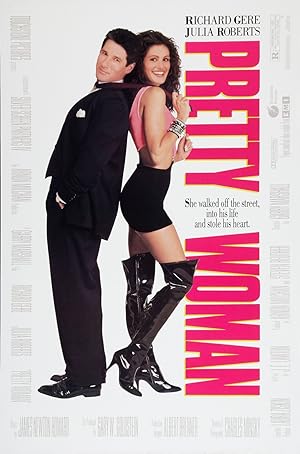
Pretty Woman
Because of his extreme wealth and suave good looks, Edward Lewis could seemingly have any woman he wants, that committed significant other which he needs on his arm at social events to further how he makes his money as a corporate raider. However, he focuses more on his corporate raiding pursuits with his partner in crime, Philip Stuckey, his lawyer of ten years, than those women, with every significant other he's had in his life feeling neglected and eventually leaving him, this fact about which he is just coming to the realization. In Beverly Hills, Edward, in needing that woman on his arms as he and Philip work toward taking over the company owned by the increasingly insolvent James Morse, decides, based on a chance encounter, to hire Hollywood Boulevard hooker Vivian Ward as his escort for the week 24/7. He does so because he wants to have a professional who would be committed to the work, yet not have any commitments to her after the week is over. Beyond their chance encounter, he also makes this decision because she surprises him about how unhookerish she is in certain respects. Vivian, relatively new to Los Angeles and the business, still has to look and act the part, with Edward, beyond giving her money, leaving her largely to her own devices to do so. So she gets a somewhat unlikely Henry Higgins in Barney Thompson, the manager of the Beverly Wilshire Hotel where Edward is staying. Barney has to draw that fine line of keeping the hotel's upscale clients happy, while maintaining the posh decorum of the upper class, which does not include people coming into the hotel looking for rooms with hourly rates. As Barney and his associates are able to transform Vivian into a Cinderella, the questions become whether Vivian can go back to her Hollywood Boulevard life and whether she does have her Prince Charming beyond this week in the form of Edward or anyone else who truly does see her as Cinderella as opposed to a Hollywood Boulevard streetwalker.
Despite its tight budget of $14.0M, Pretty Woman became a box office phenomenon, earning $463.4M worldwide—a remarkable 3210% return. The film's unique voice found its audience, proving that strong storytelling can transcend budget limitations.
Nominated for 1 Oscar. 8 wins & 11 nominations


Plot Structure
Story beats plotted across runtime


Narrative Arc
Emotional journey through the story's key moments
Story Circle
Blueprint 15-beat structure
Arcplot Score Breakdown
Weighted: Precision (70%) + Arc (15%) + Theme (15%)
Pretty Woman (1990) exhibits meticulously timed plot construction, characteristic of Garry Marshall's storytelling approach. This structural analysis examines how the film's 15-point plot structure maps to proven narrative frameworks across 2 hours. With an Arcplot score of 6.7, the film balances conventional beats with creative variation.
Characters
Cast & narrative archetypes

Vivian Ward
Edward Lewis
Kit De Luca
Philip Stuckey
James Morse
Barney Thompson
Main Cast & Characters
Vivian Ward
Played by Julia Roberts
A Hollywood Boulevard prostitute with street smarts and natural charm who becomes involved with a wealthy businessman.
Edward Lewis
Played by Richard Gere
A wealthy corporate raider who hires Vivian for a week and gradually falls in love with her.
Kit De Luca
Played by Laura San Giacomo
Vivian's best friend and fellow sex worker who provides comic relief and emotional support.
Philip Stuckey
Played by Jason Alexander
Edward's sleazy lawyer and business associate who represents corruption and moral compromise.
James Morse
Played by Ralph Bellamy
The elderly businessman whose company Edward is attempting to acquire through a hostile takeover.
Barney Thompson
Played by Hector Elizondo
The hotel manager at the Regent Beverly Wilshire who helps Vivian navigate high society with kindness and discretion.
Structural Analysis
The Status Quo at 1 minutes (1% through the runtime) establishes Vivian works as a prostitute on Hollywood Boulevard, struggling to make rent with her roommate Kit. She's street-smart but trapped in a life of survival with no clear future.. The analysis reveals that this early placement immediately immerses viewers in the story world.
The inciting incident occurs at 14 minutes when Edward gets lost driving his lawyer's Lotus in Hollywood. He stops to ask Vivian for directions, and she offers to guide him to his hotel for money. This chance encounter disrupts both their lives.. At 12% through the film, this Disruption aligns precisely with traditional story structure. This beat shifts the emotional landscape, launching the protagonist into the central conflict.
The First Threshold at 29 minutes marks the transition into Act II, occurring at 24% of the runtime. This indicates the protagonist's commitment to Vivian agrees to the week-long arrangement and moves into Edward's penthouse suite. She actively chooses to enter his world of wealth and privilege, leaving her street life behind temporarily., moving from reaction to action.
At 59 minutes, the Midpoint arrives at 49% of the runtime—precisely centered, creating perfect narrative symmetry. Significantly, this crucial beat At the opera, Edward kisses Vivian on the mouth (something she never allows with clients), and she responds emotionally. This false victory suggests love is conquering the transactional nature of their relationship., fundamentally raising what's at risk. The emotional intensity shifts, dividing the narrative into clear before-and-after phases.
The Collapse moment at 88 minutes (73% through) represents the emotional nadir. Here, Edward offers to set Vivian up in an apartment as his kept mistress. She refuses, realizing he still sees her as something to be purchased. The dream of real love dies as she prepares to leave., shows the protagonist at their lowest point. This beat's placement in the final quarter sets up the climactic reversal.
The Second Threshold at 94 minutes initiates the final act resolution at 79% of the runtime. Edward's lawyer tells him, "You don't screw the help." Edward realizes he's been treating Vivian like a business transaction instead of acknowledging his love. He chooses to "rescue" her properly by offering his heart., demonstrating the transformation achieved throughout the journey.
Emotional Journey
Pretty Woman's emotional architecture traces a deliberate progression across 15 carefully calibrated beats.
Narrative Framework
This structural analysis employs a 15-point narrative structure framework that maps key story moments. By mapping Pretty Woman against these established plot points, we can identify how Garry Marshall utilizes or subverts traditional narrative conventions. The plot point approach reveals not only adherence to structural principles but also creative choices that distinguish Pretty Woman within the comedy genre.
Garry Marshall's Structural Approach
Among the 14 Garry Marshall films analyzed on Arcplot, the average structural score is 6.9, demonstrating varied approaches to story architecture. Pretty Woman takes a more unconventional approach compared to the director's typical style. For comparative analysis, explore the complete Garry Marshall filmography.
Comparative Analysis
Additional comedy films include The Bad Guys, Ella Enchanted and The Evening Star. For more Garry Marshall analyses, see Raising Helen, New Year's Eve and The Princess Diaries.
Plot Points by Act
Act I
SetupStatus Quo
Vivian works as a prostitute on Hollywood Boulevard, struggling to make rent with her roommate Kit. She's street-smart but trapped in a life of survival with no clear future.
Theme
Kit tells Vivian about fairy tales and rescue, asking "What's your dream?" This plants the thematic question: can love transform you, and is rescue real or just a fantasy?
Worldbuilding
We meet Edward Lewis, a ruthless corporate raider in town for a business deal. He's wealthy but emotionally disconnected, unable to maintain relationships. Both characters are established in their separate worlds of loneliness.
Disruption
Edward gets lost driving his lawyer's Lotus in Hollywood. He stops to ask Vivian for directions, and she offers to guide him to his hotel for money. This chance encounter disrupts both their lives.
Resistance
Edward impulsively hires Vivian for the evening, then for the entire week to accompany him to business events. Vivian debates whether to accept this unusual arrangement, but the money is too good to refuse.
Act II
ConfrontationFirst Threshold
Vivian agrees to the week-long arrangement and moves into Edward's penthouse suite. She actively chooses to enter his world of wealth and privilege, leaving her street life behind temporarily.
Mirror World
Edward begins opening up to Vivian emotionally during their time together. She represents authenticity and emotional honesty, everything missing from his corporate life. Their connection deepens beyond the transactional.
Premise
The "Pretty Woman" transformation: shopping montages, opera, polo matches, and romantic dinners. Vivian experiences luxury while teaching Edward to enjoy life. Both discover genuine feelings developing beneath the business arrangement.
Midpoint
At the opera, Edward kisses Vivian on the mouth (something she never allows with clients), and she responds emotionally. This false victory suggests love is conquering the transactional nature of their relationship.
Opposition
Reality intrudes: Edward's business partner Stuckey assaults Vivian, reminding her she's seen as a prostitute. Edward remains emotionally distant, unable to commit. The week is ending, and the fantasy must end with it.
Collapse
Edward offers to set Vivian up in an apartment as his kept mistress. She refuses, realizing he still sees her as something to be purchased. The dream of real love dies as she prepares to leave.
Crisis
Vivian returns to her apartment, heartbroken but determined to change her life. Edward processes his loss, finally confronting his fear of emotional intimacy. Both face who they've become.
Act III
ResolutionSecond Threshold
Edward's lawyer tells him, "You don't screw the help." Edward realizes he's been treating Vivian like a business transaction instead of acknowledging his love. He chooses to "rescue" her properly by offering his heart.
Synthesis
Edward overcomes his fear of heights (symbolic of emotional risk) and climbs the fire escape to Vivian's apartment with flowers. She "rescues him right back" by accepting his love, completing both their transformations.
Transformation
Vivian and Edward kiss on the fire escape as equals in love. The street girl and the corporate raider have both been transformed through genuine connection, proving fairy tales can come true.