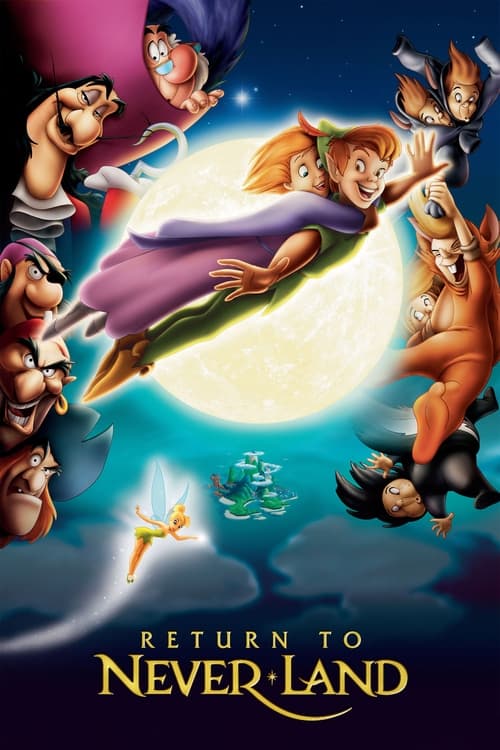
Return to Never Land
In 1940, the world is besieged by World War II. Wendy, all grown up, has two children; including Jane, who does not believe Wendy's stories about Peter Pan.
Despite a moderate budget of $20.0M, Return to Never Land became a financial success, earning $109.9M worldwide—a 449% return.


Plot Structure
Story beats plotted across runtime


Narrative Arc
Emotional journey through the story's key moments
Story Circle
Blueprint 15-beat structure
Arcplot Score Breakdown
Weighted: Precision (70%) + Arc (15%) + Theme (15%)
Return to Never Land (2002) demonstrates carefully calibrated narrative architecture, characteristic of Robin Budd's storytelling approach. This structural analysis examines how the film's 15-point plot structure maps to proven narrative frameworks across 1 hour and 12 minutes. With an Arcplot score of 8.0, the film showcases strong structural fundamentals.
Characters
Cast & narrative archetypes

Jane Darling
Peter Pan
Captain Hook
Tinker Bell
Wendy Darling
Mr. Smee
Main Cast & Characters
Jane Darling
Played by Harriet Owen
Wendy's pragmatic daughter who doesn't believe in Peter Pan, forced to grow up too fast during WWII London
Peter Pan
Played by Blayne Weaver
The eternal boy who never grows up, returns to rescue Jane and restore her belief in magic and childhood
Captain Hook
Played by Corey Burton
The villainous pirate captain obsessed with capturing Peter Pan, now aided by the octopus
Tinker Bell
Played by Kath Soucie
Peter's jealous and fiery fairy companion who initially distrusts Jane
Wendy Darling
Played by Kath Soucie
Jane's mother and the original girl who visited Never Land, now an adult trying to keep her children's spirits up during wartime
Mr. Smee
Played by Jeff Bennett
Captain Hook's bumbling but loyal first mate who provides comic relief
Structural Analysis
The Status Quo at 1 minutes (1% through the runtime) establishes London during WWII. Young Jane listens skeptically as her mother Wendy tells stories of Peter Pan to her little brother Danny. Jane is practical and doesn't believe in fairy tales, creating tension with her imaginative family.. Significantly, this early placement immediately immerses viewers in the story world.
The inciting incident occurs at 8 minutes when Captain Hook, mistaking Jane for Wendy, kidnaps her from her bedroom window and takes her to Never Land. Jane is terrified and dragged from her world into a place she doesn't believe exists.. At 12% through the film, this Disruption aligns precisely with traditional story structure. This beat shifts the emotional landscape, launching the protagonist into the central conflict.
The First Threshold at 18 minutes marks the transition into Act II, occurring at 25% of the runtime. This reveals the protagonist's commitment to Jane makes a deal with Hook: she'll help him capture Peter Pan in exchange for passage home. She actively chooses deception over belief, crossing into Act 2 as a reluctant participant working against the heroes., moving from reaction to action.
At 35 minutes, the Midpoint arrives at 49% of the runtime—precisely centered, creating perfect narrative symmetry. The analysis reveals that this crucial beat False defeat: Jane's plan succeeds and Hook captures Peter Pan in a bag. The stakes raise as Jane realizes the consequences of her betrayal. What seemed like her ticket home becomes her greatest shame., fundamentally raising what's at risk. The emotional intensity shifts, dividing the narrative into clear before-and-after phases.
The Collapse moment at 53 minutes (74% through) represents the emotional nadir. Here, Jane falls from the plank into the ocean, facing death. Tinker Bell's light is nearly extinguished. This is Jane's darkest moment - her disbelief is literally killing the magic, and she faces the consequences of her choices., shows the protagonist at their lowest point. This beat's placement in the final quarter sets up the climactic reversal.
The Second Threshold at 56 minutes initiates the final act resolution at 78% of the runtime. Jane finally believes and declares "I believe in fairies!" This faith allows her to fly and saves Tinker Bell's life. She synthesizes her mother's lesson with her own experience, gaining the power to act., demonstrating the transformation achieved throughout the journey.
Emotional Journey
Return to Never Land's emotional architecture traces a deliberate progression across 15 carefully calibrated beats.
Narrative Framework
This structural analysis employs a 15-point narrative structure framework that maps key story moments. By mapping Return to Never Land against these established plot points, we can identify how Robin Budd utilizes or subverts traditional narrative conventions. The plot point approach reveals not only adherence to structural principles but also creative choices that distinguish Return to Never Land within the adventure genre.
Comparative Analysis
Additional adventure films include The Black Stallion, The Bad Guys and Puss in Boots.
Plot Points by Act
Act I
SetupStatus Quo
London during WWII. Young Jane listens skeptically as her mother Wendy tells stories of Peter Pan to her little brother Danny. Jane is practical and doesn't believe in fairy tales, creating tension with her imaginative family.
Theme
Wendy tells Jane: "All you need is faith, trust, and pixie dust." Jane dismisses this as nonsense, saying she's too old for such things. The theme of belief versus cynicism is established.
Worldbuilding
Establishing Jane's world: war-torn London, air raids, her father away at war, her responsibilities as the "grown-up" of the family. She must protect Danny and maintain order while lacking childhood wonder.
Disruption
Captain Hook, mistaking Jane for Wendy, kidnaps her from her bedroom window and takes her to Never Land. Jane is terrified and dragged from her world into a place she doesn't believe exists.
Resistance
Jane resists Never Land and its magic. Hook uses her as bait to capture Peter Pan. Peter rescues Jane, but she refuses to believe in fairies or magic, causing Tinker Bell to lose her glow. Jane debates whether to accept this new reality.
Act II
ConfrontationFirst Threshold
Jane makes a deal with Hook: she'll help him capture Peter Pan in exchange for passage home. She actively chooses deception over belief, crossing into Act 2 as a reluctant participant working against the heroes.
Mirror World
Peter Pan serves as Jane's mirror character - he embodies pure belief and eternal youth. His relationship with her will teach her what she needs: to reclaim her lost childhood and capacity for wonder.
Premise
Jane experiences the "fun and games" of Never Land: attempting to fly, encountering mermaids, dealing with the Lost Boys, and participating in adventures while secretly planning to betray Peter to Hook.
Midpoint
False defeat: Jane's plan succeeds and Hook captures Peter Pan in a bag. The stakes raise as Jane realizes the consequences of her betrayal. What seemed like her ticket home becomes her greatest shame.
Opposition
Hook makes Jane walk the plank. The Lost Boys reject her. Tinker Bell is dying because Jane doesn't believe. Jane's cynicism and betrayal have dire consequences. She's trapped on Hook's ship with no allies.
Collapse
Jane falls from the plank into the ocean, facing death. Tinker Bell's light is nearly extinguished. This is Jane's darkest moment - her disbelief is literally killing the magic, and she faces the consequences of her choices.
Crisis
Underwater, Jane processes her failure and fear. She must confront what she's lost by refusing to believe. The emotional darkness of recognizing she's become exactly what she feared: someone who destroys joy.
Act III
ResolutionSecond Threshold
Jane finally believes and declares "I believe in fairies!" This faith allows her to fly and saves Tinker Bell's life. She synthesizes her mother's lesson with her own experience, gaining the power to act.
Synthesis
Jane flies to rescue Peter Pan. She fights alongside the Lost Boys against Hook. Using both her practical skills and newfound belief, she defeats Hook and saves Never Land. Peter returns her home safely.
Transformation
Back in London, Jane reunites with her family. She now tells Danny stories with wonder and belief, mirroring her mother. She has transformed from a cynical child forced to grow up too soon into someone who balances responsibility with faith and imagination.