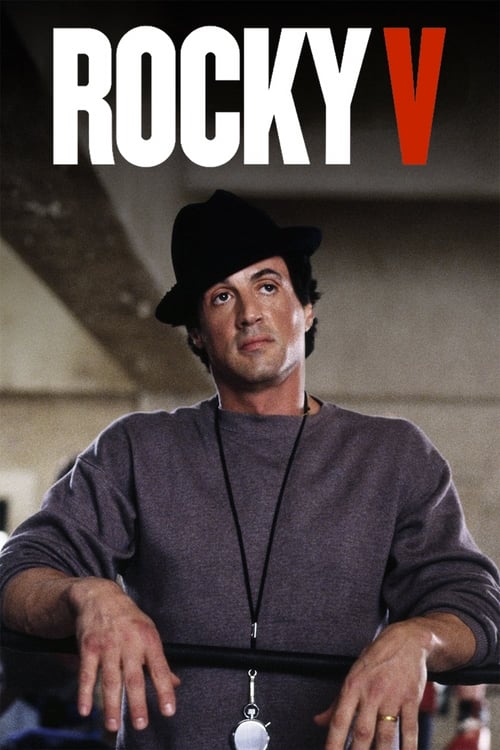
Rocky V
A lifetime of taking shots has ended Rocky’s career, and a crooked accountant has left him broke. Inspired by the memory of his trainer, however, Rocky finds glory in training and takes on an up-and-coming boxer.
Despite a mid-range budget of $42.0M, Rocky V became a commercial success, earning $119.9M worldwide—a 186% return.


Plot Structure
Story beats plotted across runtime


Narrative Arc
Emotional journey through the story's key moments
Story Circle
Blueprint 15-beat structure
Arcplot Score Breakdown
Weighted: Precision (70%) + Arc (15%) + Theme (15%)
Rocky V (1990) reveals strategically placed narrative architecture, characteristic of John G. Avildsen's storytelling approach. This structural analysis examines how the film's 15-point plot structure maps to proven narrative frameworks across 1 hour and 44 minutes. With an Arcplot score of 7.0, the film balances conventional beats with creative variation.
Characters
Cast & narrative archetypes

Rocky Balboa
Tommy Gunn
Adrian Balboa
George Washington Duke
Robert "Rocky Jr." Balboa
Paulie Pennino
Main Cast & Characters
Rocky Balboa
Played by Sylvester Stallone
Retired champion boxer forced to return home after brain damage diagnosis, struggling with poverty and mentoring a young fighter.
Tommy Gunn
Played by Tommy Morrison
Hungry young boxer from Oklahoma who becomes Rocky's protégé but is eventually corrupted by fame and turns against his mentor.
Adrian Balboa
Played by Talia Shire
Rocky's devoted wife who provides emotional support and moral guidance as the family faces financial hardship and Rocky's health crisis.
George Washington Duke
Played by Richard Gant
Ruthless boxing promoter who manipulates Tommy Gunn to exploit him for profit and provokes Rocky to fight despite his condition.
Robert "Rocky Jr." Balboa
Played by Sage Stallone
Rocky's teenage son struggling with his father's fame and seeking his own identity while dealing with family dysfunction.
Paulie Pennino
Played by Burt Young
Rocky's cynical brother-in-law who returns to working at the meat plant and struggles with the family's fall from wealth.
Structural Analysis
The Status Quo at 1 minutes (1% through the runtime) establishes Rocky defeats Ivan Drago in Moscow, standing victorious as champion. He's at the peak of his boxing career, beloved by crowds.. Notably, this early placement immediately immerses viewers in the story world.
The inciting incident occurs at 12 minutes when Doctor tells Rocky he has cavum septum pellucidum - permanent brain damage that will worsen with continued fighting. Rocky must retire immediately or risk death.. At 12% through the film, this Disruption aligns precisely with traditional story structure. This beat shifts the emotional landscape, launching the protagonist into the central conflict.
The First Threshold at 25 minutes marks the transition into Act II, occurring at 25% of the runtime. This illustrates the protagonist's commitment to Rocky actively chooses to reopen Mickey's gym and discovers young fighter Tommy Gunn. He decides to train Tommy, channeling his fighting spirit into mentorship., moving from reaction to action.
At 51 minutes, the Midpoint arrives at 49% of the runtime—precisely centered, creating perfect narrative symmetry. The analysis reveals that this crucial beat Promoter George Washington Duke offers Tommy a title shot and major money if he leaves Rocky. Tommy is tempted. Rocky realizes he may lose his protégé to greed - a false defeat that raises the stakes., fundamentally raising what's at risk. The emotional intensity shifts, dividing the narrative into clear before-and-after phases.
The Collapse moment at 76 minutes (74% through) represents the emotional nadir. Here, Tommy leaves Rocky for Duke, publicly denouncing Rocky on television and calling him a coward. Tommy wins the title but the victory is hollow. Rocky loses his surrogate son and realizes he's failed his real son Robert., indicates the protagonist at their lowest point. This beat's placement in the final quarter sets up the climactic reversal.
The Second Threshold at 82 minutes initiates the final act resolution at 78% of the runtime. Tommy and Duke confront Rocky on the street, goading him to fight. Robert stands by his father. Rocky realizes what truly matters: family, integrity, and fighting for the right reasons. He accepts the street fight., demonstrating the transformation achieved throughout the journey.
Emotional Journey
Rocky V's emotional architecture traces a deliberate progression across 15 carefully calibrated beats.
Narrative Framework
This structural analysis employs a 15-point narrative structure framework that maps key story moments. By mapping Rocky V against these established plot points, we can identify how John G. Avildsen utilizes or subverts traditional narrative conventions. The plot point approach reveals not only adherence to structural principles but also creative choices that distinguish Rocky V within the drama genre.
John G. Avildsen's Structural Approach
Among the 10 John G. Avildsen films analyzed on Arcplot, the average structural score is 7.0, reflecting strong command of classical structure. Rocky V exemplifies the director's characteristic narrative technique. For comparative analysis, explore the complete John G. Avildsen filmography.
Comparative Analysis
Additional drama films include After Thomas, South Pacific and Dirty Dancing: Havana Nights. For more John G. Avildsen analyses, see For Keeps, Rocky and 8 Seconds.
Plot Points by Act
Act I
SetupStatus Quo
Rocky defeats Ivan Drago in Moscow, standing victorious as champion. He's at the peak of his boxing career, beloved by crowds.
Theme
Adrian tells Rocky "You've proved everything you need to prove" - suggesting that external validation isn't what matters most.
Worldbuilding
Rocky returns home a hero, but discovers he's broke due to Paulie's financial mismanagement. Medical tests reveal brain damage, forcing retirement. The Balboas must sell their mansion and return to their old Philadelphia neighborhood.
Disruption
Doctor tells Rocky he has cavum septum pellucidum - permanent brain damage that will worsen with continued fighting. Rocky must retire immediately or risk death.
Resistance
Rocky struggles with his new reality: broke, brain-damaged, unable to fight. He debates what to do next while dealing with his son's difficulties adjusting to their old neighborhood. Mickey's old gym becomes a possibility.
Act II
ConfrontationFirst Threshold
Rocky actively chooses to reopen Mickey's gym and discovers young fighter Tommy Gunn. He decides to train Tommy, channeling his fighting spirit into mentorship.
Mirror World
Rocky takes Tommy Gunn under his wing completely, essentially adopting him. Tommy represents Rocky's chance to live vicariously through another fighter and pass on Mickey's lessons.
Premise
Rocky trains Tommy from obscurity to contender status. They bond like father and son. Rocky pours all his energy into Tommy's career while neglecting his own son Robert. Tommy rises through the ranks with Rocky's guidance.
Midpoint
Promoter George Washington Duke offers Tommy a title shot and major money if he leaves Rocky. Tommy is tempted. Rocky realizes he may lose his protégé to greed - a false defeat that raises the stakes.
Opposition
Rocky tries to hold onto Tommy while Duke actively works to steal him away. Tommy becomes increasingly resentful and hungry for fame. Rocky's relationship with his own son Robert deteriorates as he's been absent. The family fractures.
Collapse
Tommy leaves Rocky for Duke, publicly denouncing Rocky on television and calling him a coward. Tommy wins the title but the victory is hollow. Rocky loses his surrogate son and realizes he's failed his real son Robert.
Crisis
Rocky processes the loss in darkness. His real son Robert confronts him emotionally about being neglected. Rocky faces the consequences of chasing external validation through Tommy instead of being present for his family.
Act III
ResolutionSecond Threshold
Tommy and Duke confront Rocky on the street, goading him to fight. Robert stands by his father. Rocky realizes what truly matters: family, integrity, and fighting for the right reasons. He accepts the street fight.
Synthesis
Rocky fights Tommy Gunn in a brutal street brawl, combining all his experience with newfound clarity about what he's fighting for. He's fighting for respect, for his son, for his values - not money or fame. Rocky defeats Tommy.
Transformation
Rocky embraces his son Robert with pride and love, having learned that being a father and man of integrity matters more than championships. The transformation from chasing glory to embracing family is complete.