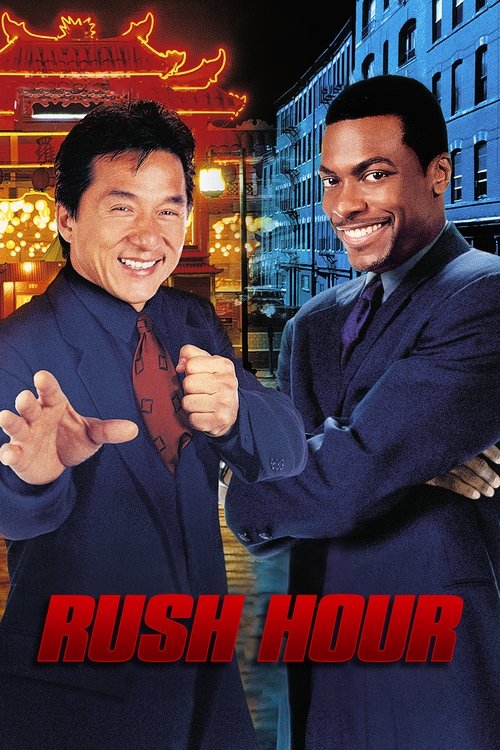
Rush Hour
When Hong Kong Inspector Lee is summoned to Los Angeles to investigate a kidnapping, the FBI doesn't want any outside help and assigns cocky LAPD Detective James Carter to distract Lee from the case. Not content to watch the action from the sidelines, Lee and Carter form an unlikely partnership and investigate the case themselves.
Despite a respectable budget of $33.0M, Rush Hour became a massive hit, earning $244.7M worldwide—a remarkable 642% return.
6 wins & 9 nominations


Plot Structure
Story beats plotted across runtime


Narrative Arc
Emotional journey through the story's key moments
Story Circle
Blueprint 15-beat structure
Arcplot Score Breakdown
Weighted: Precision (70%) + Arc (15%) + Theme (15%)
Rush Hour (1998) reveals strategically placed plot construction, characteristic of Brett Ratner's storytelling approach. This structural analysis examines how the film's 15-point plot structure maps to proven narrative frameworks across 1 hour and 37 minutes. With an Arcplot score of 7.7, the film showcases strong structural fundamentals.
Characters
Cast & narrative archetypes

Detective James Carter
Chief Inspector Lee
Consul Solon Han
Captain Diel
Agent Warren Russ
Juntao
Sang
Main Cast & Characters
Detective James Carter
Played by Chris Tucker
A loud, rule-breaking LAPD detective who gets stuck babysitting a Hong Kong inspector during a high-stakes kidnapping case.
Chief Inspector Lee
Played by Jackie Chan
A disciplined Hong Kong detective and martial arts expert who comes to LA to rescue the Chinese Consul's kidnapped daughter.
Consul Solon Han
Played by Tzi Ma
The Chinese Consul to Los Angeles whose daughter is kidnapped, triggering the investigation.
Captain Diel
Played by Philip Baker Hall
Carter's frustrated LAPD captain who assigns him to babysit Lee to keep him out of the FBI's way.
Agent Warren Russ
Played by Ken Leung
The FBI agent in charge of the kidnapping case who doesn't want local cops interfering.
Juntao
Played by Tom Wilkinson
The mysterious crime lord behind the kidnapping plot with a hidden identity.
Sang
Played by Ken Leung
Juntao's ruthless right-hand man and primary enforcer who directly confronts Lee and Carter.
Structural Analysis
The Status Quo at 1 minutes (1% through the runtime) establishes Hong Kong Detective Inspector Lee successfully orchestrates a daring operation to capture crime lord Juntao, demonstrating his skilled, methodical approach and respected status in the HKPF. He works seamlessly with his team, showing he's a consummate professional who plays by the rules.. Structural examination shows that this early placement immediately immerses viewers in the story world.
The inciting incident occurs at 11 minutes when Consul Han's daughter Soo Yung is kidnapped in Los Angeles by Juntao's organization, with a $50 million ransom demanded. This pulls Lee into the American world and creates the central crisis that will force two incompatible detectives to work together.. At 12% through the film, this Disruption aligns precisely with traditional story structure. This beat shifts the emotional landscape, launching the protagonist into the central conflict.
The First Threshold at 22 minutes marks the transition into Act II, occurring at 23% of the runtime. This indicates the protagonist's commitment to After Lee escapes Carter's babysitting and infiltrates the Chinese consulate on his own, Carter decides to actively help Lee investigate rather than just contain him. Carter chooses to become Lee's partner and work the case together, entering the world of the investigation., moving from reaction to action.
At 48 minutes, the Midpoint arrives at 49% of the runtime—precisely centered, creating perfect narrative symmetry. The analysis reveals that this crucial beat During a spectacular fight at a museum exhibition, Lee and Carter defeat numerous henchmen and recover what they believe is crucial evidence about Soo Yung's location. They're bonding, working together effectively, and feel they're winning - but this is a false victory. They don't realize they're being manipulated., fundamentally raising what's at risk. The emotional intensity shifts, dividing the narrative into clear before-and-after phases.
The Collapse moment at 68 minutes (71% through) represents the emotional nadir. Here, At the ransom exchange, Juntao/Griffin escapes with the money, and Lee is devastated when a massive explosion apparently kills Soo Yung (who Lee promised to protect). Carter is blown backward by the blast. Everything has failed - the girl is dead, the villain has won, and Lee has broken his oath to Han., indicates the protagonist at their lowest point. This beat's placement in the final quarter sets up the climactic reversal.
The Second Threshold at 76 minutes initiates the final act resolution at 78% of the runtime. Lee and Carter discover Soo Yung is alive - the explosion was staged. They deduce Griffin is escaping to Hong Kong with both Soo Yung and the ransom money. Lee now combines his martial arts skills with Carter's street-smart improvisation, and Carter brings his LAPD resources. True synthesis of their partnership., demonstrating the transformation achieved throughout the journey.
Emotional Journey
Rush Hour's emotional architecture traces a deliberate progression across 15 carefully calibrated beats.
Narrative Framework
This structural analysis employs structural analysis methodology used to understand storytelling architecture. By mapping Rush Hour against these established plot points, we can identify how Brett Ratner utilizes or subverts traditional narrative conventions. The plot point approach reveals not only adherence to structural principles but also creative choices that distinguish Rush Hour within the action genre.
Brett Ratner's Structural Approach
Among the 10 Brett Ratner films analyzed on Arcplot, the average structural score is 7.2, reflecting strong command of classical structure. Rush Hour represents one of the director's most structurally precise works. For comparative analysis, explore the complete Brett Ratner filmography.
Comparative Analysis
Additional action films include The Bad Guys, Puss in Boots and Venom: The Last Dance. For more Brett Ratner analyses, see Tower Heist, X-Men: The Last Stand and After the Sunset.
Plot Points by Act
Act I
SetupStatus Quo
Hong Kong Detective Inspector Lee successfully orchestrates a daring operation to capture crime lord Juntao, demonstrating his skilled, methodical approach and respected status in the HKPF. He works seamlessly with his team, showing he's a consummate professional who plays by the rules.
Theme
Consul Han tells Lee, "In America, they believe in freedom - sometimes too much freedom." This establishes the film's theme about cultural differences, partnership, and learning that different approaches can complement each other rather than conflict.
Worldbuilding
Parallel introduction of two worlds: Lee in Hong Kong as a respected detective saying goodbye to Consul Han's family, and Carter in LA as a loudmouthed, rule-breaking LAPD detective whose cowboy tactics embarrass his superiors. Both are good at what they do but operate in completely different styles.
Disruption
Consul Han's daughter Soo Yung is kidnapped in Los Angeles by Juntao's organization, with a $50 million ransom demanded. This pulls Lee into the American world and creates the central crisis that will force two incompatible detectives to work together.
Resistance
The FBI takes over the case, sidelining Carter. Captain Diel assigns Carter to babysit Lee (who Han specifically requested) to keep both of them out of the FBI's way. Carter resists, trying to dump Lee at various tourist spots. Lee wants to investigate; Carter wants to avoid work. Neither wants this partnership.
Act II
ConfrontationFirst Threshold
After Lee escapes Carter's babysitting and infiltrates the Chinese consulate on his own, Carter decides to actively help Lee investigate rather than just contain him. Carter chooses to become Lee's partner and work the case together, entering the world of the investigation.
Mirror World
Carter introduces Lee to his world - his informant network, his street contacts, and singer Tania at the bar. This relationship subplot shows Carter's connections and methods, revealing that beneath his clownish exterior is someone who genuinely cares about his community and knows how to work his city.
Premise
The "odd couple" premise plays out as Lee and Carter clash culturally while following leads: visiting Carter's street informants, discovering Juntao's involvement, infiltrating a Chinese restaurant, and navigating their completely different investigative styles. Fish-out-of-water comedy as methodical Lee meets impulsive Carter.
Midpoint
During a spectacular fight at a museum exhibition, Lee and Carter defeat numerous henchmen and recover what they believe is crucial evidence about Soo Yung's location. They're bonding, working together effectively, and feel they're winning - but this is a false victory. They don't realize they're being manipulated.
Opposition
The FBI is furious with their interference. Carter is removed from the case and suspended. Lee and Carter follow leads to discover Juntao is actually Consul Han's trusted friend Thomas Griffin. The enemy was inside all along, and the ransom exchange is a trap. Pressure mounts as they race against time.
Collapse
At the ransom exchange, Juntao/Griffin escapes with the money, and Lee is devastated when a massive explosion apparently kills Soo Yung (who Lee promised to protect). Carter is blown backward by the blast. Everything has failed - the girl is dead, the villain has won, and Lee has broken his oath to Han.
Crisis
Lee sits in devastated silence, blaming himself for Soo Yung's death. Carter tries to console him, showing genuine friendship and emotional support. In this dark moment, their partnership becomes real - no longer just professional necessity but actual brotherhood forged through shared failure and grief.
Act III
ResolutionSecond Threshold
Lee and Carter discover Soo Yung is alive - the explosion was staged. They deduce Griffin is escaping to Hong Kong with both Soo Yung and the ransom money. Lee now combines his martial arts skills with Carter's street-smart improvisation, and Carter brings his LAPD resources. True synthesis of their partnership.
Synthesis
Lee and Carter storm Griffin's compound at the Chinese theater and Los Angeles airport. They fight through henchmen using combined tactics - Lee's kung fu precision and Carter's improvised chaos working in harmony. Carter saves Lee; Lee saves Carter. They rescue Soo Yung and defeat Griffin together, each using what they learned from the other.
Transformation
Lee and Carter, now genuine friends, celebrate together with music and dancing. Carter teaches Lee about American soul music and relaxation; Lee has learned to loosen up and trust his partner. They've transformed from reluctant, mismatched partners into brothers who respect and complement each other's differences.