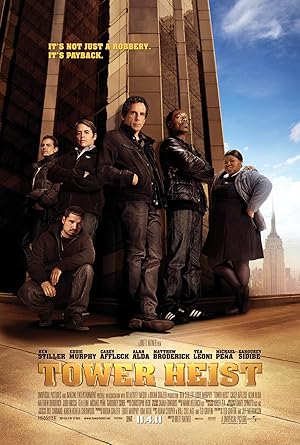
Tower Heist
Manager of a high-rise condo, Josh Kovaks' a good relationship with the tenants; especially financier, Arthur Shaw. When Shaw's arrested for fraud. Josh thinks it's a misunderstanding that can be resolved, but later he learns that the employees' pension fund - which he asked Shaw to handle - is gone. When one of the employees tries to kill himself, Josh's views of Shaw change. He goes to see him and loses his temper - and his job. An FBI agent tells him Shaw might just walk, and recovering the fund is unlikely. She tells him it's been rumored that Shaw has $20 million lying around if he needs it in a hurry. Josh thinks he knows where it is. Josh, along with 2 other (fired) employees, a(n evicted) tenant, and an (criminal) acquaintance, they set out to get into Shaw's, and get the money.
Despite a considerable budget of $75.0M, Tower Heist became a solid performer, earning $152.9M worldwide—a 104% return.


Plot Structure
Story beats plotted across runtime


Narrative Arc
Emotional journey through the story's key moments
Story Circle
Blueprint 15-beat structure
Arcplot Score Breakdown
Weighted: Precision (70%) + Arc (15%) + Theme (15%)
Tower Heist (2011) reveals carefully calibrated plot construction, characteristic of Brett Ratner's storytelling approach. This structural analysis examines how the film's 15-point plot structure maps to proven narrative frameworks across 1 hour and 44 minutes. With an Arcplot score of 7.6, the film showcases strong structural fundamentals.
Characters
Cast & narrative archetypes

Josh Kovacs
Slide
Arthur Shaw
Mr. Fitzhugh
Charlie Gibbs
Enrique Dev'reaux
Odessa Montero
Special Agent Claire Denham
Main Cast & Characters
Josh Kovacs
Played by Ben Stiller
Building manager of an exclusive Manhattan residence who leads a heist against his billionaire tenant after losing his staff's pensions.
Slide
Played by Eddie Murphy
A career criminal and childhood acquaintance of Josh who provides the criminal expertise needed for the heist.
Arthur Shaw
Played by Alan Alda
Wealthy Wall Street businessman and Ponzi scheme architect who betrays the building staff by stealing their pensions.
Mr. Fitzhugh
Played by Matthew Broderick
Loyal concierge who loses his pension and attempts suicide, becoming the emotional catalyst for the heist.
Charlie Gibbs
Played by Casey Affleck
Doorman and expecting father desperate to recover his lost pension for his growing family.
Enrique Dev'reaux
Played by Michael Peña
New elevator operator who brings enthusiasm and unexpected skills to the heist team.
Odessa Montero
Played by Gabourey Sidibe
Jamaican maid with attitude who joins the heist crew and brings street smarts to the operation.
Special Agent Claire Denham
Played by Téa Leoni
FBI agent investigating Arthur Shaw who becomes romantically involved with Josh.
Structural Analysis
The Status Quo at 1 minutes (1% through the runtime) establishes Josh Kovacs expertly manages The Tower luxury residence on Thanksgiving, orchestrating staff with precision and pride. He embodies loyalty, competence, and dedication to serving the wealthy while maintaining dignity in his working-class position.. Significantly, this early placement immediately immerses viewers in the story world.
The inciting incident occurs at 12 minutes when Arthur Shaw is arrested by FBI Agent Claire Denham for securities fraud—a massive Ponzi scheme. Josh watches in shock as his trusted friend and the building's most esteemed resident is revealed as a criminal who has stolen billions.. At 11% through the film, this Disruption aligns precisely with traditional story structure. This beat shifts the emotional landscape, launching the protagonist into the central conflict.
The First Threshold at 25 minutes marks the transition into Act II, occurring at 24% of the runtime. This demonstrates the protagonist's commitment to Josh decides to rob Shaw. He declares to Charlie and Enrique: "We're going to steal back what he took from us." This active choice commits him to crossing the line from law-abiding employee to criminal, entering a world where he must break every rule he's lived by., moving from reaction to action.
At 52 minutes, the Midpoint arrives at 50% of the runtime—precisely centered, creating perfect narrative symmetry. The analysis reveals that this crucial beat The crew opens Shaw's safe during their first attempt—and it's completely empty. False defeat: their entire plan is worthless because the money isn't where they thought. The stakes raise when they realize Shaw has hidden his fortune somewhere else entirely, and they're running out of time., fundamentally raising what's at risk. The emotional intensity shifts, dividing the narrative into clear before-and-after phases.
The Collapse moment at 76 minutes (73% through) represents the emotional nadir. Here, The heist falls apart during the parade. The Ferrari crashes and is destroyed. Josh believes all the gold is lost, smashed to pieces. The crew scatters in defeat. Their one chance to get justice has literally crashed and burned, and Shaw will escape unpunished., reveals the protagonist at their lowest point. This beat's placement in the final quarter sets up the climactic reversal.
The Second Threshold at 83 minutes initiates the final act resolution at 80% of the runtime. Josh realizes they actually won—the gold is safe, and Shaw doesn't know. New information: Agent Denham reveals she knows what they did but chooses to look the other way, giving tacit approval. Josh synthesizes his learned skills with his original values: they can get justice outside the system while still doing right., demonstrating the transformation achieved throughout the journey.
Emotional Journey
Tower Heist's emotional architecture traces a deliberate progression across 15 carefully calibrated beats.
Narrative Framework
This structural analysis employs proven narrative structure principles that track dramatic progression. By mapping Tower Heist against these established plot points, we can identify how Brett Ratner utilizes or subverts traditional narrative conventions. The plot point approach reveals not only adherence to structural principles but also creative choices that distinguish Tower Heist within the action genre.
Brett Ratner's Structural Approach
Among the 10 Brett Ratner films analyzed on Arcplot, the average structural score is 7.2, reflecting strong command of classical structure. Tower Heist represents one of the director's most structurally precise works. For comparative analysis, explore the complete Brett Ratner filmography.
Comparative Analysis
Additional action films include The Bad Guys, Puss in Boots and Venom: The Last Dance. For more Brett Ratner analyses, see X-Men: The Last Stand, After the Sunset and Rush Hour.
Plot Points by Act
Act I
SetupStatus Quo
Josh Kovacs expertly manages The Tower luxury residence on Thanksgiving, orchestrating staff with precision and pride. He embodies loyalty, competence, and dedication to serving the wealthy while maintaining dignity in his working-class position.
Theme
Mr. Fitzhugh tells Josh about the importance of trust while discussing the staff pension fund that billionaire Arthur Shaw manages. The theme: those who work hard and play by the rules are vulnerable to those who exploit trust for greed.
Worldbuilding
Introduction of The Tower staff family: Charlie the concierge, Enrique the new elevator operator, Odessa the maid, Mr. Fitzhugh who manages their pensions. Josh's relationship with Arthur Shaw is established—Shaw trusts Josh, treats him like a friend. The staff's pension money is invested with Shaw.
Disruption
Arthur Shaw is arrested by FBI Agent Claire Denham for securities fraud—a massive Ponzi scheme. Josh watches in shock as his trusted friend and the building's most esteemed resident is revealed as a criminal who has stolen billions.
Resistance
Josh learns the pension fund is completely gone—$20 million stolen. Mr. Fitzhugh attempts suicide. Josh confronts Shaw on the balcony, nearly throws him off, and is fired. The staff is devastated. Josh debates what to do, wrestling between following rules and seeking justice.
Act II
ConfrontationFirst Threshold
Josh decides to rob Shaw. He declares to Charlie and Enrique: "We're going to steal back what he took from us." This active choice commits him to crossing the line from law-abiding employee to criminal, entering a world where he must break every rule he's lived by.
Mirror World
Josh recruits Slide, a petty criminal from his neighborhood who represents everything opposite to Josh's by-the-book world. Slide embodies the thematic mirror: someone who has never trusted the system and always taken what he needed. He will teach Josh how to think like a thief.
Premise
The crew assembles and plans the heist. Slide trains the amateurs in criminal thinking. They investigate Shaw's penthouse, discover a safe, and attempt to crack it. Comedy ensues as working-class people navigate the criminal world—Odessa shoplifts, Josh learns to think outside rules. FBI Agent Denham becomes a complication and possible ally.
Midpoint
The crew opens Shaw's safe during their first attempt—and it's completely empty. False defeat: their entire plan is worthless because the money isn't where they thought. The stakes raise when they realize Shaw has hidden his fortune somewhere else entirely, and they're running out of time.
Opposition
Desperation sets in. Josh discovers Shaw is about to flee the country. Charlie figures out Shaw's fortune is hidden in a car—a custom Ferrari worth $20 million. They devise a new plan to steal the car during a Thanksgiving parade. Opposition intensifies: tight security, FBI presence, Shaw's suspicions, and the crew's lack of skill.
Collapse
The heist falls apart during the parade. The Ferrari crashes and is destroyed. Josh believes all the gold is lost, smashed to pieces. The crew scatters in defeat. Their one chance to get justice has literally crashed and burned, and Shaw will escape unpunished.
Crisis
Josh sits in darkness, processing the loss. The team regroups at his apartment, defeated. But then they realize the gold was successfully extracted before the crash—hidden in plain sight as wheel weights on all the parade vehicles. Hope returns from despair.
Act III
ResolutionSecond Threshold
Josh realizes they actually won—the gold is safe, and Shaw doesn't know. New information: Agent Denham reveals she knows what they did but chooses to look the other way, giving tacit approval. Josh synthesizes his learned skills with his original values: they can get justice outside the system while still doing right.
Synthesis
The crew distributes the gold to all of Shaw's victims. Josh confronts Shaw one final time, revealing they outsmarted him. Shaw is led away to real prison, unable to buy his way out. The pension fund is restored. Justice is served outside the broken legal system, and the working-class heroes reclaim their dignity.
Transformation
Josh manages The Tower again, but transformed. Where the opening showed him serving the wealthy with subservient pride, he now operates with earned equality and self-respect. Mr. Fitzhugh returns to work healthy. The staff celebrates together as equals who stood up for themselves and won.