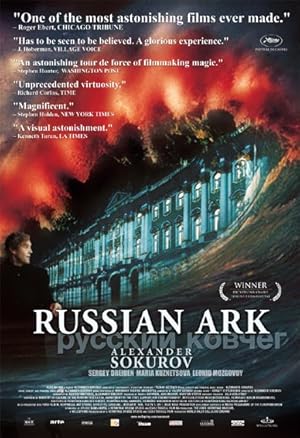
Russian Ark
An unseen man regains consciousness, not knowing who or where he is. No one seems to be able to see him, except the mysterious man dressed in black. He eventually learns through their discussions that this man is a 19th century French aristocrat, who he coins the "European". This turn of events is unusual as the unseen man has a knowledge of the present day. The two quickly learn that they are in the Winter Palace of the Hermitage in St. Petersburg, the European who has a comprehensive knowledge of Russian history to his time. As the two travel through the palace and its grounds, they interact with people from various eras of Russian history, either through events that have happened at the palace or through the viewing of artifacts housed in the museum. Ultimately, the unseen man's desired journey is to move forward, with or without his European companion.
The film earned $6.7M at the global box office.
10 wins & 15 nominations


Plot Structure
Story beats plotted across runtime


Narrative Arc
Emotional journey through the story's key moments
Story Circle
Blueprint 15-beat structure
Arcplot Score Breakdown
Weighted: Precision (70%) + Arc (15%) + Theme (15%)
Russian Ark (2002) reveals strategically placed story structure, characteristic of Aleksandr Sokurov's storytelling approach. This structural analysis examines how the film's 15-point plot structure maps to proven narrative frameworks across 1 hour and 39 minutes. With an Arcplot score of 6.5, the film balances conventional beats with creative variation.
Characters
Cast & narrative archetypes

The Narrator
The Marquis
Main Cast & Characters
The Narrator
Played by Aleksandr Sokurov
An unseen observer who awakens in the Hermitage and witnesses Russian history unfold, serving as the audience's consciousness through time.
The Marquis
Played by Sergei Dreiden
A sardonic 19th-century French diplomat who appears as a ghost-like guide, offering acerbic commentary on Russian culture and art.
Structural Analysis
The Status Quo at 1 minutes (1% through the runtime) establishes The narrator awakens in darkness, disoriented, outside the Winter Palace. He cannot remember how he arrived or what accident befell him. The camera emerges into daylight as 18th-century courtiers rush past into the Hermitage, establishing the dreamlike, time-displaced journey to come.. Of particular interest, this early placement immediately immerses viewers in the story world.
The inciting incident occurs at 11 minutes when Custine challenges the narrator to accompany him deeper into the museum and through Russian history itself. "Shall we continue together?" The invisible narrator accepts, binding himself to this cynical European guide. The journey is no longer aimless wandering but a deliberate exploration with an antagonistic companion.. At 11% through the film, this Disruption aligns precisely with traditional story structure. This beat shifts the emotional landscape, launching the protagonist into the central conflict.
The First Threshold at 25 minutes marks the transition into Act II, occurring at 25% of the runtime. This indicates the protagonist's commitment to The pair enter the galleries containing the Hermitage's greatest European masterworks. The narrator commits fully to the journey, choosing to see Russian cultural achievement through both his own eyes and Custine's skeptical European gaze. There is no turning back; they must traverse all of Russian history to understand its soul., moving from reaction to action.
At 50 minutes, the Midpoint arrives at 50% of the runtime—precisely centered, creating perfect narrative symmetry. The analysis reveals that this crucial beat The Persian diplomatic delegation arrives for an elaborate state reception, presenting Russia as a bridge between European and Eastern civilizations. The ceremony is magnificent, with Nicholas I receiving ambassadors in full imperial splendor. This false victory suggests Russia has successfully synthesized East and West—but darker history awaits., fundamentally raising what's at risk. The emotional intensity shifts, dividing the narrative into clear before-and-after phases.
The Collapse moment at 74 minutes (75% through) represents the emotional nadir. Here, The camera enters a stark room where workers construct coffins during the Siege of Leningrad. Over a million died of starvation and bombardment. The Hermitage's treasures were evacuated, but the building itself became a shelter for survivors surrounded by death. Russian civilization nearly perished entirely in this room., illustrates the protagonist at their lowest point. This beat's placement in the final quarter sets up the climactic reversal.
The Second Threshold at 78 minutes initiates the final act resolution at 79% of the runtime. Music swells as the pair approach the Nicholas Hall. The narrator realizes the journey's purpose: to witness the final great ball of Imperial Russia before the revolution destroyed that world forever. Custine, despite everything, agrees to attend. They will see Russian civilization at its zenith before its fall., demonstrating the transformation achieved throughout the journey.
Emotional Journey
Russian Ark's emotional architecture traces a deliberate progression across 15 carefully calibrated beats.
Narrative Framework
This structural analysis employs proven narrative structure principles that track dramatic progression. By mapping Russian Ark against these established plot points, we can identify how Aleksandr Sokurov utilizes or subverts traditional narrative conventions. The plot point approach reveals not only adherence to structural principles but also creative choices that distinguish Russian Ark within the drama genre.
Comparative Analysis
Additional drama films include After Thomas, South Pacific and Dirty Dancing: Havana Nights.
Plot Points by Act
Act I
SetupStatus Quo
The narrator awakens in darkness, disoriented, outside the Winter Palace. He cannot remember how he arrived or what accident befell him. The camera emerges into daylight as 18th-century courtiers rush past into the Hermitage, establishing the dreamlike, time-displaced journey to come.
Theme
The Marquis de Custine appears and immediately questions whether Russians can truly create art or merely imitate Europe. "This is all copied," he sneers at the architecture. His dismissiveness frames the film's central debate: does Russian culture have authentic value, or is it derivative of the West?
Worldbuilding
The narrator and Custine move through the early chambers of the Hermitage, encountering figures from Peter the Great's era. We see the museum's vast scale, its mix of European and Russian artistic traditions, and the ghostly way historical periods blur together. The rules of this timeless space are established.
Disruption
Custine challenges the narrator to accompany him deeper into the museum and through Russian history itself. "Shall we continue together?" The invisible narrator accepts, binding himself to this cynical European guide. The journey is no longer aimless wandering but a deliberate exploration with an antagonistic companion.
Resistance
Custine leads the narrator through galleries as they witness Catherine the Great directing a theatrical production and encounter various historical figures. The Marquis offers running commentary, alternating between admiration and condescension toward Russian attempts at European sophistication. The narrator debates silently whether to accept Custine's judgments.
Act II
ConfrontationFirst Threshold
The pair enter the galleries containing the Hermitage's greatest European masterworks. The narrator commits fully to the journey, choosing to see Russian cultural achievement through both his own eyes and Custine's skeptical European gaze. There is no turning back; they must traverse all of Russian history to understand its soul.
Mirror World
They encounter a blind woman lovingly describing sculptures she cannot see, guided only by touch and memory. She represents pure aesthetic appreciation uncorrupted by visual prejudice. Her reverence contrasts sharply with Custine's intellectual snobbery, suggesting that true art appreciation transcends cultural origin and even sight itself.
Premise
The promise of the premise unfolds as we drift through the Hermitage's treasures: Rembrandt, Rubens, Van Dyck, El Greco. We witness intimate historical moments—a family breakfast of the last Romanovs, court ceremonies, artistic discussions. Custine's criticism softens occasionally as genuine beauty moves even his cynical heart.
Midpoint
The Persian diplomatic delegation arrives for an elaborate state reception, presenting Russia as a bridge between European and Eastern civilizations. The ceremony is magnificent, with Nicholas I receiving ambassadors in full imperial splendor. This false victory suggests Russia has successfully synthesized East and West—but darker history awaits.
Opposition
The journey through the latter Romanov period reveals tensions beneath the imperial surface. Custine grows more pointed in his criticisms, noting the cruelty underlying Russian autocracy. Historical figures appear increasingly isolated and melancholic. The narrator defends Russian culture but cannot deny its shadows.
Collapse
The camera enters a stark room where workers construct coffins during the Siege of Leningrad. Over a million died of starvation and bombardment. The Hermitage's treasures were evacuated, but the building itself became a shelter for survivors surrounded by death. Russian civilization nearly perished entirely in this room.
Crisis
The narrator and Custine contemplate what nearly was lost—not just lives but the entire accumulated culture of a civilization. Even Custine is silenced by the weight of this tragedy. The Hermitage survived the siege as an ark carrying Russian art and memory through the deluge of war, but at tremendous cost.
Act III
ResolutionSecond Threshold
Music swells as the pair approach the Nicholas Hall. The narrator realizes the journey's purpose: to witness the final great ball of Imperial Russia before the revolution destroyed that world forever. Custine, despite everything, agrees to attend. They will see Russian civilization at its zenith before its fall.
Synthesis
The magnificent 1913 New Year's ball unfolds with thousands of costumed extras dancing in the vast Nicholas Hall. The Mariinsky Theatre orchestra performs Glinka. For twenty breathtaking minutes, Imperial Russia lives again in all its doomed splendor. Custine dances, finally surrendering to beauty he can no longer dismiss.
Transformation
The ball ends. Thousands of guests stream toward the exit, descending the Jordan Staircase. Custine vanishes into the crowd with a final farewell. The narrator reaches the doorway but sees only grey mist and endless water—the Hermitage has become an ark floating on an eternal sea, preserving Russian civilization forever beyond time's reach.