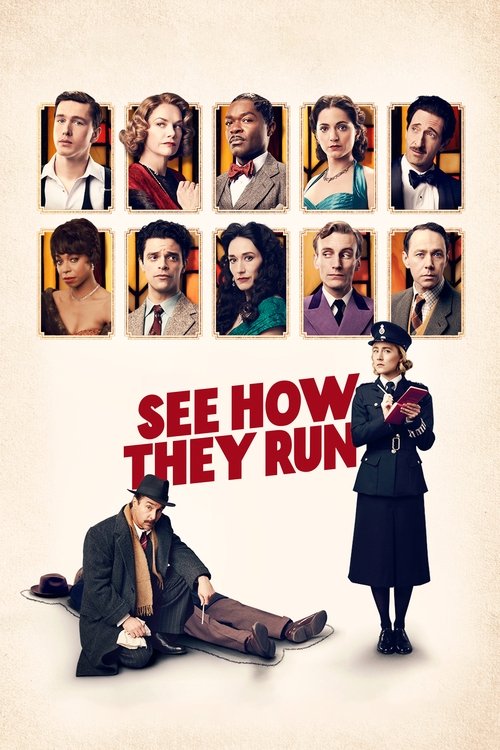
See How They Run
In the West End of 1950s London, plans for a movie version of a smash-hit play come to an abrupt halt after a pivotal member of the crew is murdered. When world-weary Inspector Stoppard and eager rookie Constable Stalker take on the case, the two find themselves thrown into a puzzling whodunit within the glamorously sordid theater underground, investigating the mysterious homicide at their own peril.
The film underperformed commercially against its mid-range budget of $40.0M, earning $21.9M globally (-45% loss). While initial box office returns were modest, the film has gained appreciation for its compelling narrative within the mystery genre.
Nominated for 1 BAFTA Award4 nominations


Plot Structure
Story beats plotted across runtime


Narrative Arc
Emotional journey through the story's key moments
Story Circle
Blueprint 15-beat structure
Arcplot Score Breakdown
Weighted: Precision (70%) + Arc (15%) + Theme (15%)
See How They Run (2022) exhibits meticulously timed narrative architecture, characteristic of Tom George's storytelling approach. This structural analysis examines how the film's 15-point plot structure maps to proven narrative frameworks across 1 hour and 39 minutes. With an Arcplot score of 6.8, the film balances conventional beats with creative variation.
Characters
Cast & narrative archetypes

Inspector Stoppard
Constable Stalker
Leo Köpernick
Sheila Sim
Richard Attenborough
Petula Spencer
Mervyn Cocker-Norris
Main Cast & Characters
Inspector Stoppard
Played by Sam Rockwell
A weary, world-worn detective investigating a murder in London's West End theater district.
Constable Stalker
Played by Saoirse Ronan
An eager, by-the-book young police officer partnered with the cynical Stoppard.
Leo Köpernick
Played by Adrien Brody
A brash American film director attempting to adapt Agatha Christie's play into a movie.
Sheila Sim
Played by Pearl Chanda
An actress in the play and wife of Richard Attenborough, drawn into the murder investigation.
Richard Attenborough
Played by Harris Dickinson
A distinguished actor in The Mousetrap who becomes entangled in the mystery.
Petula Spencer
Played by Shirley Henderson
The stage manager of The Mousetrap with intimate knowledge of backstage affairs.
Mervyn Cocker-Norris
Played by David Oyelowo
The flamboyant producer of The Mousetrap with financial and personal stakes.
Structural Analysis
The Status Quo at 1 minutes (1% through the runtime) establishes Leo Köpernick breaks the fourth wall to introduce himself as a film director adapting "The Mousetrap" for the screen, establishing the meta-theatrical world of 1950s London theater.. The analysis reveals that this early placement immediately immerses viewers in the story world.
The inciting incident occurs at 12 minutes when Leo Köpernick is murdered backstage during the celebration, his body discovered in a dramatic fashion, forcing the investigation to begin.. At 12% through the film, this Disruption aligns precisely with traditional story structure. This beat shifts the emotional landscape, launching the protagonist into the central conflict.
The First Threshold at 25 minutes marks the transition into Act II, occurring at 26% of the runtime. This demonstrates the protagonist's commitment to Stoppard and Stalker commit to working together as partners to solve the murder, despite their differences, officially entering the investigation of the theatrical world., moving from reaction to action.
At 50 minutes, the Midpoint arrives at 50% of the runtime—precisely centered, creating perfect narrative symmetry. Notably, this crucial beat A second murder occurs - another member of the production is killed - raising the stakes dramatically and revealing the killer is still active and dangerous., fundamentally raising what's at risk. The emotional intensity shifts, dividing the narrative into clear before-and-after phases.
The Collapse moment at 75 minutes (76% through) represents the emotional nadir. Here, Stoppard and Stalker are pulled from the case after being deemed incompetent, with their partnership dissolving and the investigation seemingly failed - Stoppard returns to his whiskey-soaked despair., shows the protagonist at their lowest point. This beat's placement in the final quarter sets up the climactic reversal.
The Second Threshold at 80 minutes initiates the final act resolution at 81% of the runtime. Stalker pieces together the final clues and reunites with Stoppard, combining her fresh perspective with his experience to identify the true killer and their motive., demonstrating the transformation achieved throughout the journey.
Emotional Journey
See How They Run's emotional architecture traces a deliberate progression across 15 carefully calibrated beats.
Narrative Framework
This structural analysis employs a 15-point narrative structure framework that maps key story moments. By mapping See How They Run against these established plot points, we can identify how Tom George utilizes or subverts traditional narrative conventions. The plot point approach reveals not only adherence to structural principles but also creative choices that distinguish See How They Run within the mystery genre.
Comparative Analysis
Additional mystery films include Lone Star, The Wicker Man and A Soldier's Story.
Plot Points by Act
Act I
SetupStatus Quo
Leo Köpernick breaks the fourth wall to introduce himself as a film director adapting "The Mousetrap" for the screen, establishing the meta-theatrical world of 1950s London theater.
Theme
Leo declares "See how they run" - a comment about watching people flee from murder, foreshadowing the whodunit structure and the theme of appearances versus reality in both theater and life.
Worldbuilding
Introduction to the cast and crew of "The Mousetrap" celebrating their 100th performance in 1950s London, establishing relationships, rivalries, and the theatrical milieu before the murder occurs.
Disruption
Leo Köpernick is murdered backstage during the celebration, his body discovered in a dramatic fashion, forcing the investigation to begin.
Resistance
Rookie Constable Stalker and world-weary Inspector Stoppard are paired together to investigate the murder, with Stalker's enthusiasm clashing against Stoppard's cynicism as they debate how to approach the case.
Act II
ConfrontationFirst Threshold
Stoppard and Stalker commit to working together as partners to solve the murder, despite their differences, officially entering the investigation of the theatrical world.
Mirror World
The partnership between the idealistic Stalker and the disillusioned Stoppard begins to develop, mirroring the theme of finding purpose and connection in unexpected places.
Premise
Stoppard and Stalker interview suspects, uncover clues, and navigate the theatrical world, delivering the promised fun of a classic whodunit with meta-commentary and comedic interrogations.
Midpoint
A second murder occurs - another member of the production is killed - raising the stakes dramatically and revealing the killer is still active and dangerous.
Opposition
The investigation intensifies as the detectives realize the danger is escalating, suspects become more defensive, and Stoppard's past trauma and alcoholism threaten to derail the case.
Collapse
Stoppard and Stalker are pulled from the case after being deemed incompetent, with their partnership dissolving and the investigation seemingly failed - Stoppard returns to his whiskey-soaked despair.
Crisis
Stoppard wallows in defeat while Stalker processes the failure, each confronting whether they can continue as detectives and whether their partnership meant anything.
Act III
ResolutionSecond Threshold
Stalker pieces together the final clues and reunites with Stoppard, combining her fresh perspective with his experience to identify the true killer and their motive.
Synthesis
Stoppard and Stalker return to the theater to confront the killer, leading to a final chase and revelation that brings justice while proving the value of their unlikely partnership.
Transformation
Stoppard and Stalker stand together as genuine partners, with Stoppard renewed in his purpose and Stalker validated in her instincts, both transformed by solving the case together.