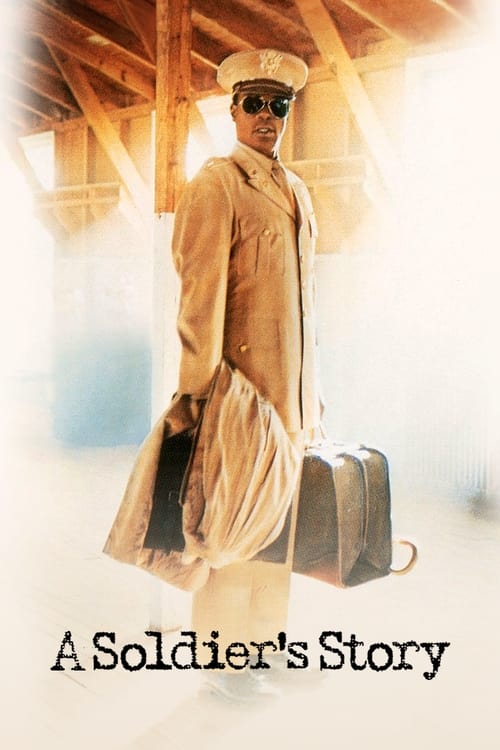
A Soldier's Story
In a rural town in Louisiana, a black Master Sergeant is found shot to death just outside the local Army Base. Military lawyer, Captain Davenport—also a black man—is sent from Washington to conduct an investigation. Facing an uncooperative chain of command and fearful black troops, Davenport must battle with deceit and prejudice in order to find out exactly who really did kill the Master Sergeant.
Despite its modest budget of $6.0M, A Soldier's Story became a financial success, earning $21.8M worldwide—a 264% return. The film's unique voice found its audience, showing that strong storytelling can transcend budget limitations.
Nominated for 3 Oscars. 6 wins & 9 nominations


Plot Structure
Story beats plotted across runtime


Narrative Arc
Emotional journey through the story's key moments
Story Circle
Blueprint 15-beat structure
Arcplot Score Breakdown
Weighted: Precision (70%) + Arc (15%) + Theme (15%)
A Soldier's Story (1984) showcases carefully calibrated story structure, characteristic of Norman Jewison's storytelling approach. This structural analysis examines how the film's 15-point plot structure maps to proven narrative frameworks across 1 hour and 41 minutes. With an Arcplot score of 7.8, the film showcases strong structural fundamentals.
Characters
Cast & narrative archetypes

Captain Richard Davenport
Sergeant Vernon Waters
Private First Class Melvin Peterson
Private C.J. Memphis
Captain Charles Taylor
Corporal Bernard Cobb
Private Tony Smalls
Private James Wilkie
Main Cast & Characters
Captain Richard Davenport
Played by Howard E. Rollins Jr.
A Black Army lawyer from Washington sent to investigate the murder of Sergeant Waters at a segregated Louisiana base during WWII.
Sergeant Vernon Waters
Played by Adolph Caesar
The murdered platoon sergeant, a harsh disciplinarian who despised uneducated Black soldiers and sought to elevate the race through rigid standards.
Private First Class Melvin Peterson
Played by Denzel Washington
An educated, proud soldier who clashed with Waters over his treatment of C.J. and harbored deep resentment toward the sergeant.
Private C.J. Memphis
Played by Larry Riley
A gentle, guitar-playing country boy from Mississippi who becomes the target of Waters' cruelty and represents everything Waters despises.
Captain Charles Taylor
Played by Dennis Lipscomb
The white commanding officer of the base who is initially hostile to Davenport's investigation and represents institutional racism.
Corporal Bernard Cobb
Played by David Alan Grier
A member of Waters' platoon who provides key testimony about the night of the murder and the unit's dynamics.
Private Tony Smalls
Played by David Harris
A soldier in the platoon who witnessed Waters' drunken behavior and provides crucial information to Davenport.
Private James Wilkie
Played by Art Evans
Another member of the platoon who is interrogated by Davenport and reveals tensions within the unit.
Structural Analysis
The Status Quo at 1 minutes (1% through the runtime) establishes Opening image: Sergeant Waters staggers drunkenly down a dark road at the segregated Fort Neal Army base in Louisiana, 1944. He is shot and killed by unseen assailants, establishing the murder mystery and the racial tensions of the segregated military.. Of particular interest, this early placement immediately immerses viewers in the story world.
The inciting incident occurs at 11 minutes when Captain Davenport, a Black JAG officer from Washington, arrives to investigate the murder. His presence disrupts expectations - both white officers assume a white investigator will come, and Black soldiers are shocked to see a Black captain.. At 11% through the film, this Disruption aligns precisely with traditional story structure. This beat shifts the emotional landscape, launching the protagonist into the central conflict.
The First Threshold at 25 minutes marks the transition into Act II, occurring at 24% of the runtime. This illustrates the protagonist's commitment to Davenport commits fully to the investigation despite Captain Taylor's suggestion to blame it on the Klan and close the case. He chooses to pursue the truth rather than the convenient answer, crossing into the deeper mystery of who Waters really was., moving from reaction to action.
At 49 minutes, the Midpoint arrives at 49% of the runtime—precisely centered, creating perfect narrative symmetry. Notably, this crucial beat Davenport discovers that C.J. Memphis hanged himself in the stockade after Waters falsely accused him of stealing. This false defeat reveals the true depth of Waters' self-hatred and cruelty - he destroyed an innocent man to eliminate what he saw as an embarrassment to the race., fundamentally raising what's at risk. The emotional intensity shifts, dividing the narrative into clear before-and-after phases.
The Collapse moment at 74 minutes (73% through) represents the emotional nadir. Here, Davenport's investigation appears to hit a wall. Two white officers who were near the scene on the night of the murder are being shipped out, removing key witnesses. The "whiff of death" - both C.J.'s suicide and the seeming death of justice as the case may go unsolved., indicates the protagonist at their lowest point. This beat's placement in the final quarter sets up the climactic reversal.
The Second Threshold at 80 minutes initiates the final act resolution at 80% of the runtime. A soldier finally breaks and reveals the truth: Peterson and Smalls found Waters drunk and ranting the night of his death, and Peterson shot him in rage over C.J.'s death. Davenport now has the complete picture - Waters was killed by his own man, proving the opening thematic question., demonstrating the transformation achieved throughout the journey.
Emotional Journey
A Soldier's Story's emotional architecture traces a deliberate progression across 15 carefully calibrated beats.
Narrative Framework
This structural analysis employs proven narrative structure principles that track dramatic progression. By mapping A Soldier's Story against these established plot points, we can identify how Norman Jewison utilizes or subverts traditional narrative conventions. The plot point approach reveals not only adherence to structural principles but also creative choices that distinguish A Soldier's Story within the mystery genre.
Norman Jewison's Structural Approach
Among the 13 Norman Jewison films analyzed on Arcplot, the average structural score is 7.2, reflecting strong command of classical structure. A Soldier's Story represents one of the director's most structurally precise works. For comparative analysis, explore the complete Norman Jewison filmography.
Comparative Analysis
Additional mystery films include Lone Star, The Wicker Man and Bloodline. For more Norman Jewison analyses, see ...And Justice for All, F.I.S.T. and Moonstruck.
Plot Points by Act
Act I
SetupStatus Quo
Opening image: Sergeant Waters staggers drunkenly down a dark road at the segregated Fort Neal Army base in Louisiana, 1944. He is shot and killed by unseen assailants, establishing the murder mystery and the racial tensions of the segregated military.
Theme
Captain Taylor states the thematic question about identity and self-hatred within the Black community when discussing the murder: "Who would want to kill one of their own?" This introduces the central theme of internalized racism and identity.
Worldbuilding
Introduction of Fort Neal, the all-Black company, their baseball team, and the racist dynamics both external (white officers) and internal (class divisions among Black soldiers). Captain Davenport arrives as the first Black officer many have seen.
Disruption
Captain Davenport, a Black JAG officer from Washington, arrives to investigate the murder. His presence disrupts expectations - both white officers assume a white investigator will come, and Black soldiers are shocked to see a Black captain.
Resistance
Davenport begins interviewing soldiers, meeting resistance and skepticism. Through flashbacks, we learn about Waters' cruel treatment of Private C.J. Memphis, a beloved country boy. Davenport debates whether the killer was white (KKK) or Black (one of Waters' own men).
Act II
ConfrontationFirst Threshold
Davenport commits fully to the investigation despite Captain Taylor's suggestion to blame it on the Klan and close the case. He chooses to pursue the truth rather than the convenient answer, crossing into the deeper mystery of who Waters really was.
Mirror World
Private Wilkie and Corporal Ellis become Davenport's guides into the company's dynamics. Their relationship with Davenport mirrors the film's theme - they must decide whether to trust this educated Black officer who represents both authority and their own potential.
Premise
The investigation deepens through flashbacks revealing Waters' complexity: his self-hatred, his persecution of C.J. for embodying stereotypes, C.J.'s subsequent suicide, and the growing hatred the soldiers felt for Waters. Davenport pieces together the psychological warfare within the company.
Midpoint
Davenport discovers that C.J. Memphis hanged himself in the stockade after Waters falsely accused him of stealing. This false defeat reveals the true depth of Waters' self-hatred and cruelty - he destroyed an innocent man to eliminate what he saw as an embarrassment to the race.
Opposition
Pressure mounts as white officers want the case closed. Davenport faces increased hostility and racial slurs. He uncovers that Peterson and Smalls had violent confrontations with Waters after C.J.'s death. The list of suspects narrows, but each interview reveals deeper layers of pain and rage.
Collapse
Davenport's investigation appears to hit a wall. Two white officers who were near the scene on the night of the murder are being shipped out, removing key witnesses. The "whiff of death" - both C.J.'s suicide and the seeming death of justice as the case may go unsolved.
Crisis
Davenport processes the darkness - the system wants this buried, justice for a Black sergeant may be impossible, and the real tragedy is the self-hatred that consumed Waters and destroyed C.J. He must decide whether solving the murder even matters if the deeper disease can't be cured.
Act III
ResolutionSecond Threshold
A soldier finally breaks and reveals the truth: Peterson and Smalls found Waters drunk and ranting the night of his death, and Peterson shot him in rage over C.J.'s death. Davenport now has the complete picture - Waters was killed by his own man, proving the opening thematic question.
Synthesis
Davenport confronts Peterson, who confesses. The finale synthesizes the film's themes: Peterson killed Waters not just for C.J., but because Waters represented the self-hatred killing Black people from within. Justice is served, but the deeper questions about identity and internalized racism remain.
Transformation
Closing image: Davenport departs Fort Neal. The company has lost three men - C.J. to suicide, Waters to murder, Peterson to military prison - but they've gained something: proof that a Black officer can deliver justice, and a reckoning with the internal divisions that weaken them.