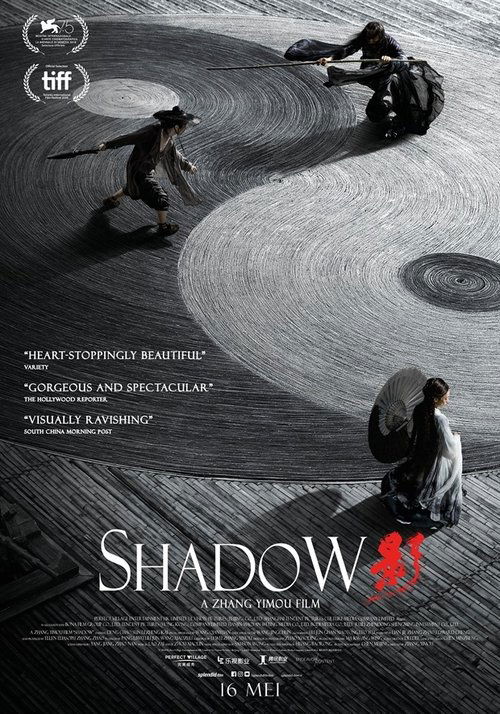
Shadow
In a kingdom ruled by a young and unpredictable king, the military commander has a secret weapon: a shadow, a look-alike who can fool both his enemies and the King himself. Now he must use this weapon in an intricate plan that will lead his people to victory in a war that the King does not want.
Despite a mid-range budget of $44.0M, Shadow became a solid performer, earning $91.7M worldwide—a 108% return.
38 wins & 59 nominations


Plot Structure
Story beats plotted across runtime


Narrative Arc
Emotional journey through the story's key moments
Story Circle
Blueprint 15-beat structure
Arcplot Score Breakdown
Weighted: Precision (70%) + Arc (15%) + Theme (15%)
Shadow (2018) reveals carefully calibrated plot construction, characteristic of Zhang Yimou's storytelling approach. This structural analysis examines how the film's 15-point plot structure maps to proven narrative frameworks across 1 hour and 56 minutes. With an Arcplot score of 6.8, the film balances conventional beats with creative variation.
Characters
Cast & narrative archetypes

Jing Zhou (Shadow)
Commander Yu (The Real)
Xiao Ai
King Pei
Yang Cang
Yang Ping
Lu Yan
Main Cast & Characters
Jing Zhou (Shadow)
Played by Deng Chao
A former soldier serving as the secret body double for the ailing Commander Yu, trained to impersonate him while harboring his own desires for freedom.
Commander Yu (The Real)
Played by Deng Chao
The brilliant but chronically ill military commander who uses his shadow to maintain his position while plotting revenge against Yang Cang.
Xiao Ai
Played by Sun Li
The wife of Commander Yu who develops feelings for the shadow while tending to him, caught between duty and desire.
King Pei
Played by Zheng Kai
The weak-willed ruler of the Pei Kingdom who prefers peace over confrontation and struggles to control his ambitious subordinates.
Yang Cang
Played by Hu Jun
The formidable general of the Yang Kingdom who defeated Commander Yu in single combat and holds the conquered city.
Yang Ping
Played by Guan Xiaotong
The ambitious daughter of Yang Cang who becomes a pawn in the political machinations between kingdoms.
Lu Yan
Played by Wang Jingchun
The loyal minister and strategist to King Pei who advocates for peaceful resolution over military conflict.
Structural Analysis
The Status Quo at 1 minutes (1% through the runtime) establishes The Shadow, posing as Commander Ziyu, practices martial arts in the rain-soaked palace courtyard. His identity as a double is hidden from all but a few, establishing the world of deception and duality.. Structural examination shows that this early placement immediately immerses viewers in the story world.
The inciting incident occurs at 14 minutes when The Shadow publicly challenges General Yang to single combat for control of Jing City, defying King Pei's orders for peace. This act of insubordination sets the entire plot in motion and creates an irreversible political crisis.. At 12% through the film, this Disruption aligns precisely with traditional story structure. This beat shifts the emotional landscape, launching the protagonist into the central conflict.
The First Threshold at 29 minutes marks the transition into Act II, occurring at 25% of the runtime. This reveals the protagonist's commitment to The Shadow commits fully to Ziyu's plan to defeat General Yang, accepting that he must master the umbrella technique and become the perfect weapon. He chooses to embrace his role rather than flee, crossing into a world of calculated deception., moving from reaction to action.
At 58 minutes, the Midpoint arrives at 50% of the runtime—precisely centered, creating perfect narrative symmetry. Structural examination shows that this crucial beat The Shadow defeats General Yang in the rain-drenched duel using the umbrella technique, winning the right to Jing City. This false victory marks a turning point, but the political consequences and Ziyu's true intentions remain hidden dangers., fundamentally raising what's at risk. The emotional intensity shifts, dividing the narrative into clear before-and-after phases.
The Collapse moment at 87 minutes (75% through) represents the emotional nadir. Here, The battle for Jing City claims massive casualties. The Shadow discovers the full extent of Ziyu's manipulation—he was always meant to be sacrificed. The whiff of death becomes literal as bodies pile up and the Shadow realizes he is expendable to everyone., shows the protagonist at their lowest point. This beat's placement in the final quarter sets up the climactic reversal.
The Second Threshold at 93 minutes initiates the final act resolution at 80% of the runtime. The Shadow realizes he must kill the real Ziyu to stop being a shadow. The synthesis of his training and his newfound desire for autonomy crystallizes into a decision: he will no longer be anyone's tool. He chooses to become real., demonstrating the transformation achieved throughout the journey.
Emotional Journey
Shadow's emotional architecture traces a deliberate progression across 15 carefully calibrated beats.
Narrative Framework
This structural analysis employs a 15-point narrative structure framework that maps key story moments. By mapping Shadow against these established plot points, we can identify how Zhang Yimou utilizes or subverts traditional narrative conventions. The plot point approach reveals not only adherence to structural principles but also creative choices that distinguish Shadow within the action genre.
Zhang Yimou's Structural Approach
Among the 11 Zhang Yimou films analyzed on Arcplot, the average structural score is 6.8, demonstrating varied approaches to story architecture. Shadow takes a more unconventional approach compared to the director's typical style. For comparative analysis, explore the complete Zhang Yimou filmography.
Comparative Analysis
Additional action films include The Bad Guys, Puss in Boots and Venom: The Last Dance. For more Zhang Yimou analyses, see Full River Red, Cliff Walkers and The Flowers of War.
Plot Points by Act
Act I
SetupStatus Quo
The Shadow, posing as Commander Ziyu, practices martial arts in the rain-soaked palace courtyard. His identity as a double is hidden from all but a few, establishing the world of deception and duality.
Theme
The real Commander Ziyu, hidden in his underground lair, tells the Shadow: "You are my shadow. A shadow has no life of its own." This establishes the central question of identity and whether one can transcend their assigned role.
Worldbuilding
The political landscape of the Pei Kingdom is established. King Pei seeks peace with rival Yang while Commander Ziyu (the Shadow acting in his place) secretly desires to reclaim Jing City. The court intrigue, the yin-yang aesthetic, and the secret underground hideout are introduced.
Disruption
The Shadow publicly challenges General Yang to single combat for control of Jing City, defying King Pei's orders for peace. This act of insubordination sets the entire plot in motion and creates an irreversible political crisis.
Resistance
The Shadow debates his path forward with the real Ziyu in the underground lair. Ziyu reveals his master plan: use the Shadow to defeat Yang and reclaim Jing City. Princess Qingping is offered as a bride to Yang's son. The Shadow trains in the feminine umbrella fighting technique with Xiao Ai.
Act II
ConfrontationFirst Threshold
The Shadow commits fully to Ziyu's plan to defeat General Yang, accepting that he must master the umbrella technique and become the perfect weapon. He chooses to embrace his role rather than flee, crossing into a world of calculated deception.
Mirror World
Xiao Ai trains intimately with the Shadow in the umbrella dance combat technique. Their physical closeness during training reveals growing emotional connection. She represents his chance at a real life and identity beyond being Ziyu's shadow.
Premise
The Shadow masters the feminine umbrella fighting style designed to counter Yang's masculine blade techniques. Political maneuvering intensifies as Princess Qingping is sent to marry Yang's son. The yin-yang philosophy of combat is explored through training sequences that showcase the film's stunning visual aesthetic.
Midpoint
The Shadow defeats General Yang in the rain-drenched duel using the umbrella technique, winning the right to Jing City. This false victory marks a turning point, but the political consequences and Ziyu's true intentions remain hidden dangers.
Opposition
The aftermath of the duel creates chaos. King Pei's suspicions grow about the Commander's true loyalties. The real Ziyu prepares his coup from the shadows. Yang's forces seek revenge. The Shadow is caught between multiple masters as all parties converge toward violent confrontation.
Collapse
The battle for Jing City claims massive casualties. The Shadow discovers the full extent of Ziyu's manipulation—he was always meant to be sacrificed. The whiff of death becomes literal as bodies pile up and the Shadow realizes he is expendable to everyone.
Crisis
In the dark aftermath, the Shadow faces his true nature. He has been a tool for everyone—Ziyu, the King, the Kingdom. Xiao Ai is the only one who has seen him as human. He must decide whether to remain a shadow or claim his own existence.
Act III
ResolutionSecond Threshold
The Shadow realizes he must kill the real Ziyu to stop being a shadow. The synthesis of his training and his newfound desire for autonomy crystallizes into a decision: he will no longer be anyone's tool. He chooses to become real.
Synthesis
The final bloodbath unfolds in the palace. The real Ziyu emerges to claim his victory but the Shadow confronts him. King Pei is killed. Ziyu is killed. In the stunning climax, the Shadow eliminates all who knew his true identity, standing alone amid the carnage.
Transformation
Xiao Ai opens the door to find the Shadow standing alone, covered in blood, everyone else dead. Her expression of horror mirrors the audience's—the Shadow has become real, but at the cost of his humanity. The closing image inverts the opening: the shadow has consumed all light.