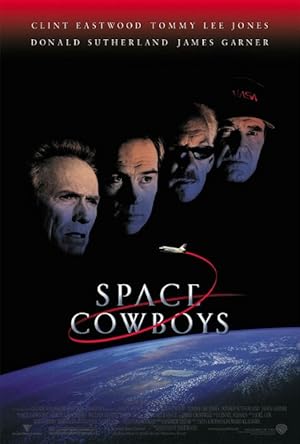
Space Cowboys
When a Russian satellite orbiting the Earth starts to veer off course. It seems like the guidance system in the satellite is of American origin. It's important to try and fix it before it comes into the atmosphere. N.A.S.A. man, Bob Gerson (James Cromwell) tries to find out who designed it, and discovers that it was designed by Frank Corvin (Clint Eastwood), an Air Force pilot who, forty years ago, was part of a team who was originally suppose to go to space, but when N.A.S.A. was formed and Gerson's influence, they were dropped. Gerson asks Frank to help, but Frank still holds a grudge. But after some prodding, he agrees but only if he and his team can go there so he can fix it. Gerson reluctantly agrees, so Frank recruits his former team members, "Tank" Sullivan (James Garner), Jerry O'Neill (Donald Sutherland), and "Hawk" Hawkins (Tommy Lee Jones) to join him. After some strenuous tests, they're cleared. And they go up with two other astronauts and check out the satellite and discover that they weren't told the whole truth.
Working with a mid-range budget of $65.0M, the film achieved a modest success with $128.9M in global revenue (+98% profit margin).
Nominated for 1 Oscar. 4 wins & 9 nominations


Plot Structure
Story beats plotted across runtime


Narrative Arc
Emotional journey through the story's key moments
Story Circle
Blueprint 15-beat structure
Arcplot Score Breakdown
Weighted: Precision (70%) + Arc (15%) + Theme (15%)
Space Cowboys (2000) demonstrates precise story structure, characteristic of Clint Eastwood's storytelling approach. This structural analysis examines how the film's 15-point plot structure maps to proven narrative frameworks across 2 hours and 10 minutes. With an Arcplot score of 7.4, the film balances conventional beats with creative variation.
Characters
Cast & narrative archetypes

Frank Corvin
Hawk Hawkins
Jerry O'Neill
Tank Sullivan
Bob Gerson
Sara Holland
Main Cast & Characters
Frank Corvin
Played by Clint Eastwood
Former Air Force pilot and engineer who leads the team of aging astronauts on a critical satellite repair mission.
Hawk Hawkins
Played by Tommy Lee Jones
Thrill-seeking former test pilot and the team's most reckless member, now a crop duster and roller coaster designer.
Jerry O'Neill
Played by Donald Sutherland
Smooth-talking structural engineer and ladies' man who reluctantly rejoins his old team for one last mission.
Tank Sullivan
Played by James Garner
Baptist minister and former navigator who must reconcile his faith with the mission's demands.
Bob Gerson
Played by James Cromwell
NASA mission director who reluctantly recruits the aging Team Daedalus after discovering the satellite's secrets.
Sara Holland
Played by Marcia Gay Harden
NASA flight director who oversees the mission and develops respect for the older astronauts.
Structural Analysis
The Status Quo at 1 minutes (1% through the runtime) establishes 1958 flashback: Young Team Daedalus test pilots (Frank, Hawk, Jerry, Tank) prepare for space as America's first astronauts, embodying the dawn of the space race and their brotherhood.. Notably, this early placement immediately immerses viewers in the story world.
The inciting incident occurs at 16 minutes when NASA discovers the failing Ikon satellite uses guidance systems Frank designed 40 years ago. Bob Gerson, now a NASA official, must swallow his pride and ask Frank for help, threatening a potential disaster if the satellite falls.. At 12% through the film, this Disruption aligns precisely with traditional story structure. This beat shifts the emotional landscape, launching the protagonist into the central conflict.
The First Threshold at 33 minutes marks the transition into Act II, occurring at 25% of the runtime. This demonstrates the protagonist's commitment to The four aging pilots make the active choice to accept the mission and begin NASA training. They commit to proving they still have what it takes, crossing from their ordinary lives into the world of astronaut preparation., moving from reaction to action.
At 65 minutes, the Midpoint arrives at 50% of the runtime—precisely centered, creating perfect narrative symmetry. The analysis reveals that this crucial beat False defeat: The team discovers Ikon isn't just a communications satellite—it's armed with nuclear missiles pointed at the U.S. The mission is more dangerous than they knew. Gerson knew all along. Stakes and tension dramatically escalate., fundamentally raising what's at risk. The emotional intensity shifts, dividing the narrative into clear before-and-after phases.
The Collapse moment at 98 minutes (75% through) represents the emotional nadir. Here, Hawk, dying from cancer and bleeding internally, sacrifices himself. He manually guides the nuclear-armed satellite away from Earth, riding it like his beloved planes one last time. The team loses their brother—a literal death that devastates them., reveals the protagonist at their lowest point. This beat's placement in the final quarter sets up the climactic reversal.
The Second Threshold at 104 minutes initiates the final act resolution at 80% of the runtime. The team realizes Hawk's sacrifice wasn't in vain—he saved the world and died doing what he loved. They find new resolve to complete the mission and return home safely, honoring his memory by finishing what they started together., demonstrating the transformation achieved throughout the journey.
Emotional Journey
Space Cowboys's emotional architecture traces a deliberate progression across 15 carefully calibrated beats.
Narrative Framework
This structural analysis employs proven narrative structure principles that track dramatic progression. By mapping Space Cowboys against these established plot points, we can identify how Clint Eastwood utilizes or subverts traditional narrative conventions. The plot point approach reveals not only adherence to structural principles but also creative choices that distinguish Space Cowboys within the action genre.
Clint Eastwood's Structural Approach
Among the 32 Clint Eastwood films analyzed on Arcplot, the average structural score is 6.5, demonstrating varied approaches to story architecture. Space Cowboys represents one of the director's most structurally precise works. For comparative analysis, explore the complete Clint Eastwood filmography.
Comparative Analysis
Additional action films include The Bad Guys, Puss in Boots and Venom: The Last Dance. For more Clint Eastwood analyses, see True Crime, Million Dollar Baby and The Gauntlet.
Plot Points by Act
Act I
SetupStatus Quo
1958 flashback: Young Team Daedalus test pilots (Frank, Hawk, Jerry, Tank) prepare for space as America's first astronauts, embodying the dawn of the space race and their brotherhood.
Theme
Bob Gerson replaces the Daedalus team with a monkey, telling them "You're too old for this." The theme of ageism vs. experience, second chances, and proving worth regardless of age is established.
Worldbuilding
Present day: The four aging pilots live separate lives. Frank designs planes, Hawk barnstorms air shows, Tank is a minister, Jerry is an engineer. All harbor resentment about their stolen space dream. A Russian satellite (Ikon) begins failing and threatens to crash.
Disruption
NASA discovers the failing Ikon satellite uses guidance systems Frank designed 40 years ago. Bob Gerson, now a NASA official, must swallow his pride and ask Frank for help, threatening a potential disaster if the satellite falls.
Resistance
Frank negotiates with Gerson: he'll fix the satellite only if his entire original Team Daedalus crew goes up. Gerson resists, debates ensue about age and capability. Frank reunites the team, they argue and deliberate whether this second chance is worth the risk.
Act II
ConfrontationFirst Threshold
The four aging pilots make the active choice to accept the mission and begin NASA training. They commit to proving they still have what it takes, crossing from their ordinary lives into the world of astronaut preparation.
Mirror World
The team bonds with young mission specialists Ethan and Roger, and reconnects with Sara (mission director). These relationships represent the theme: bridging generations, mutual respect between old and young, proving experience has value alongside youth.
Premise
The "fun and games" of elderly astronauts in training. They struggle with physical tests, pass medical exams, prove their competence, handle media attention, and prepare for the mission while bonding as a team and confronting their age with humor and determination.
Midpoint
False defeat: The team discovers Ikon isn't just a communications satellite—it's armed with nuclear missiles pointed at the U.S. The mission is more dangerous than they knew. Gerson knew all along. Stakes and tension dramatically escalate.
Opposition
In space, complications mount: the satellite repair is harder than expected, Hawk's pancreatic cancer symptoms worsen, equipment fails, younger mission specialists doubt the old-timers, and the nuclear payload creates moral dilemmas about whether to complete the mission.
Collapse
Hawk, dying from cancer and bleeding internally, sacrifices himself. He manually guides the nuclear-armed satellite away from Earth, riding it like his beloved planes one last time. The team loses their brother—a literal death that devastates them.
Crisis
The surviving crew mourns Hawk while drifting in space. Frank, Jerry, and Tank process the loss, questioning whether this mission was worth their friend's life. They face the dark emotional weight of mortality and sacrifice.
Act III
ResolutionSecond Threshold
The team realizes Hawk's sacrifice wasn't in vain—he saved the world and died doing what he loved. They find new resolve to complete the mission and return home safely, honoring his memory by finishing what they started together.
Synthesis
The finale: Team Daedalus executes a dangerous re-entry with damaged equipment. Using their decades of flying experience, they pilot the shuttle through crisis, proving their worth. They land successfully and are celebrated as heroes who earned their place in history.
Transformation
Final image mirrors the opening: Frank, Jerry, and Tank stand together, no longer bitter old men denied their dream, but fulfilled astronauts who proved age doesn't diminish value. Hawk's presence on the moon memorializes their triumph and friendship.