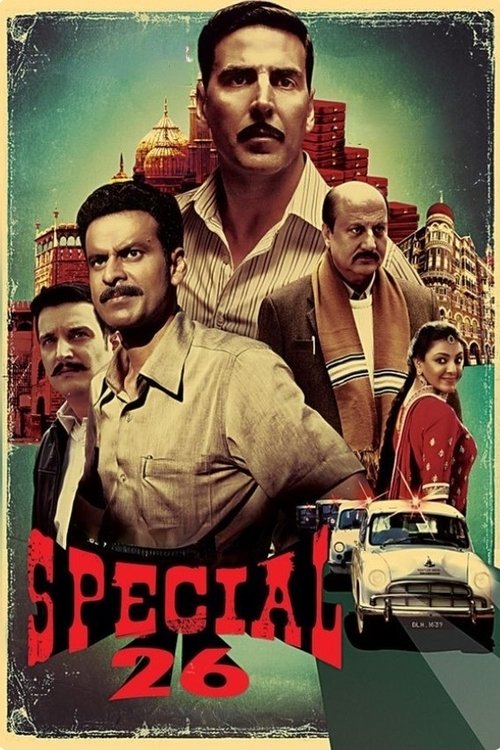
Special 26
In the early 1980s India, a group of con artists rob businessmen and politicians by conducting fake raids, posing as officers of the CBI or Income Tax Department . They plan to execute their biggest con as a final job while a relentless cop is on their trail.
Despite its limited budget of $7.1M, Special 26 became a commercial success, earning $18.0M worldwide—a 154% return.



Plot Structure
Story beats plotted across runtime


Narrative Arc
Emotional journey through the story's key moments
Story Circle
Blueprint 15-beat structure
Arcplot Score Breakdown
Weighted: Precision (70%) + Arc (15%) + Theme (15%)
Special 26 (2013) exemplifies strategically placed narrative design, characteristic of Neeraj Pandey's storytelling approach. This structural analysis examines how the film's 15-point plot structure maps to proven narrative frameworks across 2 hours and 24 minutes. With an Arcplot score of 7.4, the film balances conventional beats with creative variation.
Structural Analysis
The Status Quo at 2 minutes (1% through the runtime) establishes Ajay and his team pose as CBI officers conducting a raid on a jewelry store in 1987, establishing their con operation as fake government officials who steal during fake raids.. Of particular interest, this early placement immediately immerses viewers in the story world.
The inciting incident occurs at 17 minutes when Real CBI officer Wasim Khan is assigned to investigate the fake CBI raids after multiple complaints, threatening to expose Ajay's entire operation.. At 12% through the film, this Disruption aligns precisely with traditional story structure. This beat shifts the emotional landscape, launching the protagonist into the central conflict.
The First Threshold at 36 minutes marks the transition into Act II, occurring at 25% of the runtime. This illustrates the protagonist's commitment to Ajay makes the active decision to execute their most ambitious heist yet: raiding the Tribhovandas Bhimji Zaveri jewelry showroom in Mumbai, their biggest and riskiest target., moving from reaction to action.
At 72 minutes, the Midpoint arrives at 50% of the runtime—precisely centered, creating perfect narrative symmetry. Notably, this crucial beat The team successfully executes the massive Tribhovandas Bhimji Zaveri raid in broad daylight, stealing crores. False victory: they think they've pulled off the perfect crime, but the stakes are now much higher., fundamentally raising what's at risk. The emotional intensity shifts, dividing the narrative into clear before-and-after phases.
The Collapse moment at 108 minutes (75% through) represents the emotional nadir. Here, Wasim Khan identifies Ajay and discovers his real identity and location. The con is exposed. Ajay realizes he's been caught and his entire world is collapsing around him., shows the protagonist at their lowest point. This beat's placement in the final quarter sets up the climactic reversal.
The Second Threshold at 115 minutes initiates the final act resolution at 80% of the runtime. Ajay realizes he can use his con artist skills one final time, not to escape, but to execute one last brilliant deception that will cement his legend and outwit even those who caught him., demonstrating the transformation achieved throughout the journey.
Emotional Journey
Special 26's emotional architecture traces a deliberate progression across 15 carefully calibrated beats.
Narrative Framework
This structural analysis employs a 15-point narrative structure framework that maps key story moments. By mapping Special 26 against these established plot points, we can identify how Neeraj Pandey utilizes or subverts traditional narrative conventions. The plot point approach reveals not only adherence to structural principles but also creative choices that distinguish Special 26 within the crime genre.
Comparative Analysis
Additional crime films include The Bad Guys, Batman Forever and 12 Rounds.
Plot Points by Act
Act I
SetupStatus Quo
Ajay and his team pose as CBI officers conducting a raid on a jewelry store in 1987, establishing their con operation as fake government officials who steal during fake raids.
Theme
A character observes that in India, people fear and respect government authority so much they never question officials, foreshadowing how the con artists exploit this blind trust.
Worldbuilding
Introduction of Ajay's crew members, their methods of operation, the 1987 setting, and how they meticulously plan and execute fake CBI raids to steal from corrupt businessmen.
Disruption
Real CBI officer Wasim Khan is assigned to investigate the fake CBI raids after multiple complaints, threatening to expose Ajay's entire operation.
Resistance
Ajay debates whether to continue or quit as the real CBI closes in. He plans one bigger job to secure their future. Wasim Khan investigates methodically, getting closer to the truth.
Act II
ConfrontationFirst Threshold
Ajay makes the active decision to execute their most ambitious heist yet: raiding the Tribhovandas Bhimji Zaveri jewelry showroom in Mumbai, their biggest and riskiest target.
Mirror World
The relationship between Ajay and his team deepens as they prepare together, showing their loyalty and camaraderie. This mirrors the theme of trust and deception running through the film.
Premise
The fun of watching the con unfold: meticulous planning, recruiting new members, rehearsing the raid, creating fake documents, and the team executing increasingly complex deceptions.
Midpoint
The team successfully executes the massive Tribhovandas Bhimji Zaveri raid in broad daylight, stealing crores. False victory: they think they've pulled off the perfect crime, but the stakes are now much higher.
Opposition
Wasim Khan intensifies his investigation, connecting dots and getting closer to identifying Ajay. The net tightens as pressure mounts from real CBI and police. Team tensions emerge about splitting the money.
Collapse
Wasim Khan identifies Ajay and discovers his real identity and location. The con is exposed. Ajay realizes he's been caught and his entire world is collapsing around him.
Crisis
Ajay faces the darkness of his situation, contemplating surrender or escape. The dream of one last perfect heist has died. He must decide who he really is and what matters most.
Act III
ResolutionSecond Threshold
Ajay realizes he can use his con artist skills one final time, not to escape, but to execute one last brilliant deception that will cement his legend and outwit even those who caught him.
Synthesis
The finale reveals Ajay's ultimate con: he's been one step ahead all along. The final confrontation with Wasim Khan and the revelation of how Ajay planned his escape from the very beginning.
Transformation
The closing image shows Ajay has successfully disappeared with the money, having outconned everyone. Unlike the opening raid, he's now truly free, transformed from small-time conman to legendary mastermind.