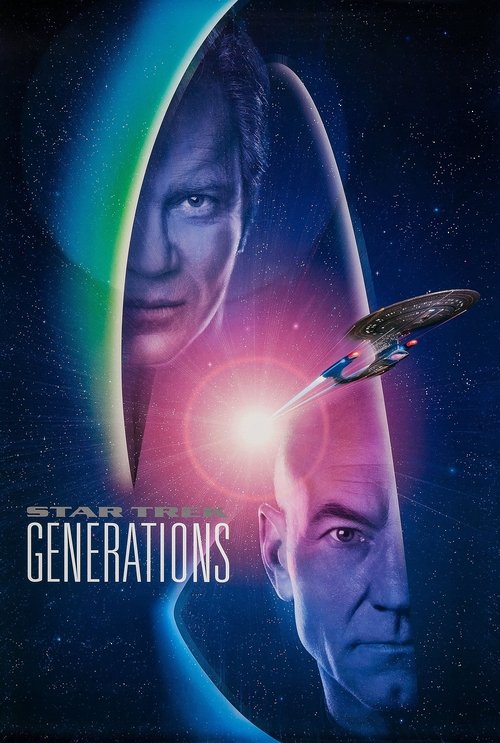
Star Trek: Generations
Captain Jean-Luc Picard and the crew of the Enterprise-D find themselves at odds with the renegade scientist Soran who is destroying entire star systems. Only one man can help Picard stop Soran's scheme...and he's been dead for seventy-eight years.
Despite a respectable budget of $38.0M, Star Trek: Generations became a box office success, earning $118.1M worldwide—a 211% return.
2 wins & 4 nominations


Plot Structure
Story beats plotted across runtime


Narrative Arc
Emotional journey through the story's key moments
Story Circle
Blueprint 15-beat structure
Arcplot Score Breakdown
Weighted: Precision (70%) + Arc (15%) + Theme (15%)
Star Trek: Generations (1994) exemplifies carefully calibrated story structure, characteristic of David Carson's storytelling approach. This structural analysis examines how the film's 15-point plot structure maps to proven narrative frameworks across 1 hour and 57 minutes. With an Arcplot score of 7.2, the film balances conventional beats with creative variation.
Characters
Cast & narrative archetypes

Captain Jean-Luc Picard
Captain James T. Kirk
Dr. Tolian Soran
Commander William Riker
Lieutenant Commander Data
Lieutenant Commander Geordi La Forge
Lieutenant Worf
Dr. Beverly Crusher
Counselor Deanna Troi
Main Cast & Characters
Captain Jean-Luc Picard
Played by Patrick Stewart
Captain of the Enterprise-D who faces mortality and loss when his family dies, ultimately confronting Soran to prevent the destruction of billions.
Captain James T. Kirk
Played by William Shatner
Legendary Starfleet captain pulled from retirement, struggling with aging and irrelevance before sacrificing himself to save millions.
Dr. Tolian Soran
Played by Malcolm McDowell
El-Aurian scientist obsessed with returning to the Nexus at any cost, willing to destroy entire star systems to achieve eternal paradise.
Commander William Riker
Played by Jonathan Frakes
First Officer of the Enterprise-D, Picard's trusted right-hand and loyal friend throughout the crisis.
Lieutenant Commander Data
Played by Brent Spiner
Android officer experiencing emotions for the first time via an emotion chip, struggling to control fear and joy during the crisis.
Lieutenant Commander Geordi La Forge
Played by LeVar Burton
Chief Engineer of the Enterprise-D who is kidnapped and used by Soran to gain access to the ship.
Lieutenant Worf
Played by Michael Dorn
Klingon security officer who participates in a promotion ceremony and fights to defend the Enterprise.
Dr. Beverly Crusher
Played by Gates McFadden
Chief Medical Officer of the Enterprise-D who provides medical support and counsel during the crisis.
Counselor Deanna Troi
Played by Marina Sirtis
Ship's counselor who crashes the Enterprise saucer section on Veridian III and supports the crew emotionally.
Structural Analysis
The Status Quo at 1 minutes (1% through the runtime) establishes Captain Kirk presides over the christening ceremony of the Enterprise-B, a celebratory moment honoring his legendary career and the passing of the torch to a new generation.. The analysis reveals that this early placement immediately immerses viewers in the story world.
The inciting incident occurs at 14 minutes when Kirk is pulled into space and apparently killed while saving the Enterprise-B from the Nexus energy ribbon. The hero dies, shattering the status quo and introducing the central mystery.. At 12% through the film, this Disruption aligns precisely with traditional story structure. This beat shifts the emotional landscape, launching the protagonist into the central conflict.
The First Threshold at 30 minutes marks the transition into Act II, occurring at 25% of the runtime. This demonstrates the protagonist's commitment to Picard decides to pursue Soran to the Amargosa stellar observatory after discovering the connection between Soran and the Nexus. He actively chooses to investigate rather than remaining in mourning., moving from reaction to action.
At 59 minutes, the Midpoint arrives at 50% of the runtime—precisely centered, creating perfect narrative symmetry. Structural examination shows that this crucial beat Picard discovers Soran's full plan in stellar cartography: he will destroy the Veridian star, killing 230 million people on Veridian IV, to bring the Nexus to him. The stakes are raised from personal to galactic. False defeat: the plan seems unstoppable., fundamentally raising what's at risk. The emotional intensity shifts, dividing the narrative into clear before-and-after phases.
The Collapse moment at 89 minutes (76% through) represents the emotional nadir. Here, The Enterprise-D is destroyed. Soran launches the probe that will destroy the Veridian star. Picard is pulled into the Nexus as the star explodes. Total defeat: millions die, the Enterprise is lost, and Soran wins. Literal death of the ship and crew's home., illustrates the protagonist at their lowest point. This beat's placement in the final quarter sets up the climactic reversal.
The Second Threshold at 95 minutes initiates the final act resolution at 81% of the runtime. Picard realizes the Nexus is an illusion and chooses to leave. Guinan reveals he can go anywhere in time. Picard decides to recruit Kirk, synthesizing past and present, legacy and action. He chooses meaning over comfort., demonstrating the transformation achieved throughout the journey.
Emotional Journey
Star Trek: Generations's emotional architecture traces a deliberate progression across 15 carefully calibrated beats.
Narrative Framework
This structural analysis employs systematic plot point analysis that identifies crucial turning points. By mapping Star Trek: Generations against these established plot points, we can identify how David Carson utilizes or subverts traditional narrative conventions. The plot point approach reveals not only adherence to structural principles but also creative choices that distinguish Star Trek: Generations within the science fiction genre.
Comparative Analysis
Additional science fiction films include The Postman, Mad Max 2 and AVP: Alien vs. Predator.
Plot Points by Act
Act I
SetupStatus Quo
Captain Kirk presides over the christening ceremony of the Enterprise-B, a celebratory moment honoring his legendary career and the passing of the torch to a new generation.
Theme
Journalist asks Kirk about mortality and retirement: "Don't you wish you were out there... making a difference?" The theme of legacy, mortality, and finding meaning beyond glory is established.
Worldbuilding
Enterprise-B shakedown cruise interrupted by distress call. Kirk feels obsolete on the new ship. Introduction of the Nexus energy ribbon and refugee ships. Establishes both eras and the Nexus as the film's MacGuffin.
Disruption
Kirk is pulled into space and apparently killed while saving the Enterprise-B from the Nexus energy ribbon. The hero dies, shattering the status quo and introducing the central mystery.
Resistance
78 years later: Picard on Enterprise-D deals with his own mortality after learning his brother and nephew died in a fire. Data installs emotion chip. Soran escapes from custody. The two storylines (Picard's grief and Soran's mission) are established in parallel.
Act II
ConfrontationFirst Threshold
Picard decides to pursue Soran to the Amargosa stellar observatory after discovering the connection between Soran and the Nexus. He actively chooses to investigate rather than remaining in mourning.
Mirror World
At the destroyed observatory, Picard meets Guinan who reveals her connection to the Nexus and explains its nature as a place of "joy" where time has no meaning—a mirror to Picard's grief and desire to change the past.
Premise
Picard investigates Soran's plan across multiple locations: the observatory, stellar cartography, and tracking Soran to Veridian III. Data explores emotions. The promise: can Picard stop Soran from destroying a star system to reach the Nexus?
Midpoint
Picard discovers Soran's full plan in stellar cartography: he will destroy the Veridian star, killing 230 million people on Veridian IV, to bring the Nexus to him. The stakes are raised from personal to galactic. False defeat: the plan seems unstoppable.
Opposition
Lursa and B'Etor attack the Enterprise while Picard beams down to confront Soran. The ship battle goes badly. Picard fails to stop Soran on the planet. Everything tightens as both conflicts escalate simultaneously.
Collapse
The Enterprise-D is destroyed. Soran launches the probe that will destroy the Veridian star. Picard is pulled into the Nexus as the star explodes. Total defeat: millions die, the Enterprise is lost, and Soran wins. Literal death of the ship and crew's home.
Crisis
Picard experiences the Nexus fantasy: the family he never had, children opening Christmas presents. He processes what he's lost and what he truly values. The dark temptation to stay in the illusion versus returning to harsh reality.
Act III
ResolutionSecond Threshold
Picard realizes the Nexus is an illusion and chooses to leave. Guinan reveals he can go anywhere in time. Picard decides to recruit Kirk, synthesizing past and present, legacy and action. He chooses meaning over comfort.
Synthesis
Picard convinces Kirk to leave his Nexus paradise. Two captains return to Veridian III moments before Soran launches the probe. They work together to stop Soran and disarm the weapon. Kirk sacrifices himself—this time truly dying—to save millions.
Transformation
Picard buries Kirk on the mountaintop. "I'm sure it was fun." Unlike the opening ceremony, this is a quiet, meaningful moment honoring a hero's true death. Picard has learned that legacy isn't about glory—it's about making a difference when it matters, even at cost.