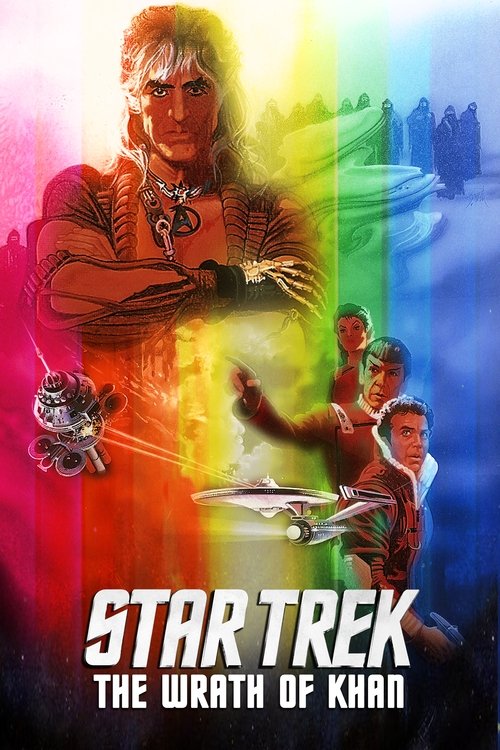
Star Trek II: The Wrath of Khan
The starship Enterprise and its crew is pulled back into action when old nemesis, Khan, steals a top secret device called Project Genesis.
Despite its tight budget of $12.0M, Star Trek II: The Wrath of Khan became a box office phenomenon, earning $96.6M worldwide—a remarkable 705% return. The film's innovative storytelling connected with viewers, proving that strong storytelling can transcend budget limitations.
5 wins & 9 nominations


Plot Structure
Story beats plotted across runtime


Narrative Arc
Emotional journey through the story's key moments
Story Circle
Blueprint 15-beat structure
Arcplot Score Breakdown
Weighted: Precision (70%) + Arc (15%) + Theme (15%)
Star Trek II: The Wrath of Khan (1982) demonstrates strategically placed story structure, characteristic of Nicholas Meyer's storytelling approach. This structural analysis examines how the film's 15-point plot structure maps to proven narrative frameworks across 1 hour and 52 minutes. With an Arcplot score of 7.1, the film balances conventional beats with creative variation.
Characters
Cast & narrative archetypes

James T. Kirk
Khan Noonien Singh
Spock
Leonard McCoy
Montgomery Scott
Hikaru Sulu
Uhura
Pavel Chekov
Carol Marcus
David Marcus
Main Cast & Characters
James T. Kirk
Played by William Shatner
Admiral and former Enterprise captain facing midlife crisis, forced to confront his past and mortality when Khan returns for revenge.
Khan Noonien Singh
Played by Ricardo Montalbán
Genetically enhanced superhuman seeking vengeance against Kirk for marooning him fifteen years earlier.
Spock
Played by Leonard Nimoy
Enterprise's Vulcan science officer and Kirk's closest friend, serving as captain of the training vessel.
Leonard McCoy
Played by DeForest Kelley
Enterprise chief medical officer and Kirk's confidant, concerned about his friend's aging and purposelessness.
Montgomery Scott
Played by James Doohan
Enterprise chief engineer, loyal and resourceful in crisis situations.
Hikaru Sulu
Played by George Takei
Enterprise helmsman, now serving on the training cruise under Spock's command.
Uhura
Played by Nichelle Nichols
Enterprise communications officer continuing her loyal service.
Pavel Chekov
Played by Walter Koenig
Former Enterprise navigator now serving as first officer on USS Reliant, captured and controlled by Khan.
Carol Marcus
Played by Bibi Besch
Brilliant scientist leading the Genesis Project and Kirk's former lover with a significant secret.
David Marcus
Played by Merritt Butrick
Young scientist on the Genesis team who is revealed to be Kirk's son.
Structural Analysis
The Status Quo at 1 minutes (1% through the runtime) establishes Saavik commands the Enterprise in the Kobayashi Maru simulation, facing certain death. Kirk's world: he is now an Admiral, training cadets, removed from the captain's chair and the adventure he craves.. Notably, this early placement immediately immerses viewers in the story world.
The inciting incident occurs at 14 minutes when Khan and his followers hijack the USS Reliant after Commander Chekov and Captain Terrell beam down to Ceti Alpha V. Khan learns about Genesis and begins his revenge plot against Kirk, the man who marooned him fifteen years ago.. At 12% through the film, this Disruption aligns precisely with traditional story structure. This beat shifts the emotional landscape, launching the protagonist into the central conflict.
The First Threshold at 28 minutes marks the transition into Act II, occurring at 25% of the runtime. This indicates the protagonist's commitment to Kirk assumes command of the Enterprise, ordering Spock to set course for Regula I. He chooses to step back into the captain's chair, leaving his Admiral's desk behind and returning to active duty in the field., moving from reaction to action.
At 57 minutes, the Midpoint arrives at 51% of the runtime—precisely centered, creating perfect narrative symmetry. Of particular interest, this crucial beat Khan discovers the true power of Genesis: it can reorganize dead matter into life, but it will destroy all existing life in the process. Khan decides to steal the Genesis Device to use as the ultimate weapon. The stakes escalate from personal revenge to galactic threat., fundamentally raising what's at risk. The emotional intensity shifts, dividing the narrative into clear before-and-after phases.
The Collapse moment at 83 minutes (74% through) represents the emotional nadir. Here, Khan activates the Genesis Device inside the Mutara Nebula. With Enterprise's warp drive disabled, the ship cannot escape the explosion radius. Kirk faces certain death—the no-win scenario—with no way to cheat. "Hours instead of days," Spock says. All is lost., illustrates the protagonist at their lowest point. This beat's placement in the final quarter sets up the climactic reversal.
The Second Threshold at 89 minutes initiates the final act resolution at 79% of the runtime. Spock enters the radiation-flooded engine room and repairs the warp drive with his bare hands, sacrificing himself to save the ship. Kirk realizes what Spock is doing but cannot stop him. The cost of survival: his best friend's life., demonstrating the transformation achieved throughout the journey.
Emotional Journey
Star Trek II: The Wrath of Khan's emotional architecture traces a deliberate progression across 15 carefully calibrated beats.
Narrative Framework
This structural analysis employs a 15-point narrative structure framework that maps key story moments. By mapping Star Trek II: The Wrath of Khan against these established plot points, we can identify how Nicholas Meyer utilizes or subverts traditional narrative conventions. The plot point approach reveals not only adherence to structural principles but also creative choices that distinguish Star Trek II: The Wrath of Khan within the action genre.
Nicholas Meyer's Structural Approach
Among the 4 Nicholas Meyer films analyzed on Arcplot, the average structural score is 7.0, demonstrating varied approaches to story architecture. Star Trek II: The Wrath of Khan represents one of the director's most structurally precise works. For comparative analysis, explore the complete Nicholas Meyer filmography.
Comparative Analysis
Additional action films include The Bad Guys, Puss in Boots and Venom: The Last Dance. For more Nicholas Meyer analyses, see Star Trek VI: The Undiscovered Country, Volunteers and Time After Time.
Plot Points by Act
Act I
SetupStatus Quo
Saavik commands the Enterprise in the Kobayashi Maru simulation, facing certain death. Kirk's world: he is now an Admiral, training cadets, removed from the captain's chair and the adventure he craves.
Theme
McCoy gives Kirk antique reading glasses for his birthday, saying "I know you better than you know yourself." He tells Kirk, "You're hiding from something" and "You're afraid of getting old." Theme: confronting mortality, aging, and what it means to face death.
Worldbuilding
Establish Kirk's malaise as an Admiral, the training voyage of the Enterprise with Spock as captain, the Genesis Project on Regula I, and Khan's exile on Ceti Alpha V. Kirk feels old and obsolete; Spock commands his ship; Carol Marcus develops terraforming technology.
Disruption
Khan and his followers hijack the USS Reliant after Commander Chekov and Captain Terrell beam down to Ceti Alpha V. Khan learns about Genesis and begins his revenge plot against Kirk, the man who marooned him fifteen years ago.
Resistance
Khan attacks Regula I station to steal Genesis data. Kirk receives a coded message from Carol Marcus and debates whether to investigate. Spock encourages Kirk to take command, recognizing his restlessness. Kirk resists, unsure if he still has what it takes.
Act II
ConfrontationFirst Threshold
Kirk assumes command of the Enterprise, ordering Spock to set course for Regula I. He chooses to step back into the captain's chair, leaving his Admiral's desk behind and returning to active duty in the field.
Mirror World
Kirk learns that Carol Marcus is the head of the Genesis Project and that David Marcus, a young scientist on the team, is his son—a relationship he abandoned years ago. This subplot will force Kirk to confront what he sacrificed for his career.
Premise
Kirk vs. Khan: the battle of wits begins. Khan ambushes Enterprise in the Mutara Nebula, crippling the ship and killing trainees. Kirk uses prefix codes to disable Reliant. Both ships damaged, Khan retreats. Kirk investigates Regula I, finds the Genesis cave, and rescues Carol and David.
Midpoint
Khan discovers the true power of Genesis: it can reorganize dead matter into life, but it will destroy all existing life in the process. Khan decides to steal the Genesis Device to use as the ultimate weapon. The stakes escalate from personal revenge to galactic threat.
Opposition
Khan hunts the Enterprise relentlessly. Kirk must protect Genesis while managing his relationship with Carol and David. Khan uses Terrell and Chekov's implanted mind-control creatures to locate Genesis. The Enterprise is outgunned, and Khan's obsession intensifies.
Collapse
Khan activates the Genesis Device inside the Mutara Nebula. With Enterprise's warp drive disabled, the ship cannot escape the explosion radius. Kirk faces certain death—the no-win scenario—with no way to cheat. "Hours instead of days," Spock says. All is lost.
Crisis
Kirk sits helpless in the captain's chair as the Genesis countdown continues. He has no options, no tricks left. For the first time, Kirk must truly face death—not simulate it, not cheat it, but accept it.
Act III
ResolutionSecond Threshold
Spock enters the radiation-flooded engine room and repairs the warp drive with his bare hands, sacrificing himself to save the ship. Kirk realizes what Spock is doing but cannot stop him. The cost of survival: his best friend's life.
Synthesis
Enterprise warps to safety as Genesis detonates, creating a new planet. Kirk rushes to the engine room for Spock's final moments. Spock dies with dignity: "I have been, and always shall be, your friend." Spock's funeral on the Genesis planet. Kirk eulogizes his friend.
Transformation
Kirk stands on the bridge, looking at the Genesis planet with hope. "I feel young," he says—transformed from the aging, obsolete Admiral into a man who has faced death, accepted loss, and found renewal. Spock's coffin rests on the Genesis planet as new life blooms.