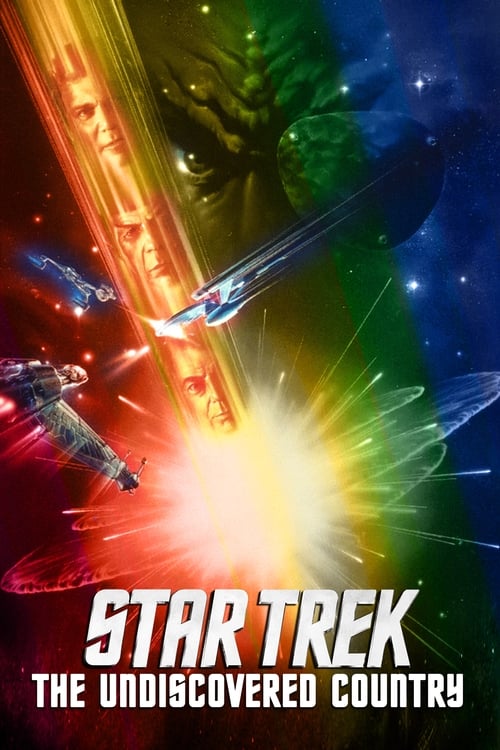
Star Trek VI: The Undiscovered Country
After years of war, the Federation and the Klingon empire find themselves on the brink of a peace summit when a Klingon ship is nearly destroyed by an apparent attack from the Enterprise. Both worlds brace for what may be their deadliest encounter.
Despite a mid-range budget of $27.0M, Star Trek VI: The Undiscovered Country became a solid performer, earning $96.9M worldwide—a 259% return.
Nominated for 2 Oscars. 2 wins & 9 nominations


Plot Structure
Story beats plotted across runtime


Narrative Arc
Emotional journey through the story's key moments
Story Circle
Blueprint 15-beat structure
Arcplot Score Breakdown
Weighted: Precision (70%) + Arc (15%) + Theme (15%)
Star Trek VI: The Undiscovered Country (1991) exhibits strategically placed dramatic framework, characteristic of Nicholas Meyer's storytelling approach. This structural analysis examines how the film's 15-point plot structure maps to proven narrative frameworks across 1 hour and 50 minutes. With an Arcplot score of 7.2, the film balances conventional beats with creative variation.
Characters
Cast & narrative archetypes

Captain James T. Kirk
Captain Spock
Dr. Leonard McCoy
Lieutenant Valeris
Chancellor Gorkon
General Chang
Azetbur
Commander Montgomery Scott
Commander Uhura
Commander Hikaru Sulu
Commander Pavel Chekov
Main Cast & Characters
Captain James T. Kirk
Played by William Shatner
Starfleet captain struggling with prejudice against Klingons after they killed his son, must escort Klingon Chancellor to peace talks.
Captain Spock
Played by Leonard Nimoy
Logical Vulcan science officer who orchestrates the peace mission and must defend Kirk when he's accused of murder.
Dr. Leonard McCoy
Played by DeForest Kelley
Ship's doctor and Kirk's closest friend, also framed for the Chancellor's assassination.
Lieutenant Valeris
Played by Kim Cattrall
Young Vulcan protégé of Spock who serves as helmsman and harbors a deadly secret.
Chancellor Gorkon
Played by David Warner
Visionary Klingon leader pursuing peace with the Federation before his assassination.
General Chang
Played by Christopher Plummer
Militaristic Klingon warrior who quotes Shakespeare and conspires against the peace process.
Azetbur
Played by Rosana DeSoto
Gorkon's daughter who becomes Chancellor and continues her father's peace mission despite her grief.
Commander Montgomery Scott
Played by James Doohan
Chief Engineer of the Enterprise who investigates the technical aspects of the assassination.
Commander Uhura
Played by Nichelle Nichols
Communications officer who must navigate language barriers during the crisis.
Commander Hikaru Sulu
Played by George Takei
Now captain of the USS Excelsior, races to rescue Kirk and McCoy from Klingon prison.
Commander Pavel Chekov
Played by Walter Koenig
Navigator and tactical officer who assists in investigating the conspiracy.
Structural Analysis
The Status Quo at 1 minutes (1% through the runtime) establishes Captain Kirk and crew aboard the Enterprise, nearing the end of their mission. Kirk logs that they are about to escort the Klingon Chancellor for historic peace talks, representing the old guard of Starfleet in a familiar, ordered universe.. The analysis reveals that this early placement immediately immerses viewers in the story world.
The inciting incident occurs at 13 minutes when Kirk is ordered to escort Klingon Chancellor Gorkon to peace talks on Earth. This assignment disrupts Kirk's worldview—he must facilitate peace with the species he despises, challenging everything he believes.. At 12% through the film, this Disruption aligns precisely with traditional story structure. This beat shifts the emotional landscape, launching the protagonist into the central conflict.
The First Threshold at 27 minutes marks the transition into Act II, occurring at 25% of the runtime. This indicates the protagonist's commitment to Enterprise appears to fire on Gorkon's ship. Two assassins in Starfleet gear board the Klingon vessel and murder Chancellor Gorkon. Kirk and McCoy are arrested and taken into Klingon custody, forced into a nightmare world of false accusation and show trial., moving from reaction to action.
At 55 minutes, the Midpoint arrives at 50% of the runtime—precisely centered, creating perfect narrative symmetry. Of particular interest, this crucial beat Martia betrays Kirk and McCoy on the frozen surface, revealing herself as a shapeshifter working for the conspirators. Kirk is forced to kill "Martia" in self-defense. Just as they face execution, Spock beams them up. False victory: they're rescued, but the conspiracy runs deeper than imagined, and stakes escalate., fundamentally raising what's at risk. The emotional intensity shifts, dividing the narrative into clear before-and-after phases.
The Collapse moment at 82 minutes (75% through) represents the emotional nadir. Here, The Enterprise is forbidden to approach Khitomer and ordered to return home. Valeris is revealed as a traitor. Kirk confronts his own crew's betrayal and the seeming impossibility of stopping the assassination. Hope appears lost; they're out of time and out of options., illustrates the protagonist at their lowest point. This beat's placement in the final quarter sets up the climactic reversal.
The Second Threshold at 88 minutes initiates the final act resolution at 80% of the runtime. Kirk decides to violate orders and take the Enterprise to Khitomer. He synthesizes his old warrior skills with the new understanding that peace is worth fighting for. The crew commits to the mission together, combining their strengths for one final push., demonstrating the transformation achieved throughout the journey.
Emotional Journey
Star Trek VI: The Undiscovered Country's emotional architecture traces a deliberate progression across 15 carefully calibrated beats.
Narrative Framework
This structural analysis employs proven narrative structure principles that track dramatic progression. By mapping Star Trek VI: The Undiscovered Country against these established plot points, we can identify how Nicholas Meyer utilizes or subverts traditional narrative conventions. The plot point approach reveals not only adherence to structural principles but also creative choices that distinguish Star Trek VI: The Undiscovered Country within the science fiction genre.
Nicholas Meyer's Structural Approach
Among the 4 Nicholas Meyer films analyzed on Arcplot, the average structural score is 7.0, demonstrating varied approaches to story architecture. Star Trek VI: The Undiscovered Country represents one of the director's most structurally precise works. For comparative analysis, explore the complete Nicholas Meyer filmography.
Comparative Analysis
Additional science fiction films include The Postman, Mad Max 2 and AVP: Alien vs. Predator. For more Nicholas Meyer analyses, see Star Trek II: The Wrath of Khan, Volunteers and Time After Time.
Plot Points by Act
Act I
SetupStatus Quo
Captain Kirk and crew aboard the Enterprise, nearing the end of their mission. Kirk logs that they are about to escort the Klingon Chancellor for historic peace talks, representing the old guard of Starfleet in a familiar, ordered universe.
Theme
Spock quotes: "Only Nixon could go to China." The theme of unexpected peacemakers and letting go of old prejudices is stated. The question: can old enemies evolve beyond their hatred?
Worldbuilding
Establishing the political landscape: Praxis explosion cripples the Klingon Empire, forcing peace negotiations. Federation and Klingon tensions established. Kirk's deep-seated hatred of Klingons (they killed his son) is revealed. Crew dynamics and Enterprise's final mission context set up.
Disruption
Kirk is ordered to escort Klingon Chancellor Gorkon to peace talks on Earth. This assignment disrupts Kirk's worldview—he must facilitate peace with the species he despises, challenging everything he believes.
Resistance
Kirk debates and resists internally but accepts the mission. The Enterprise crew prepares for the diplomatic encounter. Tension builds as they rendezvous with Gorkon's ship. An awkward dinner aboard Enterprise reveals cultural clashes and Kirk's barely-concealed hostility.
Act II
ConfrontationFirst Threshold
Enterprise appears to fire on Gorkon's ship. Two assassins in Starfleet gear board the Klingon vessel and murder Chancellor Gorkon. Kirk and McCoy are arrested and taken into Klingon custody, forced into a nightmare world of false accusation and show trial.
Mirror World
Kirk and McCoy are convicted and sentenced to the frozen prison planet Rura Penthe. They meet fellow prisoner Martia, who offers to help them escape. This subplot represents trust and alliance where none should exist—mirroring the larger peace effort.
Premise
Kirk and McCoy struggle to survive in the brutal Klingon prison while Spock and the Enterprise crew work frantically to investigate the conspiracy and rescue them. Action and investigation interweave: prison escape attempts, examining evidence, political maneuvering. The premise delivers intrigue and action.
Midpoint
Martia betrays Kirk and McCoy on the frozen surface, revealing herself as a shapeshifter working for the conspirators. Kirk is forced to kill "Martia" in self-defense. Just as they face execution, Spock beams them up. False victory: they're rescued, but the conspiracy runs deeper than imagined, and stakes escalate.
Opposition
The crew investigates the conspiracy while evading both Klingon and Federation forces. Evidence points to traitors within Starfleet itself. Tensions rise as they race against time to prevent the assassination of the Federation President at the peace conference. The conspiracy closes in; allies become suspect.
Collapse
The Enterprise is forbidden to approach Khitomer and ordered to return home. Valeris is revealed as a traitor. Kirk confronts his own crew's betrayal and the seeming impossibility of stopping the assassination. Hope appears lost; they're out of time and out of options.
Crisis
Kirk grapples with the betrayal and the weight of failure. Through Spock's forced mind-meld with Valeris, they extract the conspirators' location and plan. Dark moment transforms into determination—they must defy orders and risk everything to save the peace conference.
Act III
ResolutionSecond Threshold
Kirk decides to violate orders and take the Enterprise to Khitomer. He synthesizes his old warrior skills with the new understanding that peace is worth fighting for. The crew commits to the mission together, combining their strengths for one final push.
Synthesis
Enterprise races to Khitomer. They expose and battle the cloaked Klingon Bird of Prey crewed by conspirators. Kirk, Spock, and crew storm the conference hall, identify and stop the assassin (Starfleet Colonel West) moments before he kills the Federation President. The conspiracy is defeated; peace is preserved.
Transformation
Kirk logs that the Enterprise is ordered to return for decommissioning, but Sulu suggests "one last adventure." Kirk orders helm to set course for "the second star to the right, and straight on 'til morning." The old warrior has made peace with change and chooses hope over bitterness—transformed.