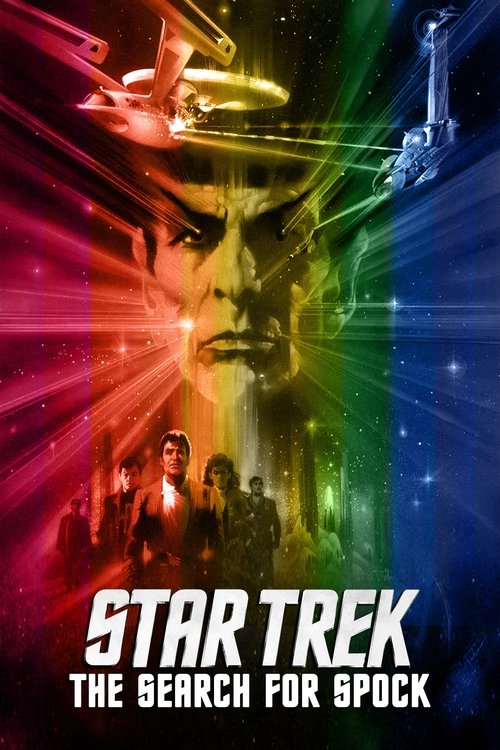
Star Trek III: The Search for Spock
A surprise visit from Spock's father provides a startling revelation: McCoy is harboring Spock's living essence.
Despite a moderate budget of $18.0M, Star Trek III: The Search for Spock became a solid performer, earning $87.0M worldwide—a 383% return.
1 win & 10 nominations


Plot Structure
Story beats plotted across runtime


Narrative Arc
Emotional journey through the story's key moments
Story Circle
Blueprint 15-beat structure
Arcplot Score Breakdown
Weighted: Precision (70%) + Arc (15%) + Theme (15%)
Star Trek III: The Search for Spock (1984) exhibits precise narrative design, characteristic of Leonard Nimoy's storytelling approach. This structural analysis examines how the film's 15-point plot structure maps to proven narrative frameworks across 1 hour and 45 minutes. With an Arcplot score of 7.5, the film showcases strong structural fundamentals.
Characters
Cast & narrative archetypes

James T. Kirk
Spock
Leonard McCoy
Montgomery Scott
Hikaru Sulu
Pavel Chekov
Uhura
David Marcus
Saavik
Kruge
Main Cast & Characters
James T. Kirk
Played by William Shatner
Admiral and former Enterprise captain who defies Starfleet orders to rescue Spock's living essence from Genesis.
Spock
Played by Leonard Nimoy
Deceased Vulcan science officer whose katra resides in McCoy, reborn on Genesis through pon farr regeneration.
Leonard McCoy
Played by DeForest Kelley
Chief medical officer carrying Spock's katra, causing mental instability and compelling him to return to Vulcan.
Montgomery Scott
Played by James Doohan
Chief engineer who helps Kirk steal the Enterprise to rescue Spock despite Starfleet prohibition.
Hikaru Sulu
Played by George Takei
Helmsman who joins Kirk's mutiny to save Spock and retrieve his body from Genesis.
Pavel Chekov
Played by Walter Koenig
Navigator who assists in the theft of the Enterprise and mission to Genesis.
Uhura
Played by Nichelle Nichols
Communications officer who helps Kirk escape and joins the mission despite career risk.
David Marcus
Played by Merritt Butrick
Kirk's son and Genesis scientist who discovers Spock's regeneration on the unstable planet.
Saavik
Played by Robin Curtis
Vulcan officer who protects the rapidly aging young Spock on Genesis planet.
Kruge
Played by Christopher Lloyd
Ruthless Klingon commander seeking Genesis secrets, willing to destroy Genesis and kill its defenders.
Structural Analysis
The Status Quo at 1 minutes (1% through the runtime) establishes The damaged Enterprise limps home after the battle with Khan. The crew is exhausted and mourning, with Spock's coffin resting in the torpedo bay - a somber reminder of their devastating loss.. Structural examination shows that this early placement immediately immerses viewers in the story world.
The inciting incident occurs at 13 minutes when Kirk learns that McCoy has Spock's katra trapped in his mind and will die unless it's returned to Vulcan. The only way to save McCoy and honor Spock is to retrieve Spock's body from the Genesis planet - a mission Starfleet explicitly forbids.. At 13% through the film, this Disruption is delayed, allowing extended setup of the story world. This beat shifts the emotional landscape, launching the protagonist into the central conflict.
The First Threshold at 27 minutes marks the transition into Act II, occurring at 25% of the runtime. This demonstrates the protagonist's commitment to Kirk makes the active choice to steal the Enterprise and go to Genesis, defying Starfleet orders. He tells his crew: "The word is no. I am therefore going anyway." This irreversible decision launches them into their mission to save Spock., moving from reaction to action.
At 53 minutes, the Midpoint arrives at 51% of the runtime—precisely centered, creating perfect narrative symmetry. Significantly, this crucial beat The Enterprise arrives at Genesis to find the Grissom destroyed and the planet destabilizing. David reveals his terrible secret: he used unstable protomatter in the Genesis matrix to solve certain problems. This false victory (reaching Genesis) becomes a defeat - Genesis is dying and will take everyone with it., fundamentally raising what's at risk. The emotional intensity shifts, dividing the narrative into clear before-and-after phases.
The Collapse moment at 77 minutes (74% through) represents the emotional nadir. Here, Kruge orders one hostage killed to force Kirk's surrender. David sacrifices himself to protect Spock, dying in his arms. Kirk's scream of anguish echoes through the bridge: "You Klingon bastard, you've killed my son." This is Kirk's darkest moment - the whiff of death realized., demonstrates the protagonist at their lowest point. This beat's placement in the final quarter sets up the climactic reversal.
The Second Threshold at 83 minutes initiates the final act resolution at 79% of the runtime. Kirk synthesizes the lesson: "The needs of the one outweigh the needs of the many." He decides to sacrifice the Enterprise itself - his other "love" - to save his crew and Spock. This realization allows him to set the auto-destruct and lure the Klingons aboard, turning their greatest weakness into strength., demonstrating the transformation achieved throughout the journey.
Emotional Journey
Star Trek III: The Search for Spock's emotional architecture traces a deliberate progression across 15 carefully calibrated beats.
Narrative Framework
This structural analysis employs systematic plot point analysis that identifies crucial turning points. By mapping Star Trek III: The Search for Spock against these established plot points, we can identify how Leonard Nimoy utilizes or subverts traditional narrative conventions. The plot point approach reveals not only adherence to structural principles but also creative choices that distinguish Star Trek III: The Search for Spock within the science fiction genre.
Leonard Nimoy's Structural Approach
Among the 3 Leonard Nimoy films analyzed on Arcplot, the average structural score is 7.2, reflecting strong command of classical structure. Star Trek III: The Search for Spock represents one of the director's most structurally precise works. For comparative analysis, explore the complete Leonard Nimoy filmography.
Comparative Analysis
Additional science fiction films include The Postman, Mad Max 2 and AVP: Alien vs. Predator. For more Leonard Nimoy analyses, see Funny About Love, Star Trek IV: The Voyage Home.
Plot Points by Act
Act I
SetupStatus Quo
The damaged Enterprise limps home after the battle with Khan. The crew is exhausted and mourning, with Spock's coffin resting in the torpedo bay - a somber reminder of their devastating loss.
Theme
Sarek confronts Kirk about Spock's katra (living spirit), stating: "He asked you to bring him to us and you denied him. You will find a way." The theme is established: the needs of the one outweigh the needs of the many - the inverse of Spock's sacrifice in Star Trek II.
Worldbuilding
The Enterprise crew returns to Earth as heroes, but Kirk is haunted by Spock's death. We learn the Genesis planet has been declared off-limits. McCoy begins acting strangely, speaking with Spock's voice and mannerisms. David Marcus and Saavik investigate life readings on Genesis, discovering rapid evolution.
Disruption
Kirk learns that McCoy has Spock's katra trapped in his mind and will die unless it's returned to Vulcan. The only way to save McCoy and honor Spock is to retrieve Spock's body from the Genesis planet - a mission Starfleet explicitly forbids.
Resistance
Kirk debates whether to defy Starfleet orders. Sarek pleads with him to help. Kirk attempts to get official permission but is denied. Meanwhile, on Genesis, David and Saavik discover a resurrected young Spock rapidly aging. Klingon Commander Kruge observes Genesis as a potential weapon and plans to seize it.
Act II
ConfrontationFirst Threshold
Kirk makes the active choice to steal the Enterprise and go to Genesis, defying Starfleet orders. He tells his crew: "The word is no. I am therefore going anyway." This irreversible decision launches them into their mission to save Spock.
Mirror World
Kruge and the Klingons represent the thematic counterpoint - they see Genesis purely as a weapon of destruction, while Kirk's crew fights to preserve life. Kruge destroys the Grissom and kills its crew, establishing the mortal stakes of opposing philosophies.
Premise
The heist unfolds as Kirk and crew execute their daring theft of the Enterprise. They evade Starfleet security, escape spacedock, and journey to Genesis. On the planet, Saavik and David protect the rapidly aging young Spock while evading Klingon forces and dealing with Genesis' unstable environment.
Midpoint
The Enterprise arrives at Genesis to find the Grissom destroyed and the planet destabilizing. David reveals his terrible secret: he used unstable protomatter in the Genesis matrix to solve certain problems. This false victory (reaching Genesis) becomes a defeat - Genesis is dying and will take everyone with it.
Opposition
Kruge captures Saavik, David, and the now-adolescent Spock on the disintegrating Genesis surface. The planet's destruction accelerates. Kruge demands Kirk beam aboard or watch his crew die. The situation deteriorates as Kirk faces impossible choices and the Enterprise itself becomes a liability against the Klingon Bird-of-Prey.
Collapse
Kruge orders one hostage killed to force Kirk's surrender. David sacrifices himself to protect Spock, dying in his arms. Kirk's scream of anguish echoes through the bridge: "You Klingon bastard, you've killed my son." This is Kirk's darkest moment - the whiff of death realized.
Crisis
Kirk processes the devastating loss of his son while the Genesis planet crumbles around them. Outmanned and outgunned, Kirk faces the ultimate sacrifice. In his dark night, he must decide what price he's willing to pay to complete the mission and honor both his son's sacrifice and Spock's legacy.
Act III
ResolutionSecond Threshold
Kirk synthesizes the lesson: "The needs of the one outweigh the needs of the many." He decides to sacrifice the Enterprise itself - his other "love" - to save his crew and Spock. This realization allows him to set the auto-destruct and lure the Klingons aboard, turning their greatest weakness into strength.
Synthesis
Kirk executes his plan, destroying the Enterprise and most of the Klingon boarding party. The crew escapes to the planet's surface and beams aboard the Klingon vessel. Kirk defeats Kruge in hand-to-hand combat. They rescue Spock and escape as Genesis destroys itself. On Vulcan, the Fal-Tor-Pan ritual reunites Spock's katra with his body.
Transformation
Spock, restored but recovering his memories, recognizes Kirk and asks, "Why would you do this?" Kirk responds: "Because the needs of the one outweigh the needs of the many." Spock completes the callback: "I have been and always shall be your friend." Kirk has transformed from a captain following rules to someone who knows friendship transcends duty.