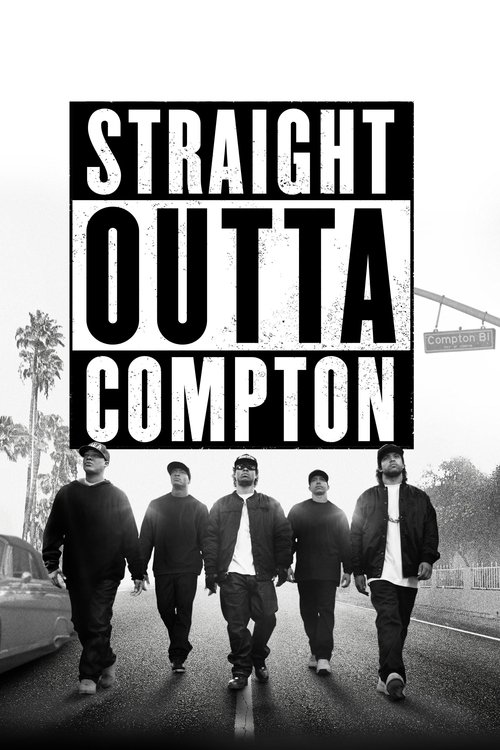
Straight Outta Compton
The rap group NWA emerges from the mean streets of Compton in the mid-1980s and revolutionizes hip-hop culture with their music and tales about life in the hood.
Despite a respectable budget of $28.0M, Straight Outta Compton became a box office phenomenon, earning $201.6M worldwide—a remarkable 620% return.
Nominated for 1 Oscar. 28 wins & 40 nominations


Plot Structure
Story beats plotted across runtime


Narrative Arc
Emotional journey through the story's key moments
Story Circle
Blueprint 15-beat structure
Characters
Cast & narrative archetypes

Eric "Eazy-E" Wright
Andre "Dr. Dre" Young
O'Shea "Ice Cube" Jackson
Jerry Heller
DJ Yella
MC Ren
Suge Knight
Main Cast & Characters
Eric "Eazy-E" Wright
Played by Jason Mitchell
Compton drug dealer turned rapper and founder of Ruthless Records who becomes N.W.A's visionary leader.
Andre "Dr. Dre" Young
Played by Corey Hawkins
Talented DJ and producer who seeks creative control and becomes hip-hop's most influential beatmaker.
O'Shea "Ice Cube" Jackson
Played by O'Shea Jackson Jr.
Fierce lyricist and songwriter who stands up for fair compensation and launches a successful solo career.
Jerry Heller
Played by Paul Giamatti
Music manager who partners with Eazy-E to launch Ruthless Records but creates division through questionable business practices.
DJ Yella
Played by Neil Brown Jr.
N.W.A's DJ and producer, loyal friend who stays with Eazy-E through the group's conflicts.
MC Ren
Played by Aldis Hodge
Aggressive lyricist and N.W.A member who remains committed to the group's original vision.
Suge Knight
Played by R. Marcos Taylor
Intimidating Death Row Records founder who uses force and manipulation to sign Dr. Dre away from Ruthless.
Structural Analysis
The Status Quo at 2 minutes (1% through the runtime) establishes Eazy-E nervously conducts a dangerous drug deal in a crack house, establishing the harsh reality of Compton street life and the desperation that drives young men to risk everything.. Of particular interest, this early placement immediately immerses viewers in the story world.
The inciting incident occurs at 19 minutes when Dre convinces Eazy-E to invest drug money into making a record at a professional studio, transforming Eazy from drug dealer to potential music mogul and opening a path out of street life.. At 13% through the film, this Disruption is delayed, allowing extended setup of the story world. This beat shifts the emotional landscape, launching the protagonist into the central conflict.
The First Threshold at 37 minutes marks the transition into Act II, occurring at 25% of the runtime. This illustrates the protagonist's commitment to N.W.A performs "Dopeman" live for the first time at the Skateland roller rink, receiving an explosive response from the crowd and fully committing to their identity as hardcore reality rappers., moving from reaction to action.
At 75 minutes, the Midpoint arrives at 51% of the runtime—precisely centered, creating perfect narrative symmetry. Of particular interest, this crucial beat Detroit police violently arrest N.W.A on stage after they defiantly perform "Fuck tha Police" despite warnings - a false victory where their rebellion against authority results in brutal consequences and raises the stakes., fundamentally raising what's at risk. The emotional intensity shifts, dividing the narrative into clear before-and-after phases.
The Collapse moment at 110 minutes (75% through) represents the emotional nadir. Here, Dre is brutally beaten by Suge Knight's associates and forced to sign away his rights, hitting rock bottom as he loses both his group and his creative ownership, completely powerless and defeated., indicates the protagonist at their lowest point. This beat's placement in the final quarter sets up the climactic reversal.
The Second Threshold at 118 minutes initiates the final act resolution at 81% of the runtime. Dre leaves Ruthless Records and partners with Suge Knight to form Death Row Records, choosing to forge his own path and apply everything he learned about the business to maintain creative control., demonstrating the transformation achieved throughout the journey.
Emotional Journey
Straight Outta Compton's emotional architecture traces a deliberate progression across 15 carefully calibrated beats.
Narrative Framework
This structural analysis employs a 15-point narrative structure framework that maps key story moments. By mapping Straight Outta Compton against these established plot points, we can identify how F. Gary Gray utilizes or subverts traditional narrative conventions. The plot point approach reveals not only adherence to structural principles but also creative choices that distinguish Straight Outta Compton within the biography genre.
F. Gary Gray's Structural Approach
Among the 10 F. Gary Gray films analyzed on Arcplot, the average structural score is 7.3, reflecting strong command of classical structure. Straight Outta Compton exemplifies the director's characteristic narrative technique. For comparative analysis, explore the complete F. Gary Gray filmography.
Comparative Analysis
Additional biography films include After Thomas, Taking Woodstock and The Fire Inside. For more F. Gary Gray analyses, see Lift, Friday and Set It Off.
Plot Points by Act
Act I
SetupStatus Quo
Eazy-E nervously conducts a dangerous drug deal in a crack house, establishing the harsh reality of Compton street life and the desperation that drives young men to risk everything.
Theme
Dr. Dre at the club tells the DJ "You gotta give the people what they want" - establishing the central theme about authentic expression versus commercial compromise and speaking truth to power.
Worldbuilding
Introduction to mid-1980s Compton: Eazy-E dealing drugs, Dre DJing at clubs but frustrated creatively, Ice Cube writing rhymes on the bus, all trapped by poverty, police brutality, and gang violence with music as their only escape.
Disruption
Dre convinces Eazy-E to invest drug money into making a record at a professional studio, transforming Eazy from drug dealer to potential music mogul and opening a path out of street life.
Resistance
The group struggles to record their first track; Eazy initially can't rap, but eventually nails "Boyz-n-the-Hood." They debate whether to pursue music seriously, form N.W.A, and meet manager Jerry Heller who promises to make them stars.
Act II
ConfrontationFirst Threshold
N.W.A performs "Dopeman" live for the first time at the Skateland roller rink, receiving an explosive response from the crowd and fully committing to their identity as hardcore reality rappers.
Mirror World
Jerry Heller becomes Eazy-E's mentor and father figure, promising to protect him and guide the group to success - representing the business world that will both elevate and ultimately betray them.
Premise
N.W.A rises to fame with "Fuck tha Police" and their debut album, experiencing sold-out shows, media controversy, FBI warnings, and the thrill of speaking truth about police brutality while becoming increasingly wealthy and famous.
Midpoint
Detroit police violently arrest N.W.A on stage after they defiantly perform "Fuck tha Police" despite warnings - a false victory where their rebellion against authority results in brutal consequences and raises the stakes.
Opposition
Ice Cube discovers financial exploitation and leaves the group, launching a brutal diss track war. Internal tensions grow as Dre and Eazy clash over Jerry Heller's management, money disappears, and the group fractures under pressure and mistrust.
Collapse
Dre is brutally beaten by Suge Knight's associates and forced to sign away his rights, hitting rock bottom as he loses both his group and his creative ownership, completely powerless and defeated.
Crisis
Dre processes his betrayal and loss, realizing that Jerry Heller has been manipulating Eazy and stealing from them all along. He must find the strength to rebuild without his brother Eazy and the group that made him.
Act III
ResolutionSecond Threshold
Dre leaves Ruthless Records and partners with Suge Knight to form Death Row Records, choosing to forge his own path and apply everything he learned about the business to maintain creative control.
Synthesis
Dre becomes a superproducer with "The Chronic" and discovers new artists. Ice Cube finds success in film. Eazy, diagnosed with AIDS, finally sees Jerry's betrayal and reconciles with his former friends before his tragic death.
Transformation
At Eazy-E's funeral, the surviving members honor their fallen brother as archival footage shows N.W.A's lasting cultural impact - they transformed from street hustlers into legends who changed music and gave voice to the voiceless.